Stage tells only half the story in marvellously meta show

Advertisement
Read this article for free:
or
Already have an account? Log in here »
To continue reading, please subscribe:

Digital Subscription
One year of digital access for only $205*
- Enjoy unlimited reading on winnipegfreepress.com
- Read the E-Edition, our digital replica newspaper
- Access News Break, our award-winning app
- Play interactive puzzles
*First annual payment billed as $205.00 + GST for one year. This annual subscription will automatically renew at $233.00 + GST every 52 weeks (10% off the regular annual price of $259.35). Offer available to new and qualified returning subscribers only. Cancel any time.
To continue reading, please subscribe:
Add Free Press access to your Brandon Sun subscription for only an additional
$1 for the first 4 weeks*
- Enjoy unlimited reading on winnipegfreepress.com
- Read the E-Edition, our digital replica newspaper
- Access News Break, our award-winning app
- Play interactive puzzles
*Your next Brandon Sun subscription payment will increase by $1.00 and you will be charged $17.95 plus GST for four weeks. After four weeks, your payment will increase to $24.95 plus GST every four weeks.
Read unlimited articles for free today:
or
Already have an account? Log in here »
Fifty years after its founding by the late Benjamin Taylor, Winnipeg’s Elizabeth Paige Theatre, under the interim artistic directorship of Oliver Tedding, defied increasingly ridiculous odds to deliver an unforgettable final production of its season-opening run of Romeo and Juliet on Thursday.
In his endearingly scattered welcoming address, Tedding — a veteran of over 20 company productions — seemed as surprised as the assembled audience to learn that Brie Sands, the rising Winnipeg actor cast as a star-crossed lover alongside her offstage beau Sebastian Reynolds, wouldn’t be making an appearance on the Cherry Karpyshin Mainstage.
Instead, Sands was in the Exchange District to film scenes from the upcoming action flick Freedom Fighter 3, a locally lensed picture co-starring Tobey Maguire.
The absence of Sands made for a last-minute shuffle, thrusting Clementine Mantaglioni onto Juliet’s balcony without a net.
Making her EPT debut, Mantaglioni — a recent graduate of the University of Winnipeg’s Honours Acting program — certainly stuck the landing, her portrayal of the young Capulet vulnerably and fiercely shared, galvanized by the adrenaline rush of sudden substitution: in early interactions with Reynolds’s Romeo, there is a refreshing palpability to the displays of courtship and affection.
Though the couple’s early embraces may seem clumsy, they serve as an effective reminder that young love is an especially tender, malleable thing.
For his part, Reynolds has clearly been influenced by director Terry Neymar to position Romeo as a young man torn between loyalty and desire, embodying that emotional schism especially well during interactions with peers — Mac Cruz’s Benvolio and Washington Levesque’s Mercutio — and adversaries — Maggie Collins’ Tybalt, a whirling dervish of clattering sabres — who wish to influence his romantic pursuits.
The supporting cast, including Lawrence Gable and Meredith Widgemore, also did well to accommodate the shifting roles necessitated by Sands’s unplanned absence.
Decades after sharing the stage in The Sound of Music, in a keystone production for the EPT, Gable and Widgemore embody the pain of interfamilial conflict, particularly during Widgemore’s impassioned, final-act mourning for the loss of a love that could have been.
With reddened, swollen eyes, Tedding’s Friar Lawrence seems to have sampled his own apothecary, an intriguing creative choice that helps the audience divorce itself from the expectation of clear-eyed guidance from Romeo’s trusted friend.
Through no fault of the performers, the production was hampered by the effects of roving power outages in downtown Winnipeg, rendering the mainstage area pitch-black for an evocative final act that showcased quick thinking and ingenuity on the part of both cast and crew.
Lit by tealights, without any vocal amplification, this legendary story of woe ended encircled by handheld, autumnal glow — a fitting end for the Elizabeth Paige Theatre’s Juliet and her Romeo.
What you just read was written for an audience from a different universe: there is no such thing as the Elizabeth Paige Theatre, there was no power outage, and Oliver Tedding is actually named Arne MacPherson.
The above passage also only represents a fraction of the theatrical worldbuilding efforts put forth by Theatre Projects Manitoba and the Fox Den Collective for this intricately layered deconstruction of the live experience. R+J: Closing Night, written by Winnipeg’s Jessy Ardern, is a two-pronged experience that the producing companies describe as a love letter to theatre.
The above passage also only represents a fraction of the theatrical worldbuilding efforts put forth by Theatre Projects Manitoba and the Fox Den Collective for this intricately layered deconstruction of the live experience.
Beginning at 7 p.m., with matinees starting at 1 p.m., the audience for this brisk, kinetic 3.5-hour experience at the Prairie Theatre Exchange is divided upon arrival into two groups.
One group heads to its seats to witness Romeo and Juliet, with real actors playing fake ones playing the most iconic roles in theatre history: Sebastian Reynolds is Samuel Benson, Clementine Mantaglioni is Chael Donald, and Maggie Collins is Gwen Collins.
MIKAELA MACKENZIE / FREE PRESS Alexander Ariate (left) and Gwendolyn Collins run through sword-fighting scenes for R+J: Closing Night.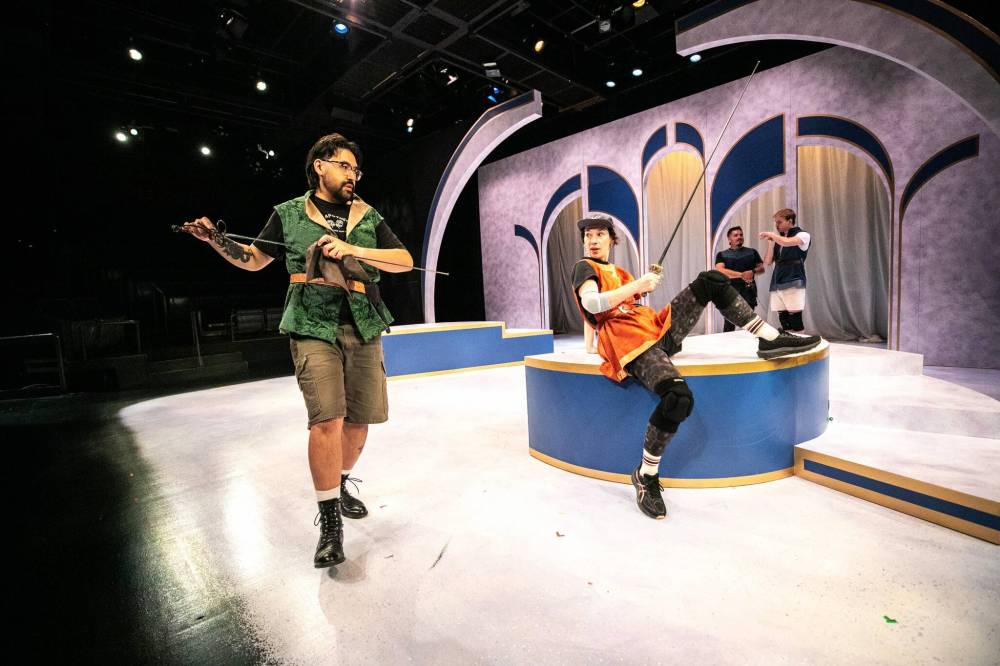
Meanwhile, the other half is granted access to the behind-the-scenes world of the fictional Elizabeth Paige Theatre through its Backstage Learning Program, watching the cast and crew navigate a windfall of unexpected challenges, including injuries, misplaced props and the downfall of intracast crushes.
On a personal audio device, these “interns” are privy to the offbeat musings of fictional stage manager Steven Persimmon (Jack Maier) as he communicates with associates Carrie Walsh (Alissa Watson) and Natalie Piper (Laurel Fife).
Structurally, this hugely ambitious play — inspired by the experiences of theatre artists across the country interviewed by Ardern — is designed to be engaged with in fantastic ways before the action even begins.
The lobby at Prairie Theatre Exchange is decorated with fake posters for Elizabeth Paige’s 2026-2027 season: rumour has it that The Crucible will be terrific and that audiences are already loading their Peggo cards for a chance to catch the season closer, Speed: The Musical.
The program is loaded with theatrical in-jokes, working in tandem with the posters — and the pseudonymous display of cast and crew in the lobby — to remind audiences that the theatrical experience can begin as early as their arrival at the box office if only they buy in.
The program is loaded with theatrical in-jokes, working in tandem with the posters – and the pseudonymous display of cast and crew in the lobby – to remind audiences that the theatrical experience can begin as early as their arrival at the box office if only they buy in.
With a concept so high-wire — the audience switches at the midway point before reuniting in the mainstage area for a satisfying denouement — there are remarkably few hiccups (every awkward pause can be argued to occur with reason) though it’s never a perfectly smooth ride when relocating large groups between spaces.
This is a purposeful frame-of-mind of which the creative team, led by director Suzie Martin, is undoubtedly aware. The backstage conversation makes that clear: in discussing the fictional company’s choice to program Romeo and Juliet, one actor argues that it’s remained in steady circulation because the work makes audiences happy.
“They don’t know any better,” another actor replies.
Exactly, this backstage portion reveals again and again.
For this performance, the Free Press began its experience in the mainstage area and could only guess at the metatextual struggles required to keep a sinking production afloat or at the origins of the drama taking place in the wings.
“Theatre is magic and everyone is happy,” stage manager Carrie Walsh says as she limps across the dressing room floor on a broken leg.
She’s only half wrong, which makes this production — a farcical companion to John Cassevetes’ dress rehearsal drama Opening Night — feel oh so right.
ben.waldman@winnipegfreepress.com
Ben Waldman is a National Newspaper Award-nominated reporter on the Arts & Life desk at the Free Press. Born and raised in Winnipeg, Ben completed three internships with the Free Press while earning his degree at Ryerson University’s (now Toronto Metropolitan University’s) School of Journalism before joining the newsroom full-time in 2019. Read more about Ben.
Every piece of reporting Ben produces is reviewed by an editing team before it is posted online or published in print — part of the Free Press‘s tradition, since 1872, of producing reliable independent journalism. Read more about Free Press’s history and mandate, and learn how our newsroom operates.
Our newsroom depends on a growing audience of readers to power our journalism. If you are not a paid reader, please consider becoming a subscriber.
Our newsroom depends on its audience of readers to power our journalism. Thank you for your support.
Theatre review
R+J: Closing Night
• Theatre Projects Manitoba
• Prairie Theatre Exchange, 393 Portage Ave.
• To Sept. 20
★★★★★ out of five
Ben Waldman is a National Newspaper Award-nominated reporter on the Arts & Life desk at the Free Press. Born and raised in Winnipeg, Ben completed three internships with the Free Press while earning his degree at Ryerson University’s (now Toronto Metropolitan University’s) School of Journalism before joining the newsroom full-time in 2019. Read more about Ben.
Every piece of reporting Ben produces is reviewed by an editing team before it is posted online or published in print — part of the Free Press‘s tradition, since 1872, of producing reliable independent journalism. Read more about Free Press’s history and mandate, and learn how our newsroom operates.
Our newsroom depends on a growing audience of readers to power our journalism. If you are not a paid reader, please consider becoming a subscriber.
Our newsroom depends on its audience of readers to power our journalism. Thank you for your support.
Related Articles
Complex dual production 'R+J: Closing Night' brings theatre audience in on panicked process of putting on a show
Advertisement Advertise With Us
Advertisement Advertise With Us
History
Updated on Friday, September 11, 2026 6:20 PM CDT: Corrects time of matinee