The efficacy of effigy
Exhibition examines the bonds we make with humanoid objects

Advertisement
Read this article for free:
or
Already have an account? Log in here »
To continue reading, please subscribe:

Digital Subscription
One year of digital access for only $205*
- Enjoy unlimited reading on winnipegfreepress.com
- Read the E-Edition, our digital replica newspaper
- Access News Break, our award-winning app
- Play interactive puzzles
*First annual payment billed as $205.00 + GST for one year. This annual subscription will automatically renew at $233.00 + GST every 52 weeks (10% off the regular annual price of $259.35). Offer available to new and qualified returning subscribers only. Cancel any time.
To continue reading, please subscribe:
Add Free Press access to your Brandon Sun subscription for only an additional
$1 for the first 4 weeks*
- Enjoy unlimited reading on winnipegfreepress.com
- Read the E-Edition, our digital replica newspaper
- Access News Break, our award-winning app
- Play interactive puzzles
*Your next Brandon Sun subscription payment will increase by $1.00 and you will be charged $17.95 plus GST for four weeks. After four weeks, your payment will increase to $24.95 plus GST every four weeks.
Read unlimited articles for free today:
or
Already have an account? Log in here »
For the past few years, Winnipeg visual artist Emilie St-Hilaire has been fascinated by the way humans relate to artificial bodies — dolls, robots, mannequins — through play, care and connection, and how those synthetic relationships can produce very real emotions in humans.
Objects of Fidelity: Barbies, bots, bébés, her solo exhibition on view now at La Maison des artistes visuels francophones, explores this space between object and companion. It’s what she calls the “visual culmination” of work that began with her 2024 PhD dissertation at Concordia University in Montreal, which examined Reborn Dolls — hyper-realistic art dolls that resemble newborns — from a feminist perspective.
But when a robot included in the exhibition started malfunctioning and giving signs that it was at the end of its life, St-Hilaire was given a new question to puzzle: what does it mean for a robot, or any other artificial body, to “die”?
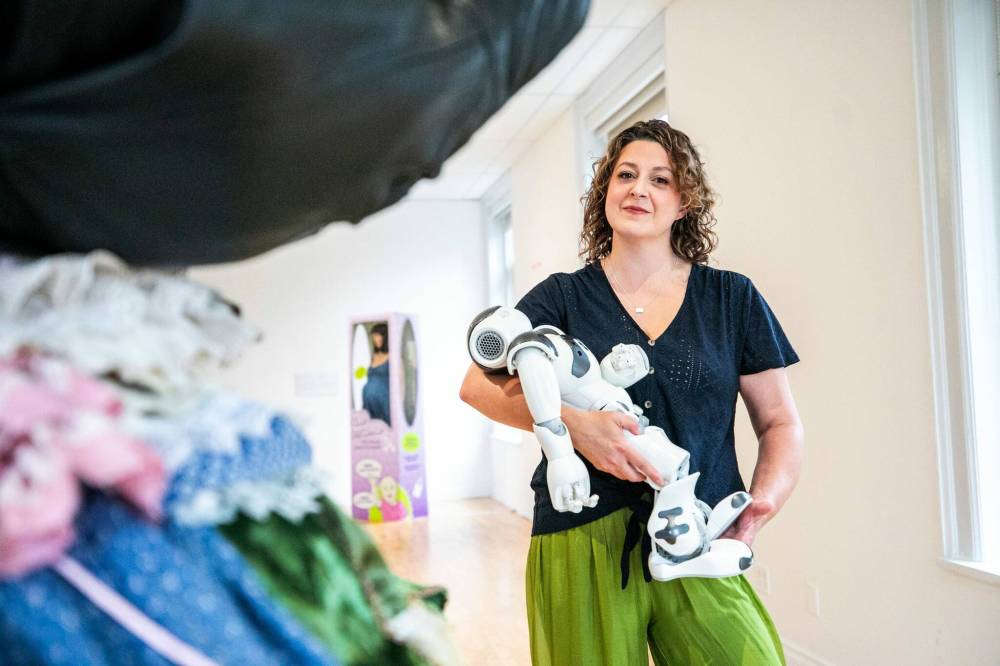
MIKAELA MACKENZIE / FREE PRESS
Artist Emilie St-Hilaire tends to an automaton while looking over her new exhibition at La Maison des Artistes.
To understand that, one must first understand how these human attachments to humanlike objects form in the first place.
“I learned so much from the doll collectors about what creates a bond — like taking care of it, for example,” St-Hilaire says. “We don’t think of taking care of a robot; we think of the robot maybe taking care of us or doing stuff for us. But it might need cleaning, changing parts. You could put clothes on it, probably.
“The way that we see how the bodies are treated in doll relationships, I think, is actually really interesting and informative to think about the future of maybe having robots at home and how that might be different.”
And then there’s the design decisions that influence how we bond with and treat those objects. In the Apple TV comedy Platonic, there’s a running gag in which Seth Rogan’s character Will kicks over electric scooters every time he encounters them. But when he starts going for autonomous delivery bots, his friend, played by Rose Byrne, cries out: “Will, don’t kick it, it has a face!”
St-Hilaire’s robot has a face, too.
“The robot I have in the show is really small and cute,” St-Hilaire says. “Its voice is almost childlike. Then you see the Chinese robot Olympics, and the robots have a blank face — maybe it’s an LED screen — but really different design decisions that will have an impact on that connection and that relationship that’s formed.”
St-Hilaire certainly had a connection with her robot, a sixth-generation Nao robot, getting to know it over a year and figuring out what it can do.
Created by French robotics company Aldebaran, Nao robots are autonomous, programmable humanoid bots designed to interact with people, and are popular in academic and scientific research. But their future is uncertain; Aldebaran filed for bankruptcy last year and, while a new company has acquired its assets, it has become hard to find replacement parts.
St-Hilaire decided the interesting thing to do would be to let it tell its own story.
“I set up the installation so that it’s sort of typing and just talking about its story, its life, and asking questions about what people expect of robots. ‘Do I disappoint people? Do I bring excitement to people?’ The text that it did type is also printed here, so people can still read what it had to say, which was sort of written collaboratively with ChatGPT on purpose because deciding what a robot would have to say, I just used another robot,” she says.

One of St-Hilaire’s works is created out of nearly 100 deconstructed dolls.
“And then, in the end, it was overheating a lot and having errors. So we decided to lay it to rest and not run it in the gallery.”
Nao is still, but viewers can still hear its voice. In a video, Nao talks about how it’s getting too hot now, and feeling tired. The effect is startlingly upsetting, especially when it asks: “Please let me rest for a while.”
Now, it’s at rest in a glass box (which one might read as a coffin). There are flowers, as though at a wake, with a small placard that reads, in French and English: Désolé, le robot est décédé/Sorry, the robot has died.
St-Hilaire gets the viewer thinking about real feelings of grief and loss for these synthetic beings — even if, like a visitor to the exhibition, you’ve only just met them
“If your microwave breaks down, you replace it and probably don’t think twice about it. There’s not a lot of sentimental attachment to appliances, but again, it’s that human form,” she says.
“Another part that’s really sad to me is just how playful and friendly this robot was versus what we see today in robotics. We are making advancements clearly, but it’s also a different era than 10 years ago. This was still a symbol of the future, and now it’s an artifact of the past. But it’s like a future that never really came to fruition.”
St-Hilaire first got interested in this subject after seeing My Fake Baby, a 2008 British documentary about Reborn Dolls.
“I was like, What is this fake baby? Why does it look so realistic? Who has this? Why? It actually just started for a course. I wrote a paper, and I had so many more questions, so I turned it into my whole PhD project, and that led me on this wild journey.”
Through her research, she met with lots of collectors. She did deep dives, reading about motherhood studies, sex-doll owners, and doll therapy and dementia care — her main areas of focus.

A doll rests in a crib as part of Objects of Fidelity: Barbies, bots, bébés.
But by the time she finished her PhD in 2024, she wasn’t sure if she was even an artist anymore, but a researcher instead.
“I hadn’t made art since, like, 2018. And then suddenly I was like, ‘Oh, I have all these ideas about dolls,’ and proposed the show here.”
Working through these ideas visually has allowed her to think about them in new ways.
“In the research realm — and this is what I think I’d had enough of by the end — it’s citing your sources, backing up everything you want to say with a series of arguments,” she says. “When you want to make an artwork that will almost present questions to the viewer, you don’t need to have all the answers. You can bring up the questions and say, let’s think about this, let’s talk about this.”
St-Hilaire has her own version of a Reborn Doll in the show. Ceci n’est pas un bébé — a reference to René Magritte’s Ceci n’est pas une pipe — features a newborn-sized doll in a bassinet under a heat lamp equipped with a motion sensor.
“The reason I have the heat lamp turn on when we get close is that it feels like the doll is getting care and warmth, and then when you walk away, it’s left in the dark. I want to highlight that zone where you think, well, it’s an object — but maybe I want it to be cosy and warm because it looks kind of fragile.”
Porcelain dolls are also a point of interest for St-Hilaire. They are objects of reverence, of perceived value; dolls to be admired, not played with, only to be consigned to thrift-store shelves.
The work Limited Edition/Good Virtues/“How dare you speak to a feminist that way?” is a towering Frankenfigure created out of nearly 100 porcelain dolls. An army of legs stands under layers upon layers of dresses; there are no faces; just an untamed mop of hair.
St-Hilaire had to deconstruct the dolls to make this piece — dismembering them, removing their hair — which brought up its own feelings.
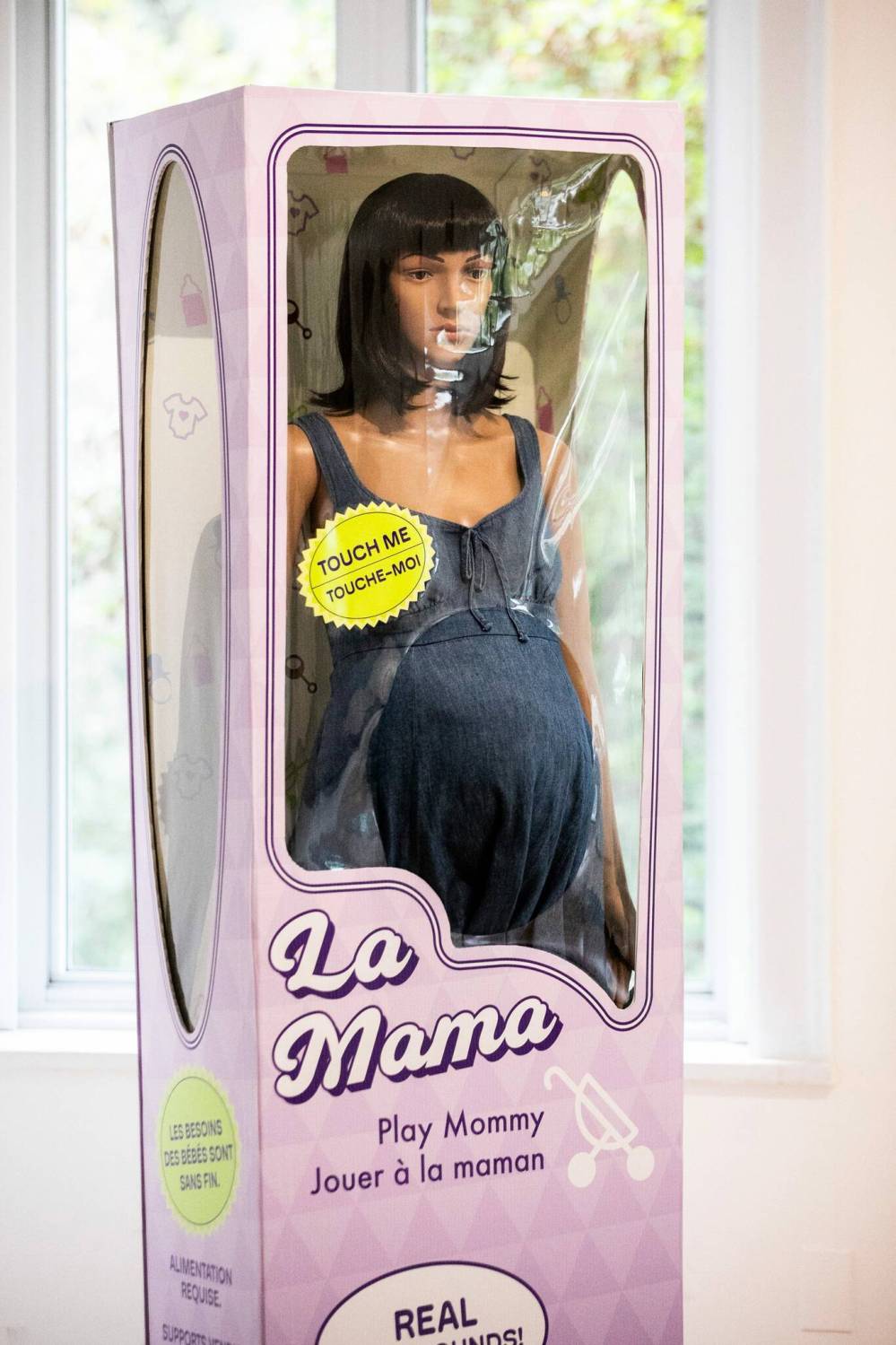
A boxed, Barbie-esque ‘mama’ toy
“It looks violent — it just does. And you know, people might say, ‘Oh, it’s just an object. It doesn’t matter. Dolls get abused all the time, they are thrown across the room.’ But when you see how they can be harmed, if you see violence to a human figure, it’s still going to be hard to see. It just is.”

But the resulting sculpture feels rebellious, even joyful, like 100 little dolls came together to become something big and, to use St-Hilaire’s word, “imposing.” The frills of the dresses give way to a studded leather bodice.
“I really leaned into the punk esthetic to try to give them a different existence than they got in the ’80s and ’90s,” she says with a smile.
St-Hilaire hopes these works get people thinking about these human figures.
“If there was something that would stay with them, perhaps just looking at dolls a bit differently, or asking questions about those design decisions,” she says. “Or why some human figures get treated one way and others get treated completely differently.”
jen.zoratti@winnipegfreepress.com
Jen Zoratti is a columnist and feature writer working in the Arts & Life department, as well as the author of the weekly newsletter NEXT. A National Newspaper Award finalist for arts and entertainment writing, Jen is a graduate of the Creative Communications program at RRC Polytech and was a music writer before joining the Free Press in 2013. Read more about Jen.
Every piece of reporting Jen produces is reviewed by an editing team before it is posted online or published in print – part of the Free Press‘s tradition, since 1872, of producing reliable independent journalism. Read more about Free Press’s history and mandate, and learn how our newsroom operates.
Our newsroom depends on a growing audience of readers to power our journalism. If you are not a paid reader, please consider becoming a subscriber.
Our newsroom depends on its audience of readers to power our journalism. Thank you for your support.
Exhibition preview
Emilie St-Hilaire: Objects of Fidelity: Barbies, bots, bébés
La Maison des Artistes, 219 Provencher Blvd.
To Sept. 19
Artist talk, Sept. 19, 2 p.m., at the gallery
Jen Zoratti is a columnist and feature writer working in the Arts & Life department, as well as the author of the weekly newsletter NEXT. A National Newspaper Award finalist for arts and entertainment writing, Jen is a graduate of the Creative Communications program at RRC Polytech and was a music writer before joining the Free Press in 2013. Read more about Jen.
Every piece of reporting Jen produces is reviewed by an editing team before it is posted online or published in print – part of the Free Press‘s tradition, since 1872, of producing reliable independent journalism. Read more about Free Press’s history and mandate, and learn how our newsroom operates.
Our newsroom depends on a growing audience of readers to power our journalism. If you are not a paid reader, please consider becoming a subscriber.
Our newsroom depends on its audience of readers to power our journalism. Thank you for your support.
Advertisement Advertise With Us
Advertisement Advertise With Us