Che film offers appreciation of his complexity

Advertisement
Read this article for free:
or
Already have an account? Log in here »
To continue reading, please subscribe:

Digital Subscription
One year of digital access for only $205*
- Enjoy unlimited reading on winnipegfreepress.com
- Read the E-Edition, our digital replica newspaper
- Access News Break, our award-winning app
- Play interactive puzzles
*First annual payment billed as $205.00 + GST for one year. This annual subscription will automatically renew at $233.00 + GST every 52 weeks (10% off the regular annual price of $259.35). Offer available to new and qualified returning subscribers only. Cancel any time.
To continue reading, please subscribe:
Add Free Press access to your Brandon Sun subscription for only an additional
$1 for the first 4 weeks*
- Enjoy unlimited reading on winnipegfreepress.com
- Read the E-Edition, our digital replica newspaper
- Access News Break, our award-winning app
- Play interactive puzzles
*Your next Brandon Sun subscription payment will increase by $1.00 and you will be charged $17.95 plus GST for four weeks. After four weeks, your payment will increase to $24.95 plus GST every four weeks.
Read unlimited articles for free today:
or
Already have an account? Log in here »
Hey there, time traveller!
This article was published 29/05/2009 (6320 days ago), so information in it may no longer be current.
With a running time of four hours and 20 minutes, this two-part biopic on the revolutionary career of Che Guevara is epic in length, but not in drama and spectacle. Eschewing the grandiose Hollywood/David Lean treatment, the films approach its controversial Marxist protagonist on doggedly intimate terms.
Spanning the years 1955 to 1967, the two films (seen separately in limited release in 2008) offer up a sympathetic but not simple portrait of the charismatic Argentine radical. The first film, adapted from Guevara’s book Reminiscences of the Cuban Revolution by screenwriter Peter Buchman, sees Che join Fidel Castro on a slow boat to Cuba, where the two men hope to overthrow the corrupt regime of U.S.-backed dictator Fulgencio Batista.
The second film, adapted from Guevara’s Bolivian Diary by Buchman, Benjamin A. van der Veen and Terrence Malick, picks up Guevara’s story in Bolivia, after the Cuban victory, where Che’s attempt to export revolution met with disaster, and his own death.
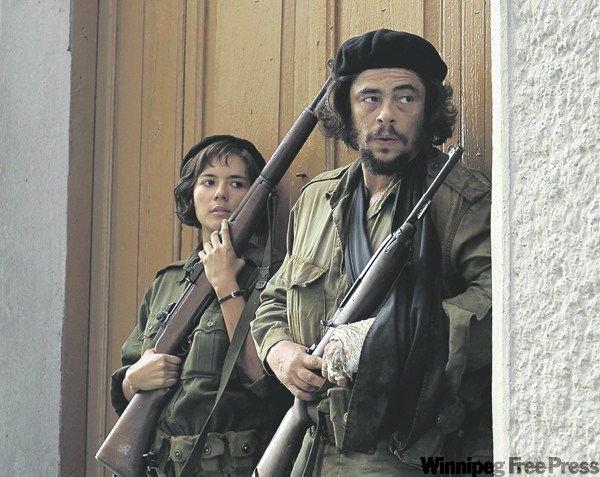
The subject matter of the second film was originally intended as a project for Malick (The Thin Red Line), who was actually in Bolivia as a journalist when Guevara was there. When the project fell to mainstream-friendly director Steven Soderbergh (Ocean’s Eleven), it was expanded into something grander (and undoubtedly more accessible), with the first film portraying Che’s ascendancy as a revolutionary hero and the second film seeing Che suffering defeat by another U.S.-backed regime, which had learned from Batista’s strategic mistakes.
Conjoined for a single "roadshow" engagement at the Globe, the films are stylistically distinctive, even if they both spend lots of footage detailing guerrilla life with its attendant hardships including sickness, treachery and out-of-the-blue violence.
The first film (released as The Argentine) fills in the blanks of that iconic Alberto Korda portrait of Che, portrayed by Benicio del Toro, as a romantic revolutionary. A doctor by profession, Guevara often serves in that capacity in the guerilla war launched by Castro (Demián Bichir) but ascends to leadership through strategic skill culminating in the decisive "suicide squad" attack on Santa Clara prior to Castro’s victory in Havana on Jan. 1, 1959.
Castro himself said Guevara could be foolhardy, and was proved right when Guevara attempted to repeat the glorious Cuban victory in Bolivia — the subject matter of the second film, released also as Guerrilla — only to be undone by a peasant class largely unwilling to risk the dangers of revolution led by a "foreigner."
After his martyrdom, the image of Guevara was marketed into something semi-erotic — he became the sexy packaging for the counterculture into the ’70s.
Director Soderbergh and del Toro are conscious of that aspect of Che’s appeal, especially in the sequence documenting his 1964 appearance at the United Nations with an appreciation of the inherent glamour that comes with his style of ideological passion.
But even as the film may gloss over Guevara’s role in history (including his hand in the potentially apocalyptic Cuban Missile Crisis), it offers an appreciation for the sheer complexity of a healer and warrior, simultaneously brutally ruthless and stubbornly humane.
randall.king@freepress.mb.ca
If you value coverage of Manitoba’s arts scene, help us do more.
Your contribution of $10, $25 or more will allow the Free Press to deepen our reporting on theatre, dance, music and galleries while also ensuring the broadest possible audience can access our arts journalism.
BECOME AN ARTS JOURNALISM SUPPORTER
Click here to learn more about the project.
Our newsroom depends on a growing audience of readers to power our journalism. If you are not a paid reader, please consider becoming a subscriber.
Our newsroom depends on its audience of readers to power our journalism. Thank you for your support.
Movie Review
Che
Starring Benicio del Toro
Globe
14A
4 stars out of 5
If you value coverage of Manitoba’s arts scene, help us do more.
Your contribution of $10, $25 or more will allow the Free Press to deepen our reporting on theatre, dance, music and galleries while also ensuring the broadest possible audience can access our arts journalism.
BECOME AN ARTS JOURNALISM SUPPORTER
Click here to learn more about the project.
Our newsroom depends on a growing audience of readers to power our journalism. If you are not a paid reader, please consider becoming a subscriber.
Our newsroom depends on its audience of readers to power our journalism. Thank you for your support.
Advertisement Advertise With Us