Take away the tutus and resonant stories remain
Classic ballets still revelant in modern age
Advertisement
Read this article for free:
or
Already have an account? Log in here »
To continue reading, please subscribe:

Digital Subscription
One year of digital access for only $205*
- Enjoy unlimited reading on winnipegfreepress.com
- Read the E-Edition, our digital replica newspaper
- Access News Break, our award-winning app
- Play interactive puzzles
*First annual payment billed as $205.00 + GST for one year. This annual subscription will automatically renew at $233.00 + GST every 52 weeks (10% off the regular annual price of $259.35). Offer available to new and qualified returning subscribers only. Cancel any time.
To continue reading, please subscribe:
Add Free Press access to your Brandon Sun subscription for only an additional
$1 for the first 4 weeks*
- Enjoy unlimited reading on winnipegfreepress.com
- Read the E-Edition, our digital replica newspaper
- Access News Break, our award-winning app
- Play interactive puzzles
*Your next Brandon Sun subscription payment will increase by $1.00 and you will be charged $17.95 plus GST for four weeks. After four weeks, your payment will increase to $24.95 plus GST every four weeks.
Read unlimited articles for free today:
or
Already have an account? Log in here »
Hey there, time traveller!
This article was published 26/12/2010 (5757 days ago), so information in it may no longer be current.
This past Tuesday night, I went to see Black Swan at Silver City Polo Park.
When I saw the healthy size of the audience, I thought for a minute that I was in the wrong theatre.
How could so many people want to see a ballet film that revolves around a production of Swan Lake, I wondered, even if it is generating a lot of buzz?
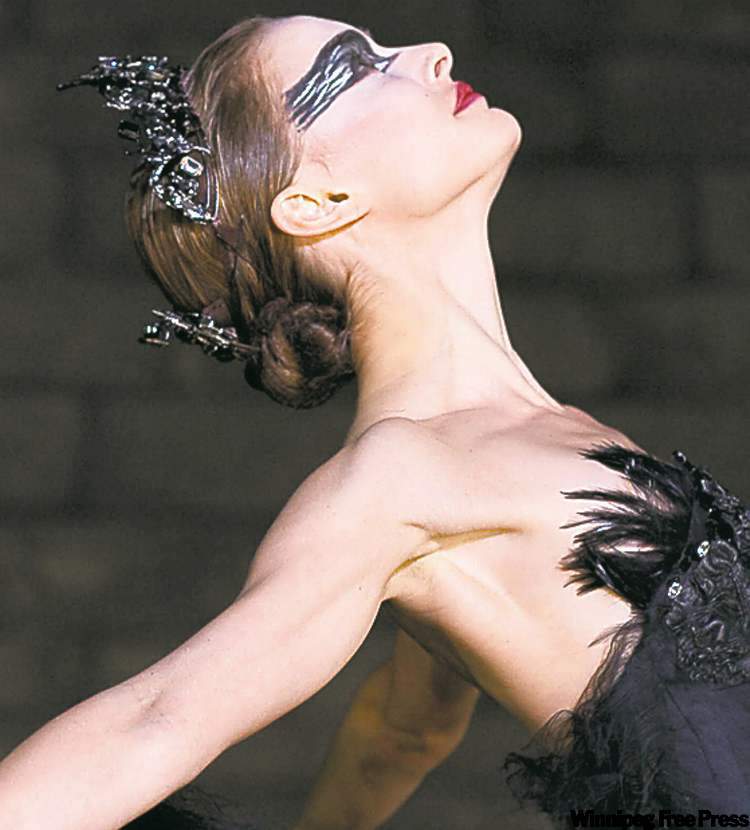
Well, having paid little attention to the buzz, I hadn’t realized that Black Swan is an over-the-top popcorn movie — a creepy, paranoid, descent-into-madness thriller dressed up in an art-film tutu.
Natalie Portman plays Nina, a dedicated — but sexless and body-loathing — dancer in a big company. She gets her long-awaited shot to play the dual ballerina role of the White Swan and the Black Swan in the Tchaikovsky-scored tragedy.
But when a sexy, spontaneous new dancer (Mila Kunis) appears to start scheming to steal the role, and the all-powerful male artistic director relentlessly pressures Nina both sexually and artistically, her grip on reality splinters.
The movie has some hokey dialogue, a caricatured thwarted-dancer mother who disturbingly controls Nina’s body, and all sorts of mirroring and twinning imagery that’s been done better in other movies.
Still, it had me chewing my nails with its visceral intensity. And it has something to say about the pressure on today’s young women to meet unattainable standards of beauty, self-control and virtue (the pure, childlike White Swan archetype) and at the same time prove themselves to be seductive and boldly confident (the alluring Black Swan archetype).
Having to be both is enough to mutilate any girl’s sense of self. And remember, the clock is ticking. Soon you’ll be yesterday’s princess. Nina’s dual burden — on and offstage — is a metaphor for the crazy-making roles that women are forced to play as long as they remain under a kind of spell of approval-seeking.
Swan Lake is a fairy tale, loaded with encoded meanings. That, and the immortal Tchaikovsky score — full of nocturnal mystery and yearning — help explain why it’s an enduring classic.
On Wednesday night, I enjoyed the Royal Winnipeg Ballet’s Nutcracker — again, a fairy tale with a glorious Tchaikovsky score, based on 19th-century Russian choreography. I never get tired of it.
All this got me thinking about the provocative new book Apollo’s Angels: A History of Ballet, by dance critic and historian Jennifer Homans. In her final chapter, Homans argues that ballet is a dying art form, no longer relevant because it’s based on noble, aristocratic, courtly ideals. Today’s choreographers, she says, are failing to reinvent ballet in ways that are meaningful to 21st-century audiences.
When I heard Homans debate Karen Kain on CBC Radio, the author suggested that audiences and companies are clinging harder than ever to the classics, particularly the Tchaikovsky Big 3 — Swan Lake, The Nutcracker and The Sleeping Beauty — because we’re actually mourning them before our culture lets them go.
Kain, head of the National Ballet of Canada, would have none of it. She’s more of the mind that we can find richness in the enduring ballets throughout our lives, as we can in Hamlet. I’m with her.
Few moviegoers are likely to attend Swan Lake just because they’ve enjoyed Black Swan. But the movie’s reinterpretation of the fairy tale demonstrates that a powerful story can be viewed through different lenses.
In the traditional ballet, the protagonist is the prince. He finds his ideal love, the virginal white swan-maiden who is under a sorcerer’s spell. He loses her because he allows himself to be tricked into swearing love for the identical-looking imposter, the bad-girl Black Swan.
Darren Aronofsky’s movie makes it a woman’s identity story. The sorcerer is the artistic director. There is no prince. That chimes in with a comment Kain made, that these great classics can be renewed through fresh interpretations.
What was it Emily Dickinson said? “Hope is the thing with feathers.”
alison.mayes@freepress.mb.ca
If you value coverage of Manitoba’s arts scene, help us do more.
Your contribution of $10, $25 or more will allow the Free Press to deepen our reporting on theatre, dance, music and galleries while also ensuring the broadest possible audience can access our arts journalism.
BECOME AN ARTS JOURNALISM SUPPORTER
Click here to learn more about the project.