EXPLAINER: What charges did Jussie Smollett face at trial?

Advertisement

Advertise with us

CHICAGO (AP) — The twists, turns and oddities of the legal saga surrounding Jussie Smollett’s claim in 2019 that he was the target of a racist and homophobic attack in Chicago culminated in a weeklong trial, which concluded with a jury convicting Smollett on five counts of disorderly conduct. Smollett was acquitted on a sixth count.

Read this article for free:


or

Already have an account? Log in here »

To continue reading, please subscribe:

Subscribe and receive a limited-edition Free Press branded hat or tote.

Digital Subscription

One year of digital access for only $205*

  • Enjoy unlimited reading on winnipegfreepress.com
  • Read the E-Edition, our digital replica newspaper
  • Access News Break, our award-winning app
  • Play interactive puzzles

*First annual payment billed as $205.00 + GST for one year. This annual subscription will automatically renew at $233.00 + GST every 52 weeks (10% off the regular annual price of $259.35). Offer available to new and qualified returning subscribers only. Cancel any time.

To continue reading, please subscribe:

Add Free Press access to your Brandon Sun subscription for only an additional

$1 for the first 4 weeks*

  • Enjoy unlimited reading on winnipegfreepress.com
  • Read the E-Edition, our digital replica newspaper
  • Access News Break, our award-winning app
  • Play interactive puzzles
Start now

*Your next Brandon Sun subscription payment will increase by $1.00 and you will be charged $17.95 plus GST for four weeks. After four weeks, your payment will increase to $24.95 plus GST every four weeks.

Hey there, time traveller!
This article was published 29/11/2021 (1769 days ago), so information in it may no longer be current.

CHICAGO (AP) — The twists, turns and oddities of the legal saga surrounding Jussie Smollett’s claim in 2019 that he was the target of a racist and homophobic attack in Chicago culminated in a weeklong trial, which concluded with a jury convicting Smollett on five counts of disorderly conduct. Smollett was acquitted on a sixth count.

Initial charges brought in February 2019 that accused the former “Empire” actor of faking the assault were soon after tossed. But in February 2020, after a special prosecutor looked into the case, a new six-count indictment was filed.

Here’s a look at the charges Cook County jurors heard testimony about:
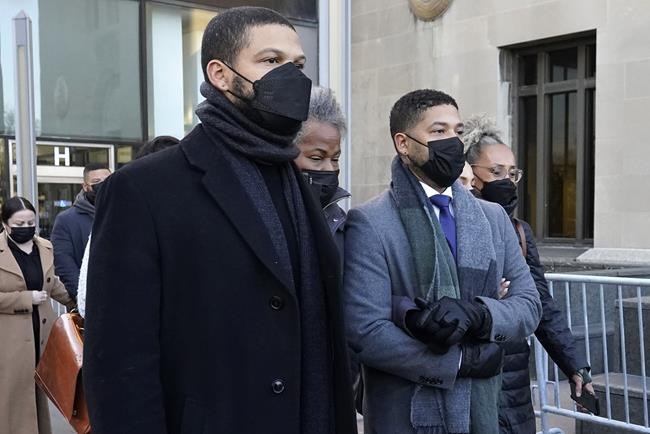
Actor Jussie Smollett, second from right, departs with his mother Janet, second from left, from the Leighton Criminal Courthouse, Wednesday, Dec. 8, 2021, in Chicago, after Cook County Judge James Linn gave the case to jury. (AP Photo/Nam Y. Huh)

WHAT WERE THE CHARGES AGAINST SMOLLETT?

The 39-year-old was charged under Illinois’ disorderly conduct statute, which encompasses a wide range of offenses, from making prank 911 calls to placing harassing calls as a debt collector.

He faced six counts of disorderly conduct under a subsection of the law that prohibits false reports to police. Some states don’t categorize false police reports as disorderly conduct.

The charges were listed as class 4 felonies, which are among the least serious felonies in Illinois. But convictions can still carry potential prison time of up to three years.

Although Smollett was found guilty Thursday of five of the six counts, his lack of criminal history and the fact that no one was seriously hurt make actual time behind bars unlikely. It’s more likely that a judge would sentence him to probation and perhaps order him to perform community service.

“I’d be shocked if he spent one day in jail,” said Andrew Weisberg, a Chicago-based criminal attorney and a former Cook County prosecutor.

HOW UNIQUE IS IT FOR SUCH CHARGES TO BE BROUGHT?

The Smollett case was certainly unique in how it involved a star actor and in its sensational claims and counterclaims — first by Smollett, who is Black and gay, that he was the subject of an attack and then by police that he had made it all up.

While it is among the biggest disorderly conduct cases in Illinois history, it’s not the only such case to have made a splash in the news.

A Canadian, Robert Spearing, was charged with disorderly conduct in 2011 after Chicago police said he lied about being beaten and robbed of tickets to an Oprah Winfrey show. He concocted the story, even cutting his own forehead with a rock, to conceal from his wife that he never had any tickets. He pleaded guilty and did no time in prison.

Disorderly conduct charges for filing a false police report aren’t uncommon and are sometimes tied to insurance fraud. Last month, a man in the Chicago suburb of Wheaton was charged with disorderly conduct for allegedly lying to police that he had been robbed in a parking garage at gunpoint.

Weisberg says those who fib in initial reports to police are frequently quick to recant and often aren’t charged if they take it back immediately. After police accused him of lying, Smollett doubled down and insisted it was all true.

Smollett’s case stands out in that it got to trial at all, Weisberg added. In many cases, those accused of lying to police seek a plea deal or plead guilty without a deal.
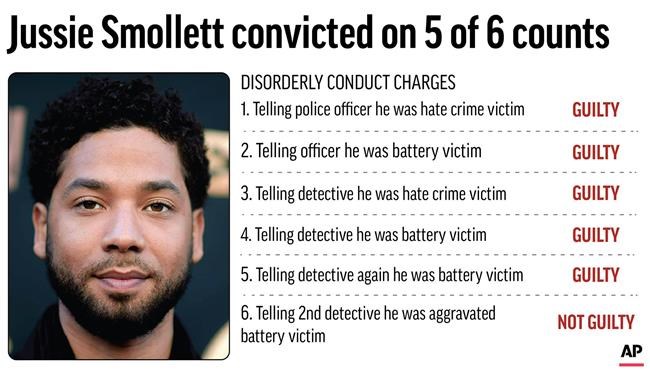
A jury convicted actor Jussie Smollett of five counts of disorderly conduct for staging a racist, anti-gay attack in Chicago and lying to police. (AP Graphic)

WHY SIX COUNTS AGAINST SMOLLETT FOR THE SAME INCIDENT?

Each count of disorderly conduct represents an instance during Jan. 29, 2019, and then on Feb. 14, 2019, in which Smollett allegedly lied to police.

Count 1 accused him of telling responding Chicago Police Officer Muhammed Baig at around 2:45 a.m., some 45 minutes after the purported attack, that he was the victim of a hate crime. He said two attackers put a rope around his neck. Count 2 referred to Smollett telling the same officer he was a victim of a battery, describing attackers beating and pouring bleach on him.

Counts 3 and 4 stemmed from Smollett making the same claims but to a different officer, Kimberly Murray, later that morning, at just before 6 a.m.

Count 5 accused Smollett of again telling Murray at around 7:15 p.m. that he was the victim of a battery. Count 6 referred to Smollett reporting on Feb. 14, 2019, to detective Robert Graves that he’d been a victim of an aggravated battery.

___

Check out The AP’s complete coverage of the Jussie Smollett case.

___

Follow Michael Tarm on Twitter at http://twitter.com/mtarm

Report Error Submit a Tip

More Stories

A 22-year-old man is dead and an 18-year-old is in hospital in critical condition after a two-vehicle crash on Highway 8 on Thursday evening.

A Gimli RCMP officer was driving north on the highway, near Riverton, when he witnessed the collision at about 6:45 p.m.

A vehicle headed north had passed the Mountie at a high speed before colliding with an SUV that was turning west onto Provincial Road 329 from Highway 8.

The driver of the first vehicle, an 18-year-old man from Arborg, was rushed to hospital by a helicopter ambulance with injuries RCMP describe as serious and life-threatening.

Creative powerhouse Perry Rosemond never lost Winnipeg roots

Ben Waldman 7 minute read Preview

Creative powerhouse Perry Rosemond never lost Winnipeg roots

Ben Waldman 7 minute read 6:00 AM CDT

He created King of Kensington, directed the troops in the Royal Canadian Air Farce, and his creative eye was behind the lens for television shows starring Johnny Cash, Tom Jones, Mr. Dress-Up and the Friendly Giant.

He also wrote and developed the Canadian version of Sesame Street during his time as the head of school and preschool programming for CBC in Toronto, and directed a televised special in 2002 for Winnipeg sketch comedy troupe Royal Liechtenstein Theatre Company.

But before his name featured in the credits of some of the most iconic and influential pieces of the Cancon canon, Perry Rosemond was an only child living in a crammed, multi-generational home in Winnipeg’s North End, racing each day to beat the morning bell next door at William Whyte School.

In memoirs that have yet to be published, the late television producer recalled his childhood. “(T)here were 14 of us in the house at 193 Andrews St., and it wasn’t that big of a house,” he writes.

Read
6:00 AM CDT

Free Press staff 2 minute read 2:01 AM CDT

Advance voting for civic and school board elections begins next week.

Voters can cast early ballots for the Oct. 28 election in certain locations from Monday through Oct. 23.

Eligible voters can use their address to search for a convenient location.

Early votes can be cast at the council building at city hall (510 Main St.) every day, except weekends and Thanksgiving, from Monday to Oct. 23.

Letters, Oct. 3

7 minute read 2:01 AM CDT

A morning in the life …

My very first lesson does not start when I walk into that lecture hall, oh no — it starts long before. It begins when I walk to my car, check the estimated arrival time to the University of Manitoba and hope that Winnipeg traffic agrees with it.

A drive that appears completely manageable changes almost immediately when I’m greeted by a tsunami of orange pylons and a line of cars that appears to go on forever. Traffic moves by the inch, lanes magically disappear and the detour I took yesterday now has a detour of its own. These factors make me do a calculation that I have become all too familiar with. How late can I arrive and still find parking, run to my class across campus and get to class with enough time left to make it worth it?

I have grown used to people saying, “Why not just leave earlier?” I do. But when I’m already leaving for my 8:30 a.m. class at 7 a.m., there’s only so much I can do. This drive that some would think is relaxing is one that feels like an assignment that I didn’t know I had to complete and is due at 8:30 a.m.

J’accuse!: Kinew uses French to fry interim Tory leader over alleged caucus subterfuge

Chris Kitching and Maggie Macintosh 4 minute read Preview

J’accuse!: Kinew uses French to fry interim Tory leader over alleged caucus subterfuge

Chris Kitching and Maggie Macintosh 4 minute read Thursday, Oct. 1, 2026

NDP Premier Wab Kinew took a dig at the Progressive Conservatives’ leadership change while facing off with Obby Khan’s short-term replacement for the first time in question period Thursday.

Read
Thursday, Oct. 1, 2026

Broadening prediction-market gambling a bad idea

Editorial 4 minute read Preview

Broadening prediction-market gambling a bad idea

Editorial 4 minute read 2:01 AM CDT

Let’s make a prediction: sooner or later, when Canadian governments find a way to take their own cut of the action, prediction-contract gambling on everything from sports to entertainment to political decisions is going to come to Canada.

And that’s a horrible, dangerous, pernicious idea.

Unless you have particular access to information — either inside information or strategic information based on skills or education — you’re not likely to make money at it. In fact, structurally, you’re likely to lose. In prediction markets, you basically pay an amount, plus fees from the company involved, to bet on whether something will or will not happen within a certain time frame. The amount you pay for your contract depends on how other people are also betting.

As Wealthsimple describes it, “You buy whichever side you think is right. Prices move with demand, so if the market leans towards one outcome, the more that side costs. If a lot of people are backing the TSX to finish above 38,000, yes gets more expensive and no gets cheaper.”

Read
2:01 AM CDT