‘Whatever it takes:’ Indigenous group seeks help repatriating items from Switzerland

Advertisement

Advertise with us

WINNIPEG - Sacred pipes, intricately beaded regalia and firearms believed to be associated with the period of the Battle of the Little Bighorn are some of the thousands of Indigenous artifacts a group of First Nations leaders and advocates are trying to repatriate from Switzerland.

Read this article for free:


or

Already have an account? Log in here »

To continue reading, please subscribe:

Subscribe and receive a limited-edition Free Press branded hat or tote.

Digital Subscription

One year of digital access for only $205*

  • Enjoy unlimited reading on winnipegfreepress.com
  • Read the E-Edition, our digital replica newspaper
  • Access News Break, our award-winning app
  • Play interactive puzzles

*First annual payment billed as $205.00 + GST for one year. This annual subscription will automatically renew at $233.00 + GST every 52 weeks (10% off the regular annual price of $259.35). Offer available to new and qualified returning subscribers only. Cancel any time.

To continue reading, please subscribe:

Add Free Press access to your Brandon Sun subscription for only an additional

$1 for the first 4 weeks*

  • Enjoy unlimited reading on winnipegfreepress.com
  • Read the E-Edition, our digital replica newspaper
  • Access News Break, our award-winning app
  • Play interactive puzzles
Start now

*Your next Brandon Sun subscription payment will increase by $1.00 and you will be charged $17.95 plus GST for four weeks. After four weeks, your payment will increase to $24.95 plus GST every four weeks.

WINNIPEG – Sacred pipes, intricately beaded regalia and firearms believed to be associated with the period of the Battle of the Little Bighorn are some of the thousands of Indigenous artifacts a group of First Nations leaders and advocates are trying to repatriate from Switzerland.

The items have been housed at a privately owned museum near Zurich, which closed its doors late last year after the collector decided he wanted to retire.

A delegation travelled to the country to visit the museum before it closed, and is now urging federal, First Nations and tribal governments in Canada and the United States to intervene and help bring these artifacts back to North America.
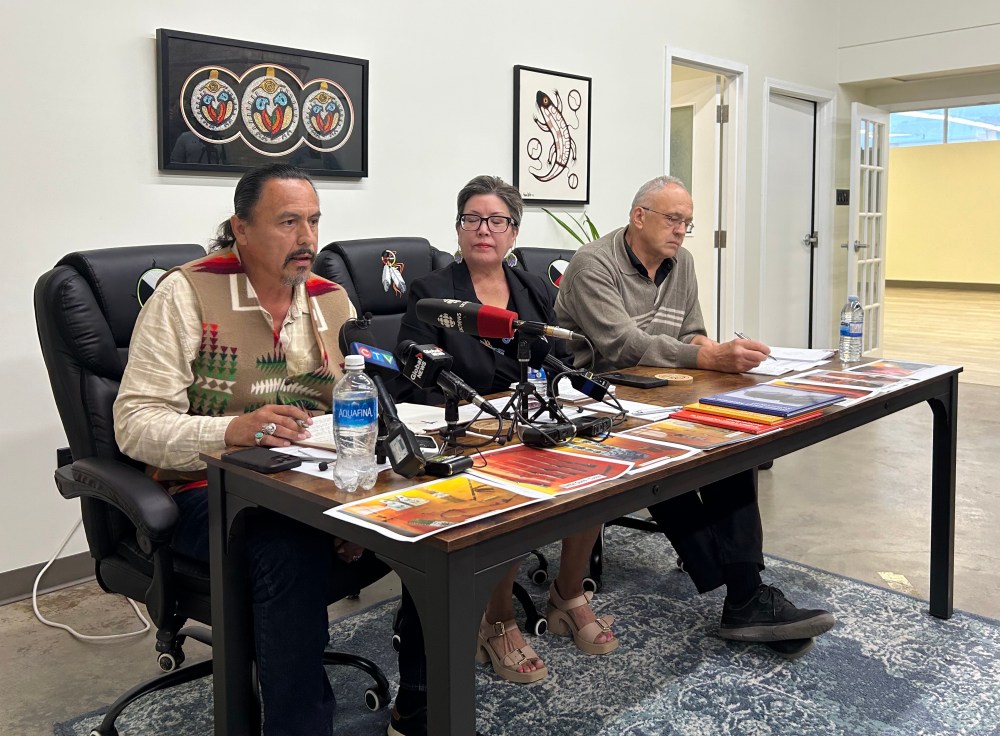
Coun. Karl Stone, left to right, Dakota Tipi First Nation Manitoba and Cree advocate Coleen Rajotte and community advocate Gerald Neufeld take part in a news conference in Winnipeg on Tuesday June 23, 2026.  THE CANADIAN PRESS/Brittany Hobson
Coun. Karl Stone, left to right, Dakota Tipi First Nation Manitoba and Cree advocate Coleen Rajotte and community advocate Gerald Neufeld take part in a news conference in Winnipeg on Tuesday June 23, 2026. THE CANADIAN PRESS/Brittany Hobson

“We’ve got to do whatever it takes to reconnect our ancestral, sacred bundles back into our communities,” said Karl Stone, a councillor in Dakota Tipi First Nation, Man., referring to a group of sacred, cultural items.

“By bringing them home, that would reconnect our younger generation to the history of our people and it’ll bring back identity to who we are.”

Stone was part of the group that visited the museum a year ago after learning there could be belongings from Dakota communities in Manitoba.

Based on documentation the private collector has kept, the group has been told many of the items are believed to originate from First Nation communities in Manitoba, Saskatchewan, Alberta and Ontario, as well as Lakota nations in the United States.

The group said the owner amassed a collection of 10,000 items, with 70 per cent being Indigenous artifacts, over several decades. It is unclear how he obtained the items and how much they cost, the group said.

There has been a push in recent years for cultural institutes and religious groups to repatriate items back to First Nations, Inuit and Métis communities.

The Vatican returned several items to Indigenous groups earlier this year after a delegation visited its museum and stressed the importance of returning these artifacts.

National museums and universities across the country have also been coming to terms with their roles in holding sacred items and have been working with communities to repatriate them to traditional caretakers.

“One of our biggest fears is that if we don’t raise the money and bring all of these items back, (the collector) could put these on private auction sites and they could end up in Dubai or in New York or elsewhere in some billionaire’s office under glass as a showpiece,” said Coleen Rajotte, a Cree advocate.

The group said it needs to raise approximately $20 million – this includes the estimated cost of the artifacts and additional funds to hire experts to authenticate the items.

One of those items is a bandolier, or a belt worn across the shoulders. It stretches about 20 centimetres wide and consists of thousands of beads that create a floral design typically seen in Ojibwa and Cree designs.

Other artifacts include large, feathered headdresses and sewn, leather moccasins believed to come from Sioux tribes.

Gerald Neufeld was part of the delegation that travelled to Switzerland and has been helping advocate for the return of the collection.

The non-Indigenous, retired engineer grew up on a Manitoba First Nation and has worked with communities on efforts to trace their genealogy.

“We need to get them authenticated. We need them priced, and we need to bring them home,” he said.

Neufeld remains in contact with the seller and said he seems to be empathetic to the group’s desire to have the items returned to Indigenous communities.

He said the seller is hoping to get things settled in months, not years, or the items will be put on the market.

The private collector did not respond to an immediate request for comment.

The Canadian Press reached out to the governments of Manitoba and Canada, as well as the Assembly of First Nations, and also did not receive immediate responses.

This report by The Canadian Press was first published June 23, 2026.

Report Error Submit a Tip

More Stories

‘Whatever it takes:’ Indigenous group seeks help repatriating items from Switzerland

Brittany Hobson, The Canadian Press 4 minute read Preview

‘Whatever it takes:’ Indigenous group seeks help repatriating items from Switzerland

Brittany Hobson, The Canadian Press 4 minute read Wednesday, Jun. 24, 2026

Sacred pipes, intricately beaded regalia and firearms believed to be associated with the period of the Battle of the Little Bighorn are some of the thousands of Indigenous artifacts a group of First Nations leaders and advocates are trying to repatriate from Switzerland.

Read
Wednesday, Jun. 24, 2026

Cabernet Sauvignon star of wine festival

Ben Sigurdson 5 minute read Preview

Cabernet Sauvignon star of wine festival

Ben Sigurdson 5 minute read 3:00 AM CDT

The Winnipeg Wine Festival will celebrate the king of red wine grapes next weekend — the theme of this year’s festival, which takes place Sept. 25 and 26 at the RBC Convention Centre, is Cabernet Sauvignon.

Cab Sauv, as it’s also known, is the world’s most widely planted wine grape of any colour, first coming to prominence in the 1800s in France’s Bordeaux region, where the grape is still popular. Rather than single-variety wines, Bordeaux reds tend to be blends, with those coming from the left bank of the Gironde estuary being Cabernet-dominant, while right-bank wines are Merlot-dominant, with Cabernet Sauvignon playing a supporting role. Cabernet and Merlot work well together and many other countries have followed suit in blending the two.

A team at University of California Davis put Cabernet Sauvignon through a DNA test in 1996 and discovered its parent grapes are Cabernet Franc and Sauvignon Blanc — it’s likely that at some point the two varieties, planted next to each other in some vineyard, crossed and mutated and became the grape we know today. (Someone growing grapes in the 19th century must have had an inkling of what was up, as the grape has been called Cabernet Sauvignon since long before the DNA test.)

Flavour-wise, most Cabernet Sauvignon wines are big and bold, with a core of deep dark berry flavours, some graphite and spice notes and relatively bright acidity. It’s a grape that is well-suited to barrel aging, with most examples seeing at least some time in wood.

Read
3:00 AM CDT

Elmwood–East Kildonan candidate promises to tackle ‘inefficiency’ in government

Gabrielle Piché 3 minute read Preview

Elmwood–East Kildonan candidate promises to tackle ‘inefficiency’ in government

Gabrielle Piché 3 minute read 6:17 PM CDT

The former assistant of late Elmwood–East Kildonan councillor Jason Schreyer is again running for the seat.

Chris Sweryda officially launched his campaign Saturday. He did so with the backdrop of a grocery program he runs, where food is sold near-cost out of St. Gerard School’s gym.

Rows of cereal, pasta sauce and chips filled tables ahead of the program’s afternoon opening. Sweryda created the pop-up with Schreyer months ahead of the former councillor’s April 2025 death.

The program sees roughly 500 people each day it’s open (which is every other week on Saturday), Sweryda said.

Read
6:17 PM CDT

Day 1 of Jets training camp in the books with pairings essentially cemented

Ken Wiebe 7 minute read Preview

Day 1 of Jets training camp in the books with pairings essentially cemented

Ken Wiebe 7 minute read Thursday, Sep. 17, 2026

Nearly six minutes into his question-and-answer session, Scott Arniel took a welcome detour from the news of the day.

After exhausting the discussion around the goalie who wasn’t in training camp, the head coach of the Winnipeg Jets finally got a query about the line combinations and defensive pairings that were unveiled in training camp.

And unlike past years, when exhibition games were more frequent and the training camp wasn’t this condensed, Arniel conceded these groupings were intentional and were likely staying together for some time.

The expansion to an 84-game regular season brings with it a reduction to four pre-season games and a much shorter training camp, which could limit the amount of experimentation that Arniel can do during the next two weeks.

Read
Thursday, Sep. 17, 2026

Steinbach Credit Union member warns others after scammer steals $10K

Scott Billeck 5 minute read Preview

Steinbach Credit Union member warns others after scammer steals $10K

Scott Billeck 5 minute read Yesterday at 5:19 PM CDT

A Winnipeg single mother whose bank account was drained of nearly $10,000 says Steinbach Credit Union needs to warn its members about what she believes is a broader security problem.

The woman, who is not being named to protect her identity, said a scammer gained access to her account earlier this week after calling SCU’s contact centre, claiming to be her and successfully completing the credit union’s authentication process.

She said she knows of at least six others who have experienced similar incidents in which callers impersonate SCU account holders and pass the authentication checks.

The woman discovered something was wrong when her minor son asked why money had been transferred out of an account they jointly hold.

Read
Yesterday at 5:19 PM CDT

Manitoba abandoning spring, fall clock changes

Carol Sanders 8 minute read Preview

Manitoba abandoning spring, fall clock changes

Carol Sanders 8 minute read Updated: Yesterday at 8:48 AM CDT

Time’s up for the time change in Manitoba.

Manitobans won’t be setting their clocks back an hour in November. The province has decided to permanently stay on daylight time after surveying residents on the twice annual clock adjustment.

“We heard from Manitobans loud and clear — no more changing the clocks in Manitoba,” Premier Wab Kinew said in a news release Thursday.

Most of the 72,000 votes submitted in an online EngageMB survey — 92 per cent — said they would like to see the practice end. The survey asked if they preferred earlier sunrises in winter with standard time or the later sunsets in summer with daylight time. More than half of survey participants (58 per cent) indicated a preference to stay on permanent daylight time; 34 per cent voted to eliminate the time change but stay on standard time.

Read
Updated: Yesterday at 8:48 AM CDT