Trump returns to correspondents’ dinner for a rambling, insult-filled speech 3 months after shooting

Advertisement

Advertise with us

President Donald Trump returned to the rescheduled White House Correspondents' Association dinner Friday night, delivering a rambling, hourlong speech that praised some journalists, took potshots at others, made jokes about public figures' weight and intellect, and quipped about a third presidential term.

Read this article for free:


or

Already have an account? Log in here »

To continue reading, please subscribe:

Subscribe and receive a limited-edition Free Press branded hat or tote.

Digital Subscription

One year of digital access for only $205*

  • Enjoy unlimited reading on winnipegfreepress.com
  • Read the E-Edition, our digital replica newspaper
  • Access News Break, our award-winning app
  • Play interactive puzzles

*First annual payment billed as $205.00 + GST for one year. This annual subscription will automatically renew at $233.00 + GST every 52 weeks (10% off the regular annual price of $259.35). Offer available to new and qualified returning subscribers only. Cancel any time.

To continue reading, please subscribe:

Add Free Press access to your Brandon Sun subscription for only an additional

$1 for the first 4 weeks*

  • Enjoy unlimited reading on winnipegfreepress.com
  • Read the E-Edition, our digital replica newspaper
  • Access News Break, our award-winning app
  • Play interactive puzzles
Start now

*Your next Brandon Sun subscription payment will increase by $1.00 and you will be charged $17.95 plus GST for four weeks. After four weeks, your payment will increase to $24.95 plus GST every four weeks.

President Donald Trump returned to the rescheduled White House Correspondents’ Association dinner Friday night, delivering a rambling, hourlong speech that praised some journalists, took potshots at others, made jokes about public figures’ weight and intellect, and quipped about a third presidential term.

He assured the crowd of journalists, though, that he’d scrapped the most biting parts of his remarks.

“That was going to be a doozy,” Trump said about the speech he’d been prepared to give in April, before a gunman upended the original dinner and forced its postponement.
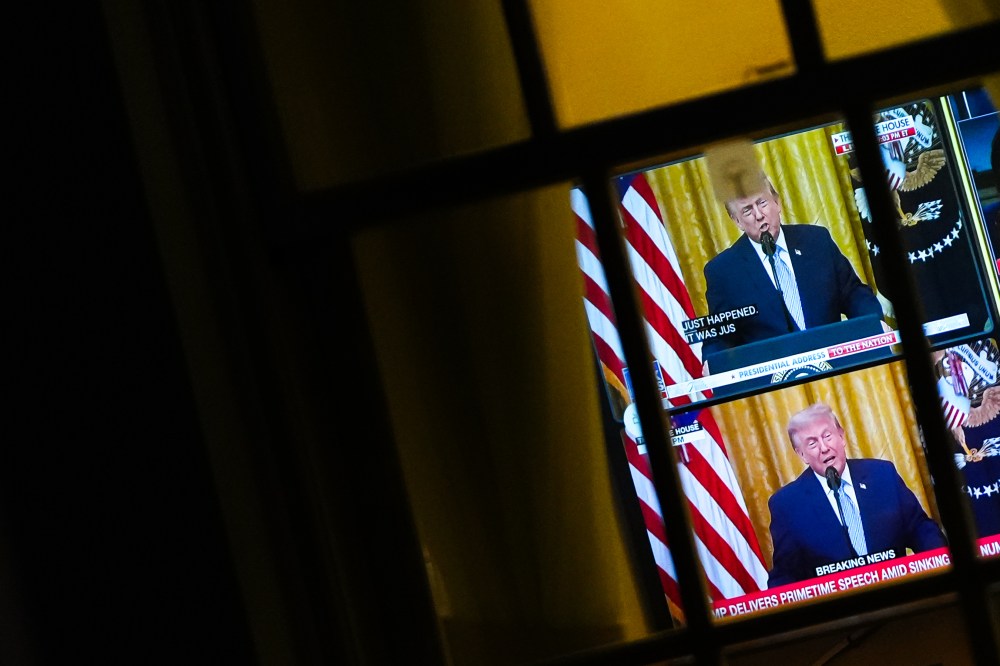
President Donald Trump is seen speaking from the East Room on a television in the West Wing of the White House, Thursday, July 16, 2026, in Washington. (AP Photo/Julia Demaree Nikhinson)

“As I said three months ago, the show must go on,” the president said to begin his remarks, hailing the decision to reschedule the dinner. He referred to “the attempted mass murder” that could have happened that night in April, but then moved largely to humor — and, increasingly, insults.

Trump’s return to the correspondents’ dinner — and his promise to come back next year as well — represented a notable moment in his relationship with the news media, which he has attacked, sued and taken administrative action against since he began his second term early last year. Among the audience members were reporters he had denounced and barred from events.

Trump’s sometimes off-color speech, which lasted just over an hour, was full of potshots directed at various individuals — from Bruce Springsteen to “Barack Hussein Obama” to familiar targets like journalist Kaitlan Collins of CNN, one of the evening’s key award winners, whom he again accused of not smiling enough. The audience reacted at first with friendly laughs, but slowly quieted to scattered titters as the insults piled up.

Among other targets of Trump’s humor: Late-night hosts Jimmy Fallon and Jimmy Kimmel; Rep. Ilhan Omar, D-Minn.; California Gov. Gavin Newsom; former New Jersey Gov. Chris Christie; and even Trump’s own speechwriters. “That was actually the only thing I thought was good in this whole fricking stupid speech they wrote,” he said when one joke fell flat.

At one point, Trump wondered aloud what his role was. “Is this supposed to be fun?” he asked. “Am I supposed to be a comedian?” He was on more comfortable ground expressing pride in the ballroom at the Waldorf Astoria, formerly the Trump International Hotel, and its chandeliers. “It’s great to be back at a place that I know very well, because I built it,” he said.

He also made a pained reference to the evening’s journalism awards, many for stories challenging him and his administration — including one for the Wall Street Journal’s coverage of his ties to convicted sex offender Jeffrey Epstein. “Do I have a say in those awards?” he asked.

He made brief mention of the Iran war, and referred to the ballroom he’s building at the White House. He also used the occasion to joke about the possibility of a third term — something barred by the U.S. Constitution’s 22nd Amendment.

“Just like my presidency, the second time is always better,” the president quipped. “And the third time will be better yet.”

He added: “I’m only kidding.” Then, at the end, he donned a red cap that said “Trump 2028” and delivered the “scoop” that he was running again.
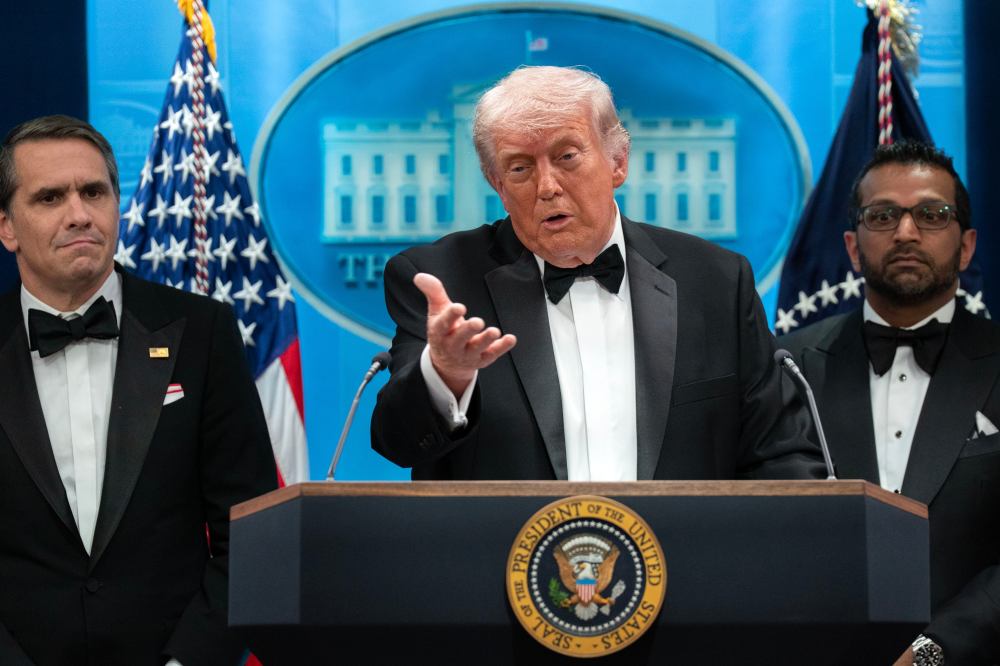
FILE - President Donald Trump speaks in the James Brady Press Briefing Room at the White House after a shooting incident outside the ballroom at at the annual White House Correspondents' Association dinner in Washington, April 25, 2026, as acting Attorney General Todd Blanche, left, and FBI director Kash Patel listen. (AP Photo/Jose Luis Magana, File)

It was a very different dinner than the previous one

Trump had entered the ballroom to polite applause, and was thanked for his support by outgoing White House Correspondents’ Association president Weijia Jiang of CBS News. After dinner, he sat through more than an hour of awards presentations, shaking hands with each winner.

One of the those winners, Tyler Pager of the New York Times, was in fact one of the reporters subpoenaed by Trump’s Justice Department over his reporting about Trump’s Qatari-gifted Air Force One jet. Those subpoenas were withdrawn Thursday in a New York courtroom — just one of the arenas where the president has been seeking to control media coverage he dislikes.

The rescheduled dinner took place at a smaller venue this time that held only about 700 people. Security was markedly tighter. Guests entered via a single entrance, through two ID checks. There was no red carpet and no separate cocktail receptions preceding the dinner.

“Let’s try this again,” Jiang quipped, welcoming the crowd. The White House press corps, she noted, “always have a follow-up.” Turning serious, she referred back to the trauma and confusion of the original dinner in April.

“Tonight our message is this: We are back,” she said. “We will not be intimidated. We refuse to let an act of violence have the final word.”

Secret Service agent, hotel staff received awards for bravery during shooting

Also receiving an award Friday evening was Victor Gonzales, the Secret Service agent who was staffing a security checkpoint in April and was struck in his protective vest.
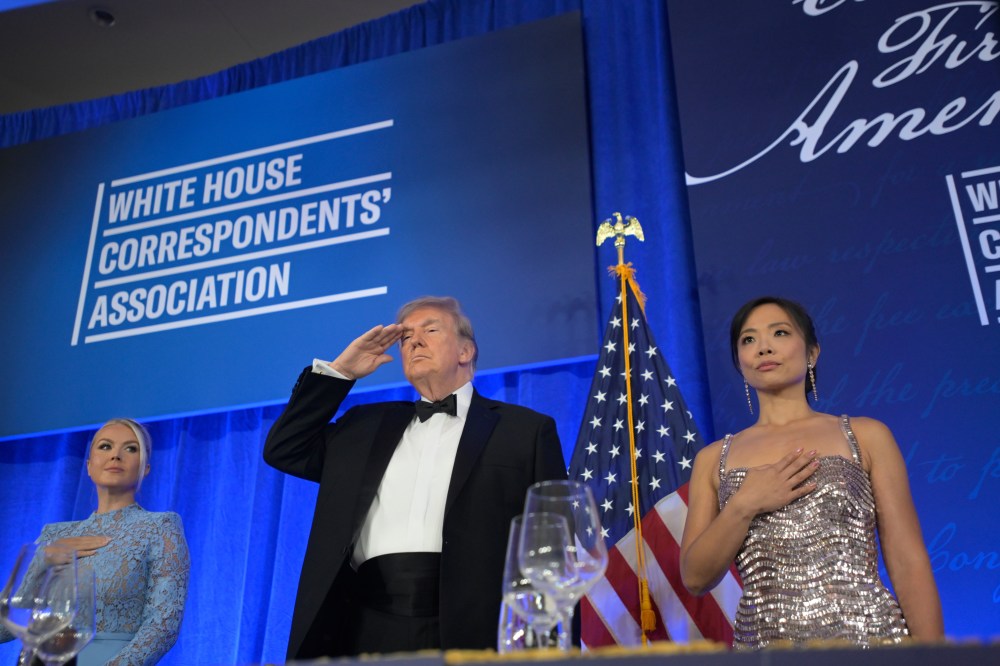
President Donald Trump attends the White House Correspondents' Association Dinner, at the Waldorf Astoria Washington DC, Friday, July 24, 2026, in Washington, with with WHCA president Weijia Jiang, right and White House press secretary Karoline Leavitt. (AP Photo/Rod Lamkey, Jr.)

Gonzales “placed himself directly in harm’s way and engaged the armed suspect,” Jiang said. “He stayed in the fight and the attacker was stopped.”

A second award was presented to the staff of the Washington Hilton, site of the first dinner, for their professionalism under pressure.

The dress code this time was a looser “black tie optional,” and dinner included grilled peach and burrata salad, lobster and roasted beet Wellington. As in April, the featured entertainment was mentalist Oz Pearlman — who now got the chance to perform his act.

Jiang and fellow board members had emphasized they did not want to let a violent act — or the image of colleagues hiding under tables — remain the final thought. Announcing the rescheduling, she’d emphasized the dinner’s stated purpose: “A celebration of a free press and the vital role of journalism in our democracy for over a century.”

There’s still lots of criticism of the event

But some people felt the dinner should not have been rescheduled at all.

Many never thought it was much of a good look in the first place, with the sight of journalists in formal wear cozying up to their sources, or the objects of their reporting.

“It undermines the public faith in how the press does its work, and it makes it look like we are pals with the people we cover,” Kelly McBride, an ethics expert at the Poynter Institute, a journalism think tank, said when the deliberations were taking place.

The new dinner came at a time of fast-increasing tension between the media and a president who has applied pressure on media outlets he’s unhappy with in a variety of ways. That pressure has ranged from sanctions against members of the White House press corps to regulatory actions through the Federal Communications Commission to outright lawsuits.
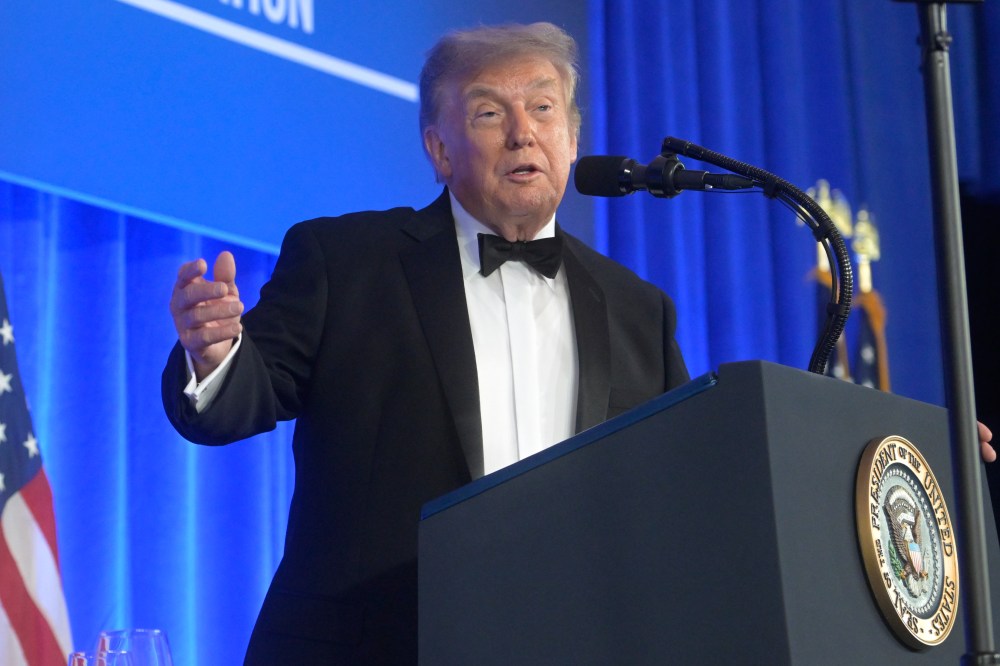
President Donald Trump speaks at the White House Correspondents' Association dinner at the Waldorf Astoria Washington DC, Friday, July 24, 2026, in Washington. (AP Photo/Rod Lamkey, Jr.)

Trump ended his remarks, though, ended with an attempt to mend fences — to a point. “I have a lot of respect for your profession,” he told the assembled journalists.

He also touted his own success, declaring: “When I’m not around, you’re all gonna be broke.”

And he concluded about the evening: “It’s far worse than I originally thought.”

___

Jocelyn Noveck covers the intersection of media and entertainment for The Associated Press.
Report Error Submit a Tip

More Stories

Nearly four in 10 Manitobans hope Canada restarts trade talks after U.S. midterm elections, poll reveals

Gabrielle Piché 5 minute read Preview

Nearly four in 10 Manitobans hope Canada restarts trade talks after U.S. midterm elections, poll reveals

Gabrielle Piché 5 minute read Yesterday at 7:00 AM CDT

Disorganized — that’s what Marcus Langlois calls recent United States tariffs.

He expects suppliers’ prices to increase — on mugs, pens, hoodies — for his employer, Dreamcatcher Promotions, if the United States–Canada trade war persists.

Still, he’s not pining for a quick trade deal.

“I think it should wait,” said Langlois, Dreamcatcher Promotions’ vice-president. “Let’s hope that it’s later on with proper negotiations happening.”

Read
Yesterday at 7:00 AM CDT

Gordon Bell rings in a century

Maggie Macintosh 13 minute read Preview

Gordon Bell rings in a century

Maggie Macintosh 13 minute read Updated: Yesterday at 8:06 PM CDT

Mischka Valencia had gotten used to the hum of heavy machinery at Gordon Bell High School.

“Ever since I’ve been here, it’s all been under construction,” the Grade 12 student said, standing on the sidelines of the brightly painted revamped outdoor basketball court. “I had no idea this was a court.”

The Filipina teenager landed in Winnipeg several months after the inner-city campus had transformed into a construction site.

It was the fall of 2023 and Mischka’s priorities were fitting in, befriending classmates and learning a third language via first-period French.

Read
Updated: Yesterday at 8:06 PM CDT

Letters, Oct. 3

7 minute read 2:01 AM CDT

A morning in the life …

My very first lesson does not start when I walk into that lecture hall, oh no — it starts long before. It begins when I walk to my car, check the estimated arrival time to the University of Manitoba and hope that Winnipeg traffic agrees with it.

A drive that appears completely manageable changes almost immediately when I’m greeted by a tsunami of orange pylons and a line of cars that appears to go on forever. Traffic moves by the inch, lanes magically disappear and the detour I took yesterday now has a detour of its own. These factors make me do a calculation that I have become all too familiar with. How late can I arrive and still find parking, run to my class across campus and get to class with enough time left to make it worth it?

I have grown used to people saying, “Why not just leave earlier?” I do. But when I’m already leaving for my 8:30 a.m. class at 7 a.m., there’s only so much I can do. This drive that some would think is relaxing is one that feels like an assignment that I didn’t know I had to complete and is due at 8:30 a.m.

Six high school hockey programs ceased operations following new Hockey Manitoba policy

Joshua Frey-Sam 7 minute read Preview

Six high school hockey programs ceased operations following new Hockey Manitoba policy

Joshua Frey-Sam 7 minute read Updated: Yesterday at 8:19 PM CDT

She lived the best of both worlds.

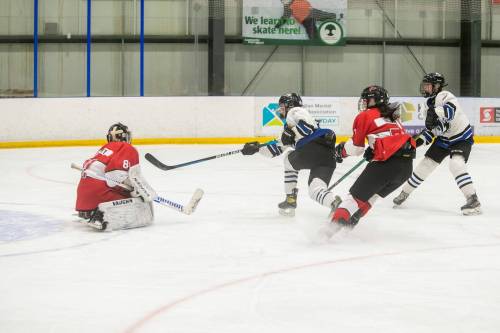
For the last three years, the 17-year-old wore a sweater for two different hockey programs — her high school team and AAA club in the Manitoba Female Hockey League — and was preparing to flourish in both colours again this winter.

Recently, however, the blue-liner was disappointed to learn she is no longer eligible to play her Grade 12 season with her school owing to a new policy imposed by Hockey Manitoba that bans players from participating in the Manitoba Women’s High School Hockey League if they are rostered on a U18 AAA team.

The rule applies to all athletes who play for both Winnipeg-based and rural AAA teams.

Read
Updated: Yesterday at 8:19 PM CDT

Broadening prediction-market gambling a bad idea

Editorial 4 minute read Preview

Broadening prediction-market gambling a bad idea

Editorial 4 minute read 2:01 AM CDT

Let’s make a prediction: sooner or later, when Canadian governments find a way to take their own cut of the action, prediction-contract gambling on everything from sports to entertainment to political decisions is going to come to Canada.

And that’s a horrible, dangerous, pernicious idea.

Unless you have particular access to information — either inside information or strategic information based on skills or education — you’re not likely to make money at it. In fact, structurally, you’re likely to lose. In prediction markets, you basically pay an amount, plus fees from the company involved, to bet on whether something will or will not happen within a certain time frame. The amount you pay for your contract depends on how other people are also betting.

As Wealthsimple describes it, “You buy whichever side you think is right. Prices move with demand, so if the market leans towards one outcome, the more that side costs. If a lot of people are backing the TSX to finish above 38,000, yes gets more expensive and no gets cheaper.”

Read
2:01 AM CDT

Manitoba marks end of sending simple workplace problems to doctor’s office

Tory McNally 7 minute read Preview

Manitoba marks end of sending simple workplace problems to doctor’s office

Tory McNally 7 minute read 2:01 AM CDT

There are some changes in the workplace that make you think: “Well, it’s about time.”

This is one of them.

Starting Oct. 1, Manitoba changed the rules around sick notes. I think it is going to be a wonderful change — not just for doctors and patients, but for employers, employees and the way we think about accountability at work.

The change comes from Bill 11, the Employment Standards Code Amendment Act (Sick Notes for Employee Absences), which received royal assent on June 1 and came into force Thursday. Under the new rules, employers generally cannot require a sick note for an illness or injury unless the employee is away for more than one week or has been absent because of illness or injury for more than 10 scheduled workdays in the calendar year.

Read
2:01 AM CDT