Ottawa wants to block kids from social media. How would age verification work?
Advertisement
Read this article for free:
or
Already have an account? Log in here »
To continue reading, please subscribe:

Digital Subscription
One year of digital access for only $205*
- Enjoy unlimited reading on winnipegfreepress.com
- Read the E-Edition, our digital replica newspaper
- Access News Break, our award-winning app
- Play interactive puzzles
*First annual payment billed as $205.00 + GST for one year. This annual subscription will automatically renew at $233.00 + GST every 52 weeks (10% off the regular annual price of $259.35). Offer available to new and qualified returning subscribers only. Cancel any time.
To continue reading, please subscribe:
Add Free Press access to your Brandon Sun subscription for only an additional
$1 for the first 4 weeks*
- Enjoy unlimited reading on winnipegfreepress.com
- Read the E-Edition, our digital replica newspaper
- Access News Break, our award-winning app
- Play interactive puzzles
*Your next Brandon Sun subscription payment will increase by $1.00 and you will be charged $17.95 plus GST for four weeks. After four weeks, your payment will increase to $24.95 plus GST every four weeks.
Read unlimited articles for free today:
or
Already have an account? Log in here »
OTTAWA – In June, the federal government introduced Bill C-34, which would force social media platforms to block access for kids under 16.
The exact ways in which social media platforms would verify age haven’t yet been worked out. Culture Minister Marc Miller said there will be “a back and forth with platforms as to what protects people’s privacy and what is adequate and sufficient in the circumstances.”
But we can look to experiences in other countries to get an idea of the options. They range from facial age estimation technology to verification through existing accounts to government-issued digital ID.
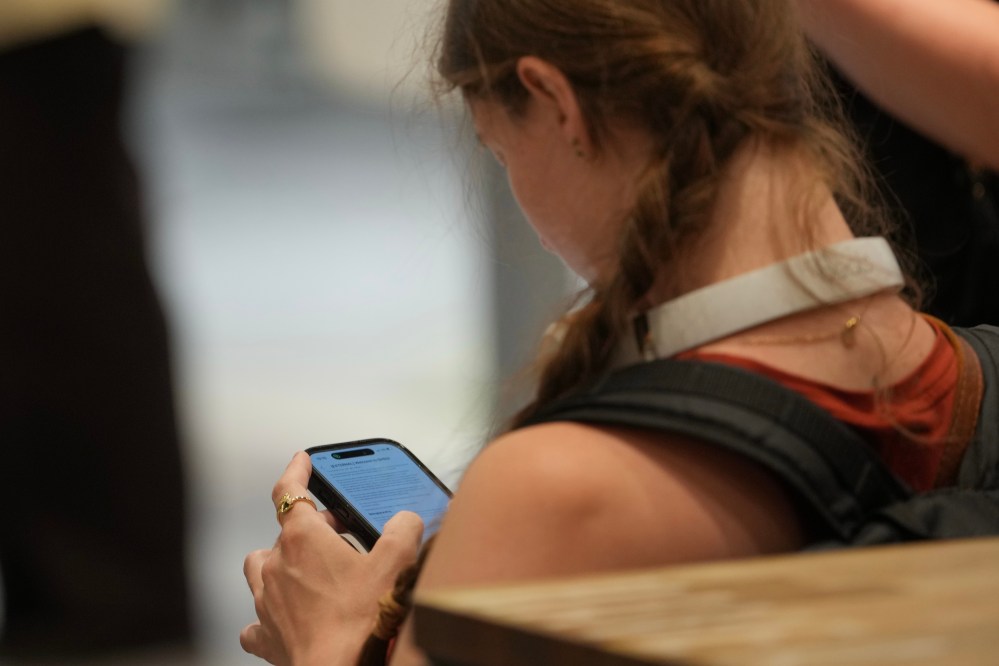
Canada is one of a number of countries around the world moving toward social media age restrictions.
They include the United Kingdom, which plans to implement a ban for kids under 16, and France, which has approved a social media ban for kids under 15.
But France’s top court, the Constitutional Council, struck down the social media ban on Friday. The court ruled the ban is too broad and infringed upon freedom of expression and privacy rights.
Countries around the world have introduced age verification systems that are operating at “various levels of efficacy,” said Heidi Tworek, a professor of history and public policy at the University of British Columbia, shortly after the Canadian bill was introduced.
They include Australia, which has age restrictions for social media, and the U.K., where there is a mandatory verification system controlling access to adult content.
In December 2025, Australia introduced a law that requires social media platforms to take reasonable steps to keep kids under 16 from using their services.
Australia’s rules apply to multiple platforms, including Meta’s Facebook and Instagram, Snapchat, TikTok, Twitch, X, YouTube and Reddit.
But the rules have gaps. In a report released in March, the country’s online safety commissioner said that while millions of accounts had been removed or restricted, “a substantial number of children aged under 16 retain accounts.”
It pointed to a survey it conducted that indicated about 70 per cent of kids with accounts on Facebook, Instagram, Snapchat or TikTok had retained them after the ban came into effect, and about half still had an account on YouTube.
The report noted that facial age estimation — a popular method of age assurance — is “known to have higher error rates for children near the age threshold of 16 years.”
Andrew MacDougall, a senior policy fellow at McGill University’s Centre for Media, Technology and Democracy, said Canada should learn from Australia’s experience by setting its own standard for age verification.
“I think the Australian example shows you that if you don’t do that, you give the platforms a lot of latitude to get around any kind of ban,” he said in an interview.
The United Kingdom’s Online Safety Act sets out seven separate methods of age verification for legal access to adult content. MacDougall took a look at each of them in a recent report.
One of the methods is facial age estimation, which involves a third-party service using a live image to estimate age.
Under the U.K. law, people can also use a digital ID issued by a government or a company. The ID verifies a person’s documents and issues a credential they can share, instead of using the original documents.
The law also includes the options of using a credit card, a mobile network operator or a bank to verify age.
It allows for the use of email to estimate age through a process that looks at where an email address has been used previously — with utilities providers, for instance.
“No single method of age verification is perfect, and policymakers should not expect one to be,” MacDougall wrote in his report.
Methods that rely on existing relationships, such as with a bank, are straightforward and reduce the risk that data will be misused, he wrote. But kids 16 and under are unlikely to have a credit card, a mobile phone contract or a driver’s licence — and not all adults have those things, either.
Photo ID-matching and email-based verification “carry greater privacy implications” and while a national digital ID is “elegant in principle,” it faces the risk of political opposition in some countries, the report said.
In Canada, the Conservative party has bristled at the idea of a government-issued digital ID.
While anyone can use facial age estimation, the technology can be circumvented and it employs biometric data, a very sensitive category of personal information, the report noted.
“The U.K.’s enforcement record, and Australia’s early experience with its social media age ban, together suggest that compliance is achievable but depends heavily on platform co-operation and regulatory capacity,” the report said.
In Canada, Meta has been lobbying the federal government to implement age verification at the app store level, which would place the burden on companies like Apple and Google.
A Texas law requires websites hosting adult material to verify the ages of users through government-issued ID or third-party age-verification services.
Wouter Lueks, a faculty member at CISPA Helmholtz Center for Information Security in Germany, said the European Union has been developing a digital ID that would have multiple uses, including for interactions with government, and a “mini-wallet” for age verification.
Lueks said there are both bad ways and privacy-protective ways to implement a digital ID.
One way to respect privacy is to allow a digital ID to provide pertinent information only, he said — by verifying a person is of age, for example, instead of providing a full date of birth.
“That is one aspect that I would argue is necessary to do this well, or necessary to do this in a privacy preserving manner,” Lueks said.
Canada’s federal privacy commissioner issued a policy note offering guidance on age assurance approaches earlier this year.
The note cited potential risks, such as breaches of personal information and surveillance campaigns tracking an individual’s online activities in a way that allows bad actors to infer sensitive information, such as sexual preferences.
It said the commissioner’s own polling indicates a large majority of Canadians do not trust social media companies to protect their personal information.
Emily Laidlaw, Canada research chair in cybersecurity law at the University of Calgary, said Bill C-34 “is light on details” on how age verification should be conducted, “and that can be good or bad.”
She noted that the legislation leaves the specifics of what will be required of social media companies to the future digital safety commission, which has not yet been launched.
“In some ways that makes sense because the commission can be more nimble and responsive to evolving technologies and safety standards and industry standards,” Laidlaw said. “And so I think if you have faith in the idea of the regulator, that’s exactly as it should work.”
MacDougall said governments shouldn’t let perfection be the enemy of the good and should pursue a regime that can “reflect on itself and iterate.”

“You’re not going to get it right in the first instance and tech moves so quickly now that what is right today might be ineffective tomorrow,” he said.
Lueks said everyone needs to acknowledge that age verification technologies are “far from foolproof.”
Getting around them can be as simple as turning to an older friend to bypass the restrictions, or using a virtual private network, or VPN — which can makes it look as if a user is located in a different country.
“Any VPN solution, as long as there are countries that do not apply these rules or don’t apply these rules with the same age limits, that will do the trick,” Lueks said.
This report by The Canadian Press was first published Aug. 16, 2026.