Colombian COLOSSUS
WAG can barely contain South American artist's colourful, larger-than-life works
Advertisement
Read this article for free:
or
Already have an account? Log in here »
To continue reading, please subscribe:

Digital Subscription
One year of digital access for only $205*
- Enjoy unlimited reading on winnipegfreepress.com
- Read the E-Edition, our digital replica newspaper
- Access News Break, our award-winning app
- Play interactive puzzles
*First annual payment billed as $205.00 + GST for one year. This annual subscription will automatically renew at $233.00 + GST every 52 weeks (10% off the regular annual price of $259.35). Offer available to new and qualified returning subscribers only. Cancel any time.
To continue reading, please subscribe:
Add Free Press access to your Brandon Sun subscription for only an additional
$1 for the first 4 weeks*
- Enjoy unlimited reading on winnipegfreepress.com
- Read the E-Edition, our digital replica newspaper
- Access News Break, our award-winning app
- Play interactive puzzles
*Your next Brandon Sun subscription payment will increase by $1.00 and you will be charged $17.95 plus GST for four weeks. After four weeks, your payment will increase to $24.95 plus GST every four weeks.
Read unlimited articles for free today:
or
Already have an account? Log in here »
Hey there, time traveller!
This article was published 09/12/2010 (5720 days ago), so information in it may no longer be current.
Call them rotund, corpulent, Rubenesque or just fat.
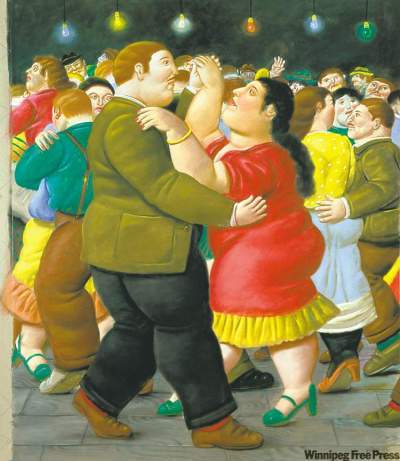
For more than 50 years, Colombian figurative painter and sculptor Fernando Botero has been puffing up his subjects to hefty proportions.
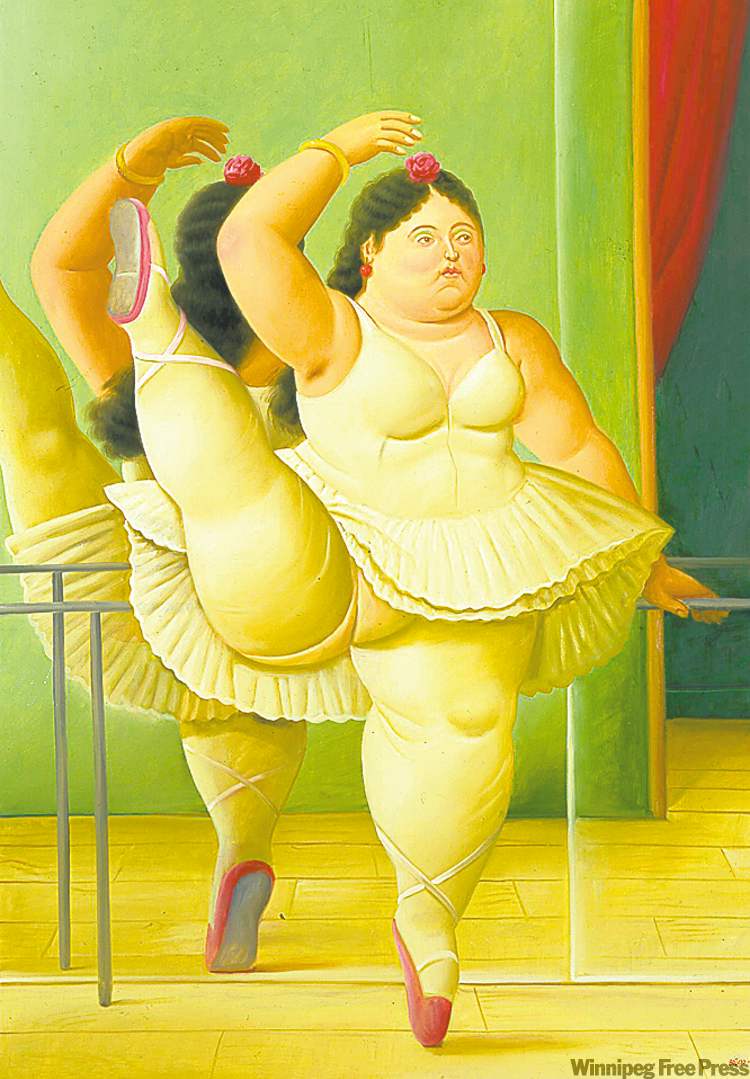
His crucified Christ has a Pavarotti physique. His Adam and Eve could be candidates for The Biggest Loser. His ballerinas have thunder thighs and his nudes’ buttocks are more than bountiful.

He wittily — or perhaps cockily — “Botero-izes” famous paintings by masters such as Velazquez, Ingres, della Francesca and Van Gogh, leaving art lovers to debate whether the works are parodies or homages.
“Everything’s big about Botero,” says Stephen Borys, director of the Winnipeg Art Gallery. “The men, the women, the dogs, the fruit, the cats — nothing escapes that hyper approach.”
Botero is often termed “enigmatic.” But his sensual, brightly colourful, highly recognizable style — influenced by both folk art and classical tradition — has made him one of South America’s most coveted artists.
In 2006, his painting The Musicians fetched $2.03 million at auction. Last month, a Botero portrait of bullfighters sold for $1.7 million.
The Baroque World of Fernando Botero, the first major retrospective of his work to tour North America since the 1970s, opens Friday at the WAG and is on view until Feb. 27.
Admission prices include a $5 surcharge on top of regular WAG prices.
This is the first time the WAG has exhibited the 78-year-old Botero. Winnipeg is one of three Canadian cities, after Quebec City and Calgary, to host the show. Circulated by Art Services International, it consists of 100 works from the artist’s personal collection: more than 60 paintings, 18 drawings and 19 sculptures.
There are four early paintings from 1959, but most of the works are from the 1980s and later.
The show is organized by theme. Many of the paintings, including a number of still lifes, are imposingly large. But the most stunning impact comes from three monumental bronzes, aptly described as the size of parade floats.
All three have a velvety texture that looks like chocolate. One is a gigantic disembodied hand that is perhaps beginning to wave. Another is Botero’s interpretation of the Rape of Europa, in which the voluptuous nude Europa isn’t depicted as a victim, but rides confidently on a harmless-looking bull. It’s one of many Botero works that seem to empower women.
The grandest sculpture is the 1,800-kilogram Smoking Woman (right), a gloriously plus-sized nude lying on her belly, holding a cigarette. Her face, like those in most Botero works, is impassive.
The artist’s trademark face has widely spaced eyes, a tiny mouth and a vacant expression. Some critics describe it as a baby’s face. When Botero paints priests, heads of state and other powerful figures with such faces and too-tight clothes, it seems clear that satire is intended.
But WAG chief curator Helen Delacretaz believes that in general, Botero is not mocking his subjects. Rather, he is “playing with volumes,” manipulating and exaggerating proportions in a way that he finds beautiful. She quotes Botero saying he takes delight in “caressing the forms” as he paints.
The prolific artist enjoys huge commercial popularity, but is dismissed by some critics for “style without substance” that has not evolved over his career.
Borys and Delacretaz acknowledge that Botero is both loved and hated. But they say he should be given his due as a brilliant colorist, highly skilled technician, and an artist who has stayed true to his radical personal vision.
Perhaps the greatest key to interpreting Botero is the word “baroque.” European baroque art, a huge inspiration for him, was extravagant, sumptuous, opulent, large-scaled and vividly coloured.
“In a way, Fernando’s paintings belong in the 17th-century baroque world, particularly what we associate with Italy and Spain,” says Borys.
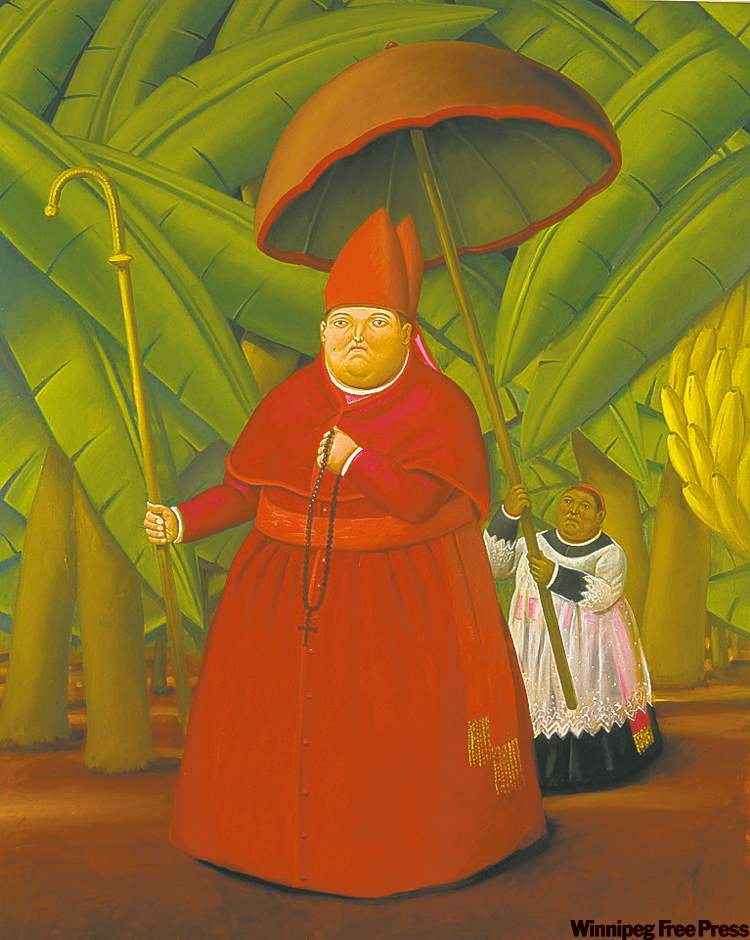

The artist draws on happy memories of the Colombia of his childhood, but also paints troubling scenes of violence reflecting today’s drug-fuelled gang wars.
While his scenes of ordinary Colombians often seem charming at first glance, a closer look often suggests melancholy or something ominous, Delacretaz notes.
“Often, there’s another underlying story,” she says.
alison.mayes@freepress.mb.ca