Wit, wisdom for sale at whor… er, Warehouse
Advertisement
Read this article for free:
or
Already have an account? Log in here »
To continue reading, please subscribe:

Digital Subscription
One year of digital access for only $205*
- Enjoy unlimited reading on winnipegfreepress.com
- Read the E-Edition, our digital replica newspaper
- Access News Break, our award-winning app
- Play interactive puzzles
*First annual payment billed as $205.00 + GST for one year. This annual subscription will automatically renew at $233.00 + GST every 52 weeks (10% off the regular annual price of $259.35). Offer available to new and qualified returning subscribers only. Cancel any time.
To continue reading, please subscribe:
Add Free Press access to your Brandon Sun subscription for only an additional
$1 for the first 4 weeks*
- Enjoy unlimited reading on winnipegfreepress.com
- Read the E-Edition, our digital replica newspaper
- Access News Break, our award-winning app
- Play interactive puzzles
*Your next Brandon Sun subscription payment will increase by $1.00 and you will be charged $17.95 plus GST for four weeks. After four weeks, your payment will increase to $24.95 plus GST every four weeks.
Read unlimited articles for free today:
or
Already have an account? Log in here »
Hey there, time traveller!
This article was published 21/01/2012 (5326 days ago), so information in it may no longer be current.
When George Bernard Shaw inflicted Mrs. Warren’s Profession on Victorian society in 1893, one in every 36 women in London was a hooker, or one for every 12 males.
Despite its prevalence, prostitution was then a taboo subject in polite society making it a natural subject for a an emerging literary provocateur like Shaw who was looking for theatrical notoriety by pushing the truth that the sex trade was not caused by female depravity but economic necessity.
Mrs. Kitty Warren’s occupation is madam of a string of European brothels for which the title serves as euphemism. Shaw never mentions the word prostitute or whorehouse or any synonym but everyone knew what he was talking about and his morality play was widely banned or rejected as immoral.
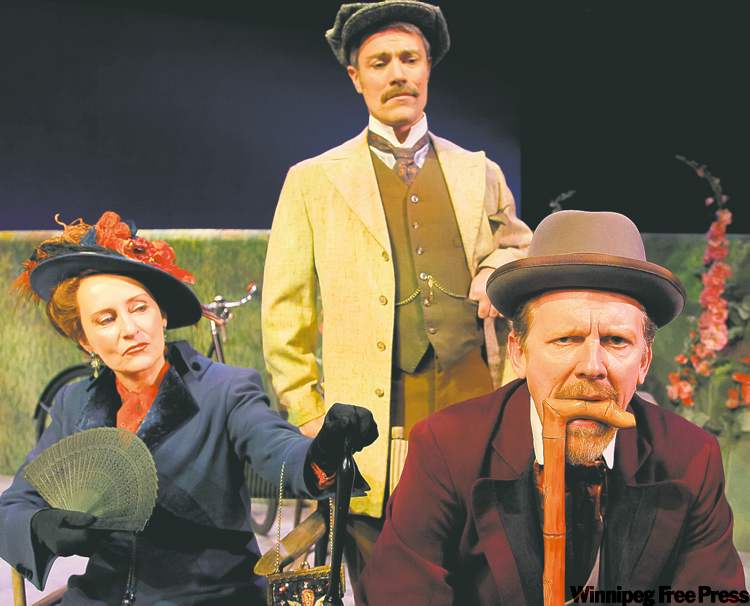
Almost 120 years later at the start of ShawFest — the Irish dramatist is being saluted at this year’s Master Playwright Festival — his infamous social critique may have lost its ability to shock but not to entertain with sparkling wit. But even that sometimes is blunted by his didactic nature, an annoying penchant for explanatory speech-making and lack of action.
His achievement with Mrs. Warren’s Profession today is how he fashions the title character as a rare self-made woman in a man’s world. In fact, Shaw creates two juicy female roles around which all of the drama orbits, a rarity in playwriting of the day.
The RMTC Warehouse revival introduces first Mrs. Warren’s daughter Vivie, a fiercely independent young woman who quickly finds herself surrounded at her country cottage (Charlotte Dean-designed with hedge and hollyhocks) by three men who might be her father and her mother is not sure which. Anyone recognizing the setup similar to the contemporary hit musical Mamma Mia! may be expecting actress Sean McKenna as Mrs. Warren to break into Dancing Queen or the more Shaw-appropriate tune, The Winner Takes It All.
The low-born Mrs. Warren has spent a fortune on Vivie’s education, making sure she wanted for nothing. When they meet again, mom is expecting a dutiful, grateful daughter but instead encounters a plain-speaking, unsentimental offspring with a taste for cigars, whiskey and actuarial work.

Vivie — truly the central character of the 130 minute show — is an example of Shaw’s new woman and is about to learn she is the product of the oldest profession. After the initial shock, she warms to mother’s story that as a young girl with looks, prostitution was preferable to life-shortening jobs or marrying men earning starvation wages.
But the two women are like cheese and chalk and their escalating standoff composes the dramatic core of the play. Initially, it appears the audience is in for a one-sided battle, given the formidable McKenna (Medea, Hedda Gabler) who is provided with a sharp tongue with which to put her feisty daughter in her place. But University of Winnipeg graduate Cherissa Richards, in her RMTC debut, is her equal as intimidating and wilful Vivie. Her glare at Kitty is withering when she discovers she is still living off the exploitation of other women. Both performers are impressive but their characters –no matter what director Alisa Palmer does — can’t escape coming across as mouthpieces for Shaw’s beliefs about society.
Each of the men in Mrs. Warren’s Profession are types of 19th century upper-class hypocrisy. Reverend Samuel, appealingly clowned up by former Winnipegger Stephen Russell, is a social-climbing clergyman with a checkered past. His idol son, Frank, played by the always likable Tom Keenan, is a fortune hunter who can’t marry solely for love. Arne MacPherson puts the surly in Sir George Crofts, Kitty’s business partner, while Gordon Tanner earns his laughs as the semi-bumbling romantic, Mr. Praed.
It’s hard in 2012 to feel the full impact of Mrs. Warren’s Profession, but Shaw provided a service to Victorians by rescuing prostitution from its evil status and making sure that future generations were aware it was a part of the fabric of 19th-century life.
kevin.prokosh@freepress.mb.ca