‘Birth certificate of freedom’ makes its way to CMHR
The 800-year-old Magna Carta will be the cornerstone of museum's new $3M high-tech gallery
Advertisement
Read this article for free:
or
Already have an account? Log in here »
To continue reading, please subscribe:

Digital Subscription
One year of digital access for only $205*
- Enjoy unlimited reading on winnipegfreepress.com
- Read the E-Edition, our digital replica newspaper
- Access News Break, our award-winning app
- Play interactive puzzles
*First annual payment billed as $205.00 + GST for one year. This annual subscription will automatically renew at $233.00 + GST every 52 weeks (10% off the regular annual price of $259.35). Offer available to new and qualified returning subscribers only. Cancel any time.
To continue reading, please subscribe:
Add Free Press access to your Brandon Sun subscription for only an additional
$1 for the first 4 weeks*
- Enjoy unlimited reading on winnipegfreepress.com
- Read the E-Edition, our digital replica newspaper
- Access News Break, our award-winning app
- Play interactive puzzles
*Your next Brandon Sun subscription payment will increase by $1.00 and you will be charged $17.95 plus GST for four weeks. After four weeks, your payment will increase to $24.95 plus GST every four weeks.
Read unlimited articles for free today:
or
Already have an account? Log in here »
Hey there, time traveller!
This article was published 14/08/2015 (4063 days ago), so information in it may no longer be current.
In 2010, Queen Elizabeth II unveiled the cornerstone for the-yet-to-be-completed Canadian Museum for Human Rights, taken from the meadow in Runnymede, England, where the Magna Carta was signed in 1215.
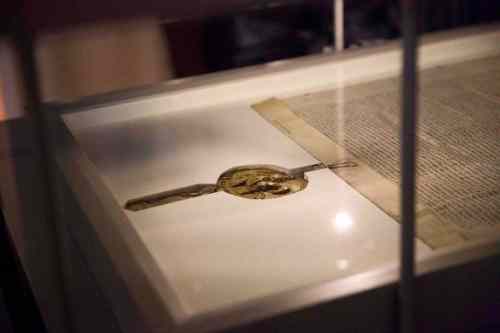
For 800 years, the so-called birth certificate of freedom has been a cornerstone of fundamental liberties, so it is fitting the historic parchment christens the CMHR’s new $3-million, high-tech gallery as part of the exhibit Magna Carta — Law, Liberty and Legacy.
“The idea that people had rights and that they did not have to be subject to the whims of the king is really one of the earliest stirrings of human rights,” says Toronto’s Suzy Rodness, who, with her husband Len, is largely responsible for the four-stop Magna Carta Canadian tour, which opens to the public today. “It’s important that it is in this museum.”

Durham Cathedral, whose ancient cloisters doubled as Hogwarts School of Witchcraft and Wizardry in the Harry Potter movies, made available to Canada one of its three copies of the Magna Carta, the first document to set rules for the ruler.
The original Magna Carta — which means Great Charter in Latin — received the royal seal of King John I on June 15, 1215, at Runnymede, along the Thames River just west of London. Rebel barons forced the despised tyrant, at the point of a sword, to affix his royal seal to a document that declared a monarch was no longer above the law.
It laid down key principles of justice that have universal relevance today, such as: “To no one will we sell, to no one deny or delay right or justice.”
Within nine weeks, the duplicitous King John had the pope declare the Magna Carta null and void. He soon died, and his nine-year-old son, Henry III, redrafted Magna Carta in 1216 to reassure subjects he was on the same parchment. Durham possesses the only surviving 1216 copy, as well as updates from 1225 and the final one issued in 1300, which will be the Magna Carta on display at the CMHR.
The signing of those iconic documents marked a turning point in British history, but also in global history. The Magna Carta has endured as a powerful symbol of resistance in the world. In 1775, revolutionary Massachusetts adopted an image of an American patriot holding a sword in one hand and the Magna Carta in the other as its state seal. Nelson Mandela cited it in his “I Am Prepared to Die” speech at his 1964 trial in Pretoria, South Africa.
“There are many people who will criticize the document as a peace treaty between angry barons and a terrible king,” says Rodness, a real-estate assets manager. “It was never meant to be what it has become. It has been held up in clenched fists for 715 years by anyone with a cause. The ideas of it caught on among revolutionaries. People use it as their North Star, rightly or wrongly.”
The quill-written document also announces the birth of women’s rights. Before it became law, if a noblewoman was widowed, the king could choose her new husband — often a man who paid the monarch large sums to marry into a noble family. Without a husband, these aristocratic wives also could have their homes and property seized.
“Women’s rights are introduced for the first time, that women cannot be compelled to marry,” Rodness says. “It may seem ridiculous now, but that’s the way women lived then. The early idea of women’s rights 800 years ago is quite remarkable when you think of the times and conditions they lived in.”
Happenstance paves the road to Ottawa
In the summer of 2011, Rodness and her husband learned by happenstance that Durham Cathedral was interested in loaning its Magna Carta to a Commonwealth country for a fee that would go to pay off costly renovations. The couple thought that country should be Canada and travelled to Durham, just south of the England-Scotland border, to negotiate and peruse its trio of Magna Carta manuscripts.
There are 17 original Magna Cartas. Fifteen are permanently housed in the British Museum and various English cathedrals, including Durham. One is in the Parliament of Australia in Canberra and another, from 1297, was purchased for US$21.3 million and donated to the National Archives in Washington, D.C.
Cathedral officials were planning on showcasing the 1216 Magna Carta in 2015, and the 1225 version was deemed too fragile to travel. So the 1300 edition was brought out of the archives for the Canadians to inspect.
“We want to make everyone who walks through the museum understand that to get to where we are now is a long, compelling story.”
“This is the final version of it that then became English law,” says Maria Piacente, curator of Magna Carta — Law, Liberty and Legacy. “The 1300 one is the Magna Carta that stuck.”
The charter had never left the grounds of Durham and has been lying folded in the vault for 715 years. It was unfolded on a black velvet pad and its corners held down by little weighted ropes.
“They asked us not to get too close or touch it,” Rodness says. “It gives you goosebumps to think how old it is. My first impression was how small it was and how perfect the calligraphy was and how abbreviated everything was. They had to get about 4,500 words on this tiny parchment.”
It took cathedral officials weeks to flatten the document bit by bit so it could be exhibited under glass in a special climate-controlled case made in Wales. The couple then raised $2 million to support the tour with a film, interactive multimedia materials and a book.
The Magna Carta and the historic Charter of the Forest were flown to Ottawa, where they were displayed at the Canadian Museum of Civilization from June 12 to July 26 before arriving at the CMHR by refrigerator truck. Next month they move on to Toronto and then to Edmonton.
Understanding its relevancy
The daunting challenge facing CMHR officials was how to make a fragile, 715-year-old piece of parchment written in medieval Latin relevant to Canadians in the 21st century.
Sure, it is the considered the world’s most important legal document, but many unimpressed Canadians could react with a shrug.
Magna Carta — Law, Liberty and Legacy attempts to explain why Canadians should care, especially during a federal election campaign.
“Magna Carta takes us back to a time when the king did not have to answer to the same laws as his people, and now we just take this for granted,” says Rodness. “We want to make everyone who walks through the museum understand that to get to where we are now is a long, compelling story.”
The telling starts as museum-goers enter the 5,200-square-foot, climate-controlled gallery, where the temperature will be set at 19 C with strictly controlled humidity. The lighting will also be dim to aid in the preservation of the documents.

Visitors will be immediately taken back to Runnymede in 1215, under the monarch’s great tent. In front of the life-size dressed mannequins of King John, Essex landowner Robert FitzWalter and a commoner are telephones on which patrons can listen to them explain their situations and opinion of the charter.
Then the result is on display: the Magna Carta and the accompanying Charter of the Forest, which restored the traditional rights of citizens to access wood and peat. They are accompanied by interactive screens that offer a translation.
A large 3D globe allows visitors to see how each part of the world has been affected by the Magna Carta.
It precedes the Canadian section, where some of Canada’s key foundational documents have been displayed, including the Royal Proclamation of 1763, which has been called the Indian Magna Carta, owing to its recognition of indigenous nations’ pre-existing rights to land.

There is also a page from a draft of the British North American Act (now known as the Constitution Act of 1867) in the handwriting of prime minister John A. Macdonald.
“I chose the page with the preamble, which says our constitution is to be modelled after that of the United Kingdom,” says CMHR curator Armando Perla, “I thought it was a really significant page to exhibit. I saw these documents in Ottawa and I felt like a kid opening a box of candy. I was so excited.”
The exhibit offers many interactive activities, as well as opportunities to be photographed in historic costumes, take calligraphy lessons or play chess on a large board with three-foot-high pieces.
The final image on the way out is that Runnymede stone, which bore witness to the historic events 800 years ago.
kevin.prokosh@free press.mb.ca