Activism can be fashionable, too
New museum exhibit to feature wearable social media dress

Advertisement
Read this article for free:
or
Already have an account? Log in here »
To continue reading, please subscribe:

Digital Subscription
One year of digital access for only $205*
- Enjoy unlimited reading on winnipegfreepress.com
- Read the E-Edition, our digital replica newspaper
- Access News Break, our award-winning app
- Play interactive puzzles
*First annual payment billed as $205.00 + GST for one year. This annual subscription will automatically renew at $233.00 + GST every 52 weeks (10% off the regular annual price of $259.35). Offer available to new and qualified returning subscribers only. Cancel any time.
To continue reading, please subscribe:
Add Free Press access to your Brandon Sun subscription for only an additional
$1 for the first 4 weeks*
- Enjoy unlimited reading on winnipegfreepress.com
- Read the E-Edition, our digital replica newspaper
- Access News Break, our award-winning app
- Play interactive puzzles
*Your next Brandon Sun subscription payment will increase by $1.00 and you will be charged $17.95 plus GST for four weeks. After four weeks, your payment will increase to $24.95 plus GST every four weeks.
Read unlimited articles for free today:
or
Already have an account? Log in here »
Hey there, time traveller!
This article was published 07/12/2017 (3187 days ago), so information in it may no longer be current.
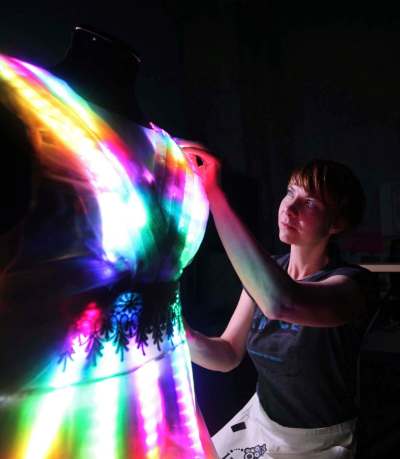
Liz Neely is working in the Design Lab at the Canadian Museum for Human Rights (CMHR), surrounded by luminous clouds of fibre optic fabric.
“Watch this,” she says.
When she activates the LED lights that wind through the fabric, it glows green. The effect looks strikingly similar to the Northern Lights.
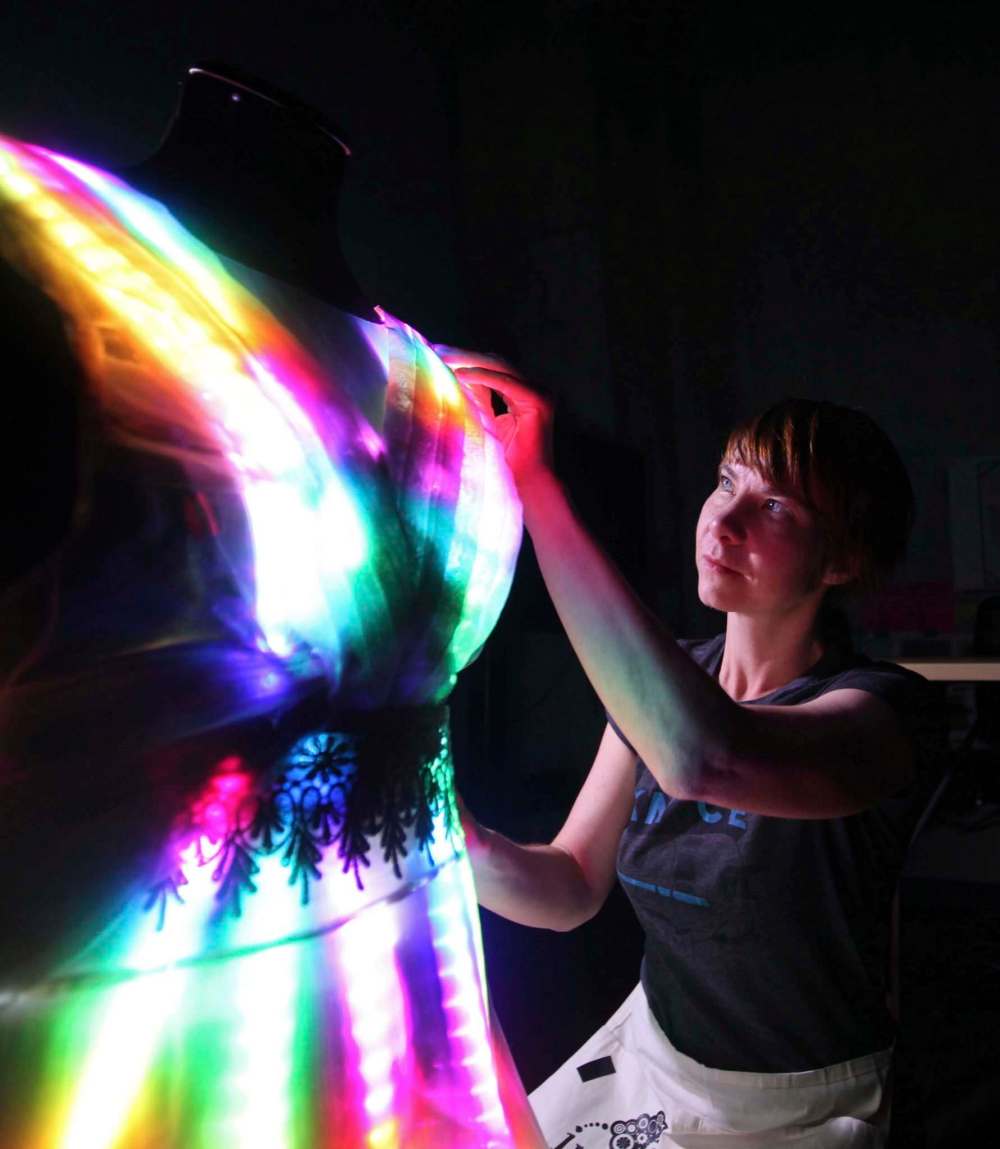
Neely is an expert in the use of digital technology at museums, and works with the American Alliance of Museums in Washington, D.C. She’s in Winnipeg to create a wearable social media dress for the CMHR’s upcoming exhibit Rights of Passage: Canada at 150, which opens Sunday, Dec. 10. The interactive exhibit highlights some key human rights events in four time periods, ranging from 1867 to today, and examines how the evolution in communications technology — from the printing press to TV and radio to Twitter — has shaped those conversations.
Neely’s dress will react to three different hashtags — #equality, #reconciliation, #environment — that will be projected onto the ground in the gallery.
“We call it a natural user interface,” Neely explains. “You don’t use a phone, you don’t have to type anything.”
All you have to do is step on the hashtag and the dress, which employs almost 700 LED lights, will light up.
For #equality, the dress will explode into a rainbow, representing freedom of self-expression. “I wanted it to be a party in a dress,” she says. For #environment, she went green, and wanted to give a visual sense of roots. For #reconciliation, the dress will glow red. Neely was inspired by The REDress Project, a public art installation by Winnipeg artist Jaime Black in which hundreds of red dresses, symbolizing missing and murdered Indigenous women, are hung up in public spaces.
“I wanted the lights to pulse like a heartbeat,” she says.
Neely has made a social media dress before. Five years ago, she made — and actually wore — a Twitter dress to a conference that lit up, made bird sounds and flapped when people tweeted at her. (Unlike her original dress, the CMHR dress will not be hooked up to the internet, although it could be.)
“I thought my relationships on Twitter were so real and sometimes they weren’t treated as real, so I wanted to bring them back out into the physical world,” she explains.
When we think about wearable tech, we often think about utilitarian gadgets such as fitness trackers and watches — not necessarily beautiful dresses. Neely’s social media dress looks like an actual dress, which was intentional.
“I wanted it to be something that felt like you could wear,” she says. “I wanted to keep it fun and not too fancy, so that it feels like it’s something that could be in your future.”
Indeed, Neely’s dresses also highlight the possibilities that exist in wearable technology. Her dresses feel, in many ways, like a logical progression of fashion — which, of course, is already a form of self expression and communication. Fashion also already influences human rights conversations; 2017, for example, has been the year of the political slogan T-shirt, thanks to the proliferation of shirts bearing phrases such as “Resist,” “Nasty Woman,” “Nevertheless, She Persisted” and “The Future is Female.”
Perhaps the future of slogan T-shirts is digital, and hashtag activism will be brought out into the physical world via our clothing.

It’s that hybrid of virtual and physical that Neely is interested in. A big focus in her day-to-day work is how integrated technology and media can help museums better tell stories.
“(The CMHR) is a museum that’s about digital and story first, but for all of our museums: how do we tell the stories that surround an object, but also allow multiple stories to be told? In the old days, a certain expert would write about this item and it would be one storyline. But we all know that there are stories that were left out, and some significant stories were left out.” Using technology can help museums tell stories without necessarily relying on physical artifacts.
But one of the biggest advantages of including digital technology in museums, Neely says, is that it allows for interaction.
“It’s a facilitator for making the museum more of a hub of society.”
jen.zoratti@freepress.mb.caTwitter: @JenZoratti
Jen Zoratti is a columnist and feature writer working in the Arts & Life department, as well as the author of the weekly newsletter NEXT. A National Newspaper Award finalist for arts and entertainment writing, Jen is a graduate of the Creative Communications program at RRC Polytech and was a music writer before joining the Free Press in 2013. Read more about Jen.
Every piece of reporting Jen produces is reviewed by an editing team before it is posted online or published in print – part of the Free Press‘s tradition, since 1872, of producing reliable independent journalism. Read more about Free Press’s history and mandate, and learn how our newsroom operates.
Our newsroom depends on a growing audience of readers to power our journalism. If you are not a paid reader, please consider becoming a subscriber.
Our newsroom depends on its audience of readers to power our journalism. Thank you for your support.
Art preview
Rights of Passage: Canada at 150
Canadian Museum for Human Rights
Sunday, Dec. 10 (International Human Rights Day)
Regular museum hours: 10 a.m. to 5 p.m. Tuesdays, Thursdays-Sundays; 10 a.m. to 9 p.m. Wednesdays
Sunday admission: Free
Jen Zoratti is a columnist and feature writer working in the Arts & Life department, as well as the author of the weekly newsletter NEXT. A National Newspaper Award finalist for arts and entertainment writing, Jen is a graduate of the Creative Communications program at RRC Polytech and was a music writer before joining the Free Press in 2013. Read more about Jen.
Every piece of reporting Jen produces is reviewed by an editing team before it is posted online or published in print – part of the Free Press‘s tradition, since 1872, of producing reliable independent journalism. Read more about Free Press’s history and mandate, and learn how our newsroom operates.
Our newsroom depends on a growing audience of readers to power our journalism. If you are not a paid reader, please consider becoming a subscriber.
Our newsroom depends on its audience of readers to power our journalism. Thank you for your support.
Advertisement Advertise With Us
Advertisement Advertise With Us