Local luminaries meet art-world twins

Free app matches selfies with faces from massive museum database

Advertisement

Advertise with us

It turns out I am the spitting image of Hermanus Boerhaave, the famed Dutch botanist, chemist and physician of the late 17th and early 18th centuries.

Read this article for free:


or

Already have an account? Log in here »

To continue reading, please subscribe:

Subscribe and receive a limited-edition Free Press branded hat or tote.

Digital Subscription

One year of digital access for only $205*

  • Enjoy unlimited reading on winnipegfreepress.com
  • Read the E-Edition, our digital replica newspaper
  • Access News Break, our award-winning app
  • Play interactive puzzles

*First annual payment billed as $205.00 + GST for one year. This annual subscription will automatically renew at $233.00 + GST every 52 weeks (10% off the regular annual price of $259.35). Offer available to new and qualified returning subscribers only. Cancel any time.

To continue reading, please subscribe:

Add Free Press access to your Brandon Sun subscription for only an additional

$1 for the first 4 weeks*

  • Enjoy unlimited reading on winnipegfreepress.com
  • Read the E-Edition, our digital replica newspaper
  • Access News Break, our award-winning app
  • Play interactive puzzles
Start now

*Your next Brandon Sun subscription payment will increase by $1.00 and you will be charged $17.95 plus GST for four weeks. After four weeks, your payment will increase to $24.95 plus GST every four weeks.

Opinion

Hey there, time traveller!
This article was published 24/01/2018 (3161 days ago), so information in it may no longer be current.

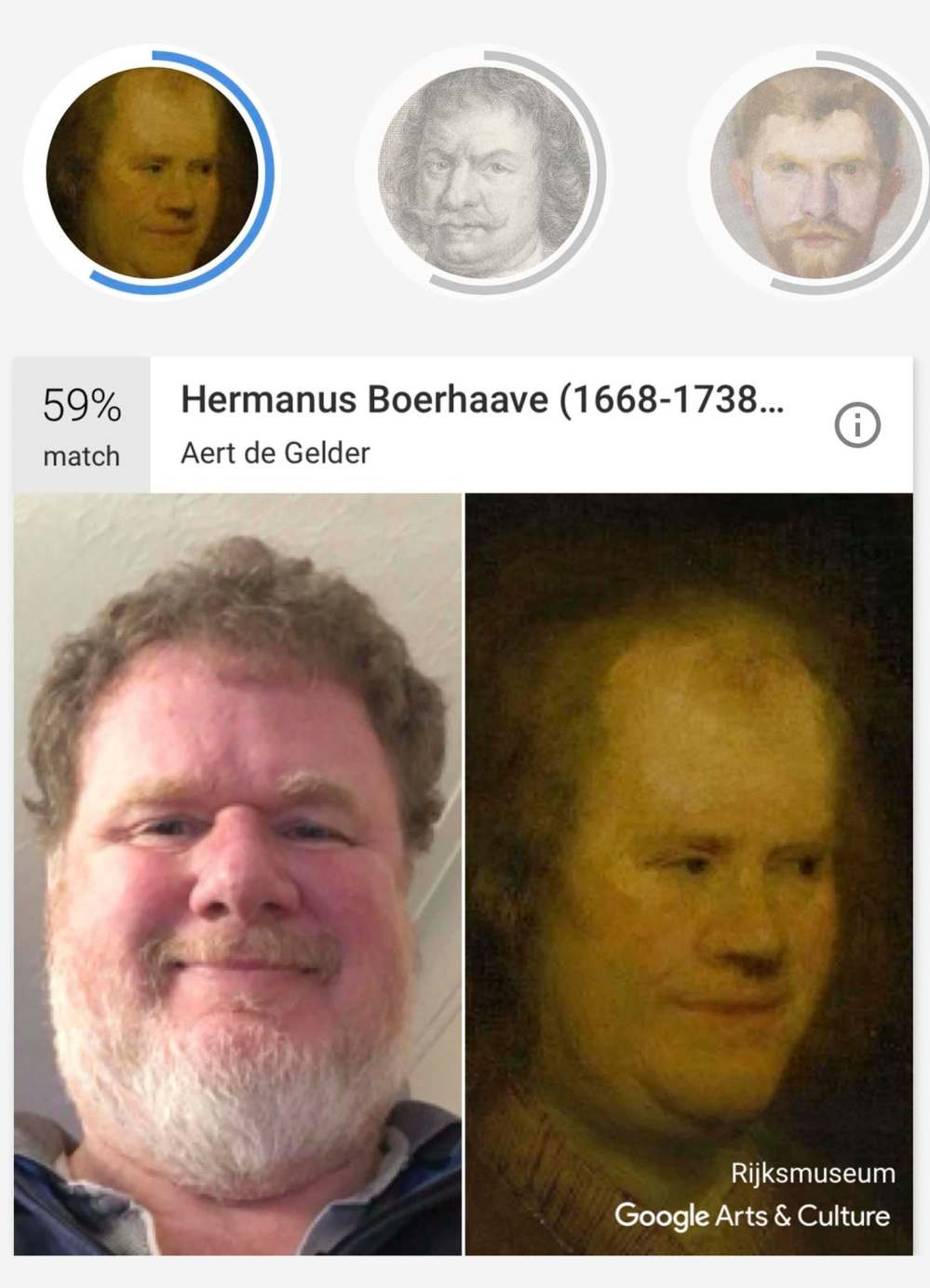
It turns out I am the spitting image of Hermanus Boerhaave, the famed Dutch botanist, chemist and physician of the late 17th and early 18th centuries.

Yes, I am the modern-day twin of some goofy-looking guy with a receding hairline who is regarded as the founder of the modern academic hospital and is sometimes referred to as “the father of physiology.”

I don’t wish to brag, but good old Hermanus was also the first person to isolate the chemical urea from urine.
GOOGLE ARTS AND CULTURE APP
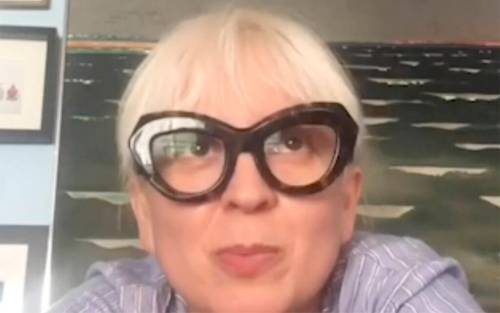
Winnipeg Free Press columnist Doug Speirs and Hermanus Boerhaave by artist Aert de Gelder.
GOOGLE ARTS AND CULTURE APP Winnipeg Free Press columnist Doug Speirs and Hermanus Boerhaave by artist Aert de Gelder.

Who knew?

I discovered that Hermanus and I are lookalikes earlier this week when I downloaded Google’s insanely popular Arts & Culture App, which is threatening to break the internet.

The app actually came out in 2016, but its newest component just became available in Canada this week — Google’s museum selfie feature, which allows you to upload a photo and then scan the databases of thousands of museums to see whether you have a lookalike hanging on a wall somewhere.

All you have to do is download the app, which is available for free to iPhone and Android users, then scroll down to the part where it says “Search with your selfie,” and hit the “Get Started” button, which will prompt the app to scour thousands of classic artworks in search of the painted faces that most closely resemble yours.

Within seconds, thanks to a fancy algorithm, it will present your face juxtaposed beside the five closest art-world matches, along with a percentage stating how closely your mugshot resembles the supposed fine-art doppelganger in the painting.

As far as I can tell, no one in the world has been able to do any productive work since the museum-selfie feature became available this week. Everyone who is anyone has been posting photos of themselves alongside their museum lookalikes.

You can imagine how excited I was to discover that Google believes I am a 59 per cent match to Hermanus Boerhaave, whose portrait hangs in Amsterdam’s Rijksmuseum and who is not going to be mistaken any time soon for a hunk of burning love, if you catch my subtle classical art drift.

So, yes, as I stared at my iPhone, comparing my mugshot to the painted visage of the first physician to put the thermometer to clinical use, I was not entirely flattered.

With sincere apologies to Hermanus, my initial reaction was this: “Blech!”

When I showed the match to my beloved spouse, She Who Must Not Be Named, she said, and I will quote her directly: “Ha ha ha! It’s funny! Ha ha ha. He’s very green looking. It’s because of the hairline that they picked him to be one of your doppelgangers. And your eyes.”

Then, after glancing at my crestfallen face, she quickly added: “Yes, dear, you are much more handsome than he is, although you have one nostril that looks bigger than the other.”

Which is when, in the spirit of art appreciation, I forced my spouse to upload her own selfie and compare her face with famous works of art.

She was reasonably happy to discover that her No. 1 match was some 15th-century painting of a flame-haired woman entitled Girl With Cherries, but I was able to laugh a cruel little laugh when we discovered her No. 5 match (56 per cent) was a portrait of a guy — none other than King Louis XIV, the legendary pouffy-haired Sun King who ruled France from 1643 to 1715.

“Well, at least I’m a king,” is what my wife muttered as I quickly stifled a laugh.

When I tried to upload photos of my dogs, however, Google wouldn’t play along, even though I am sure there are many famously artistic dogs hanging in museums around the globe.

In a sincere effort to waste time, I parked myself beside Free Press photo editor Mike Aporius (a striking 69 per cent match to an old-school portrait of Charles Calverley), and we uploaded photos of several prominent Manitobans into the app to find the masterpieces that matched their mugs.

For what it’s worth, our premier, Brian Pallister, is a 67 per cent match for some extremely mustachioed fellow named Henry Sturgis Drinker, who was featured holding a cat in an 1898 portrait entitled Man with the Cat that hangs in the Smithsonian American Art Museum.

Other than similar hairstyles, I’m not really seeing the resemblance, but then what do I know about art?

Google was also convinced that Winnipeg Jets superstar forward Patrik Laine is a close (72 per cent) match for an 1888 painting of the famed Danish writer and poet Otto Benzon that hangs in the Skagens Museum. I’m sure Otto was fine with a rhyme, but he does not look like he could strap skates and battle in the corners with Jonathan Toews.

When we fed a photo of Lt.-Gov. Janice Filmon into the system, it spat out a portrait of a lovely royal person named Amalia Van Solms, who, from what I have just read, was princess consort of Orange by marriage to Frederick Henry, Prince of Orange, back in the 17th century.

Other social media users have amused themselves by punching in a veritable who’s who of recognizable Canadian faces into Google’s free app, including Prime Minister Justin Trudeau, who Google thinks resembles Henry Raeburn’s Ritratto, or Caspar Netscher’s Trimming bales of hay, and/or a 1943 self-portrait of Soviet painter Viktor Ivanov.

The National Post found famed hockey commentator Don Cherry is a close match for a portrait of Phillip II of Spain, whereas Justin Bieber is apparently the modern reincarnation of a 1969 portrait of Elvis Presley.

With apologies to Google, I personally have famously been mistaken by actual humans for two great Manitoba personages, namely 1) Former NDP MP and MLA Bill Blaikie, who even my spouse believes is my slightly taller doppelganger; and 2) former Guess Who lead guitarist Randy Bachman, at least back when he was carrying a few more pounds.

The point is, you should all drop whatever you are doing and download this (bad word) free app right now, then we can get together and compare our much-more-famous art-world lookalikes.

You won’t have any trouble finding me — I’ll be the good-looking guy hanging around in a museum.

doug.speirs@freepress.mb.ca


History

Updated on Wednesday, January 24, 2018 12:39 AM CST: Adds photo
Report Error Submit a Tip

More Stories

‘She was looking to destroy me’: convicted harasser faces new charges

Dean Pritchard 6 minute read Preview

‘She was looking to destroy me’: convicted harasser faces new charges

Dean Pritchard 6 minute read Thursday, Sep. 17, 2026

When Agnieszka Ciochon-Newton moved into the 55-plus apartment building on Stradbrook Avenue last year, she came across as “timid, soft-spoken and sensitive,” said building manager Tanya Owen.

Little did Owen know the meek-looking 58-year-old woman would soon turn her life and the lives of many of her tenants upside down and threaten her career and family.

“She was looking to destroy me for a simple tenant disagreement,” Owen said Thursday.

Court records show Ciochon-Newton was arrested earlier this month and charged with seven counts of criminal harassment, two counts of uttering threats and one count each of fraud, breaking and entering, attempting to obstruct justice, intimidation of a justice official, mischief and defamatory libel.

Read
Thursday, Sep. 17, 2026

Gillingham in lead with decided voters

Nicole Buffie 6 minute read Preview

Gillingham in lead with decided voters

Nicole Buffie 6 minute read Friday, Sep. 18, 2026

A cloud of uncertainty is hanging over Winnipeg as October’s municipal election nears.

Three months after a poll showed more than 40 per cent of Winnipeggers wanted to see someone other than current mayor Scott Gillingham elected, a new Abacus Data poll indicates more than half of Winnipeg voters are undecided heading into next month’s civic election.

Of decided voters, 55 per cent favour Gillingham compared to 23 per cent for former councillor and provincial cabinet minister Kevin Klein and 11 per cent for funeral director Mike Vogiatzakis.

Of all respondents, just over 50 per cent said they were unsure while 13 per cent said they will not vote.

Read
Friday, Sep. 18, 2026

Steinbach Credit Union member warns others after scammer steals $10K

Scott Billeck 5 minute read Preview

Steinbach Credit Union member warns others after scammer steals $10K

Scott Billeck 5 minute read Friday, Sep. 18, 2026

A Winnipeg single mother whose bank account was drained of nearly $10,000 says Steinbach Credit Union needs to warn its members about what she believes is a broader security problem.

The woman, who is not being named to protect her identity, said a scammer gained access to her account earlier this week after calling SCU’s contact centre, claiming to be her and successfully completing the credit union’s authentication process.

She said she knows of at least six others who have experienced similar incidents in which callers impersonate SCU account holders and pass the authentication checks.

The woman discovered something was wrong when her minor son asked why money had been transferred out of an account they jointly hold.

Read
Friday, Sep. 18, 2026

Cabernet Sauvignon star of wine festival

Ben Sigurdson 5 minute read Preview

Cabernet Sauvignon star of wine festival

Ben Sigurdson 5 minute read Yesterday at 3:00 AM CDT

The Winnipeg Wine Festival will celebrate the king of red wine grapes next weekend — the theme of this year’s festival, which takes place Sept. 25 and 26 at the RBC Convention Centre, is Cabernet Sauvignon.

Cab Sauv, as it’s also known, is the world’s most widely planted wine grape of any colour, first coming to prominence in the 1800s in France’s Bordeaux region, where the grape is still popular. Rather than single-variety wines, Bordeaux reds tend to be blends, with those coming from the left bank of the Gironde estuary being Cabernet-dominant, while right-bank wines are Merlot-dominant, with Cabernet Sauvignon playing a supporting role. Cabernet and Merlot work well together and many other countries have followed suit in blending the two.

A team at University of California Davis put Cabernet Sauvignon through a DNA test in 1996 and discovered its parent grapes are Cabernet Franc and Sauvignon Blanc — it’s likely that at some point the two varieties, planted next to each other in some vineyard, crossed and mutated and became the grape we know today. (Someone growing grapes in the 19th century must have had an inkling of what was up, as the grape has been called Cabernet Sauvignon since long before the DNA test.)

Flavour-wise, most Cabernet Sauvignon wines are big and bold, with a core of deep dark berry flavours, some graphite and spice notes and relatively bright acidity. It’s a grape that is well-suited to barrel aging, with most examples seeing at least some time in wood.

Read
Yesterday at 3:00 AM CDT

Family account spiced with magic realism, geopolitical intrigue and a ghost story

Reviewed by Zilla Jones 4 minute read Preview

Family account spiced with magic realism, geopolitical intrigue and a ghost story

Reviewed by Zilla Jones 4 minute read Yesterday at 2:01 AM CDT

Tom Lin’s second novel Babylon, South Dakota moves beyond a historical account of an immigrant family’s struggle, delightfully blending and bending genres.

Lin is a Chinese-born novelist whose family emigrated to the U.S. when he was four years old. His debut novel, The Thousand Crimes of Ming Tsu, won the 2022 Andrew Carnegie Medal for Excellence in Fiction, making him the youngest ever recipient of that award. He earned a PhD in English from the University of California Davis and is currently an assistant professor of English and creative writing at the University of Iowa.

Babylon, South Dakota takes place in an unspecified time period that can be understood to be during the Mao era — likely the 1950s or ’60s. A young Chinese couple, the Hsuis, immigrate to the rural community that gives the book its title. They take the names Saul and Mei and settle on a 160-acre homestead left to them by a distant relative.

Saul’s dream is to breed and sell chrysanthemums from seeds he brought from China, while Mei wants to raise livestock. They speak no English, know nothing of life in the United States, are unprepared for the harshness of winter and the isolation of the farm and bring nothing with them except some gold, which Mei hides around the house for emergencies. Their only link to the outside world is a discarded and marginally functioning TV set, which Saul rescues and rigs up.

Read
Yesterday at 2:01 AM CDT

Canada must not accept another Iranian autocracy

David Matas 5 minute read Yesterday at 2:01 AM CDT

Iran is a state run by a radical government victimizing its citizens and its neighbours. How do we change that? Any regime change that repeats the mistakes of the past is not a solution.

What went wrong in the past which led to the current regime? One answer is the U.K. and American aided coup which led to the ouster in 1953 of a democratically elected government headed at the time by Mohammad Mossadegh and its replacement with an American friendly autocrat, the Shah of Iran, Mohammad Reza Pahlavi.

The Shah imposed his rule through the Iranian National Intelligence and Security Organization — SAVAK, the acronym of its Persian name. SAVAK systematically inflicted torture, arbitrary killings and extra-judicial killings on perceived opponents of the regime. It was only a matter of time before repression of a regime directed to serving foreign interests would be overthrown.

What replaced the regime of the Shah, in 1979, the current regime of the mullahs, is a regime as intolerant and violent as the regime of the Shah and then some. That was not inevitable. But neither was it surprising. The vicious nature of the current regime, following the example set by the Shah, and its hatred for the United States, reacting to the U.S. aided imposition of the Shah, both echoes and reacts to the past. In 1979, the U.S. reaped what it sowed in 1953.