Gillmor maps out blind luck, inevitability of history
Advertisement
Read this article for free:
or
Already have an account? Log in here »
To continue reading, please subscribe:

Digital Subscription
One year of digital access for only $205*
- Enjoy unlimited reading on winnipegfreepress.com
- Read the E-Edition, our digital replica newspaper
- Access News Break, our award-winning app
- Play interactive puzzles
*First annual payment billed as $205.00 + GST for one year. This annual subscription will automatically renew at $233.00 + GST every 52 weeks (10% off the regular annual price of $259.35). Offer available to new and qualified returning subscribers only. Cancel any time.
To continue reading, please subscribe:
Add Free Press access to your Brandon Sun subscription for only an additional
$1 for the first 4 weeks*
- Enjoy unlimited reading on winnipegfreepress.com
- Read the E-Edition, our digital replica newspaper
- Access News Break, our award-winning app
- Play interactive puzzles
*Your next Brandon Sun subscription payment will increase by $1.00 and you will be charged $17.95 plus GST for four weeks. After four weeks, your payment will increase to $24.95 plus GST every four weeks.
Read unlimited articles for free today:
or
Already have an account? Log in here »
Hey there, time traveller!
This article was published 07/11/2009 (6175 days ago), so information in it may no longer be current.
Kanata
By Don Gillmor
Viking Canada, 456 pages, $34
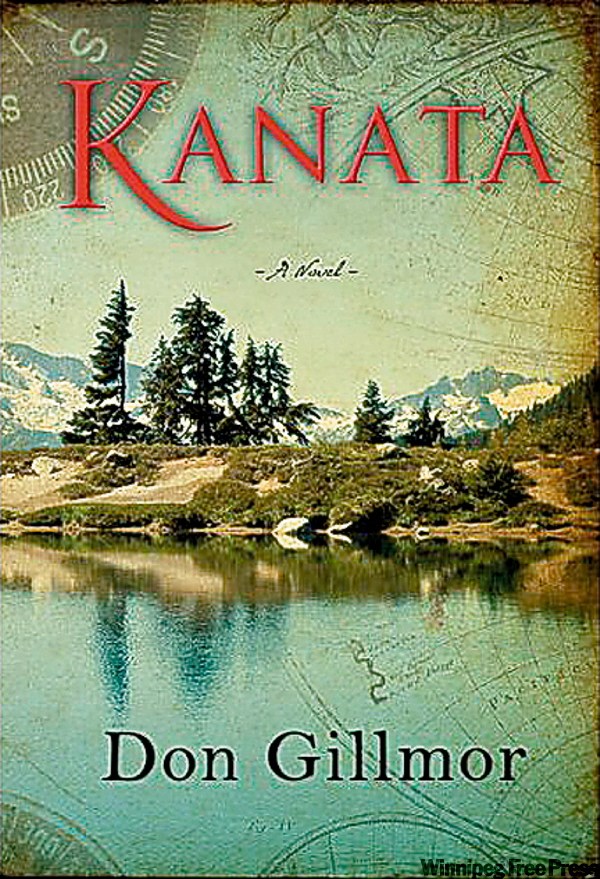
YOU certainly can’t fault Don Gillmor for lack of ambition.
The former Winnipegger’s debut novel is nothing less than an effort to capture all of Canada in one sprawling, heavily populated book, a maple-flavoured match for that Great American Novel, John Dos Passos’s U.S.A. (And to give Gillmor extra points for audacity, he aims to do in one book what took Dos Passos a trilogy.)
Kanata (the name comes from the Iroquois word for "village" that eventually became the name of our country) touches on pretty much every major chapter in Canadian history from the Plains of Abraham to 1967. Gillmor’s focus on history is no surprise, given that the Toronto-based author and journalist (and older brother of Free Press contributor Alison Gillmor) wrote the book version of CBC’s Canada: A People’s History.
Gillmor uses the life and thoughts of his protagonist, Michael Mountain Horse, the fictional great grandson of the fur trade mapmaker David Thompson, to reflect on Canada’s fate, caught between the imperial power of Great Britain and the U.S.
As the novel opens, Michael, a nearly septuagenarian history teacher, is meditating on his and Canada’s history as he waits at the bedside of a critically injured student.
Michael himself has lived through a few books’ worth of stories: Passchendaele; Edward Prince of Wales in his pre-Wallis Simpson days; Hollywood in the 1920s; the Regina Riot during the Depression; the Spanish Civil War; the great Leduc oil strike of 1947.
His busy character arc illustrates Gillmor’s thesis about Canada and empire. After working on the Alberta ranch of the Prince of Wales, Michael works for the legendary American film director King Vidor. Canada, like Michael, is a vassal to one or another kind of royalty.
Interspersed among his memories are vivid depictions of David Thompson, Sir John A. Macdonald and his aide James McIlvoy, Louis Riel, D’Arcy McGee, William Lyon Mackenzie King, Norman Bethune and John Diefenbaker.
Many of the stories touch on mapmaking. Maps, of course, are the essential tool of empire. They are also an abstraction imposed on the world and its people.
"Maps create reality," Sir John A. tells McIlvoy. "You see what is there and it ceases to be imagined."
Western Canada is created out of the maps Thompson made for the fur trade, but the reality on the ground is messier than the clean lines of a map.
Gillmor shows the consequences of the settlement and development of the West, in the disease and starvation experienced by Michael’s Blackfoot ancestors and in the ever-present violence among the oil rig workers.
He also suggests an alternative to the God’s-eye view of the mapmaker: the creation of a people through racial and cultural mixing.
The First World War segments, with two aboriginal brothers, one angry and damaged by his residential school experience, echo Joseph Boyden’s Three Day Road, while the Hollywood in the ’20s section is reminiscent of Guy Vanderhaeghe’s The Englishman’s Boy.

Fred Stenson fictionalized a similar period in fur trade history in The Trade. And, of course, musing on maps was a big part of Michael Ondaatje’s The English Patient.
There are few books, though, that can hold together so many disparate stories and see the combination of blind luck and tectonic inevitability that makes history. As a result, it’s a compelling work, despite the occasional lapse into overwriting. ("They got married in the lacuna that formed in the heat of August, an arid gap when everything was still.")
Kanata will make you feel a little less lost when you think of your place in Canada, and that’s really what a map is for.
Bob Armstrong is a Winnipeg playwright.