Oy gevalt, witty take on life needs better sense of plot

Advertisement
Read this article for free:
or
Already have an account? Log in here »
To continue reading, please subscribe:

Digital Subscription
One year of digital access for only $205*
- Enjoy unlimited reading on winnipegfreepress.com
- Read the E-Edition, our digital replica newspaper
- Access News Break, our award-winning app
- Play interactive puzzles
*First annual payment billed as $205.00 + GST for one year. This annual subscription will automatically renew at $233.00 + GST every 52 weeks (10% off the regular annual price of $259.35). Offer available to new and qualified returning subscribers only. Cancel any time.
To continue reading, please subscribe:
Add Free Press access to your Brandon Sun subscription for only an additional
$1 for the first 4 weeks*
- Enjoy unlimited reading on winnipegfreepress.com
- Read the E-Edition, our digital replica newspaper
- Access News Break, our award-winning app
- Play interactive puzzles
*Your next Brandon Sun subscription payment will increase by $1.00 and you will be charged $17.95 plus GST for four weeks. After four weeks, your payment will increase to $24.95 plus GST every four weeks.
Read unlimited articles for free today:
or
Already have an account? Log in here »
Hey there, time traveller!
This article was published 21/01/2012 (5308 days ago), so information in it may no longer be current.
NEW York-born author Shalom Auslander made his literary mark with his 2007 debut, The Foreskin’s Lament, a memoir of growing up in an Orthodox Jewish family.
At once a scathing indictment of the hypocrisy of religion and a hilarious account of the author’s inability to completely repudiate either it or the concept of an Old Testament punishing God, it was the work of a man who sweats the small stuff even though he understands the big picture.
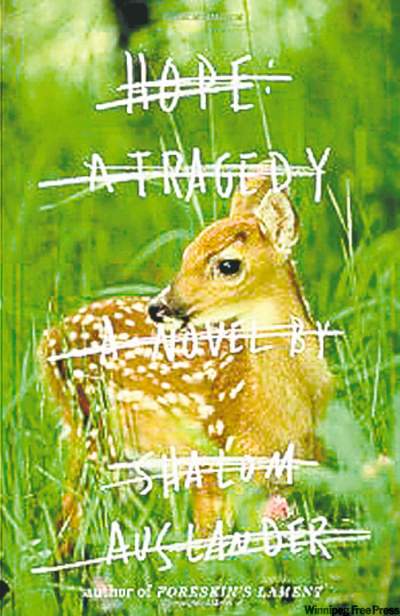
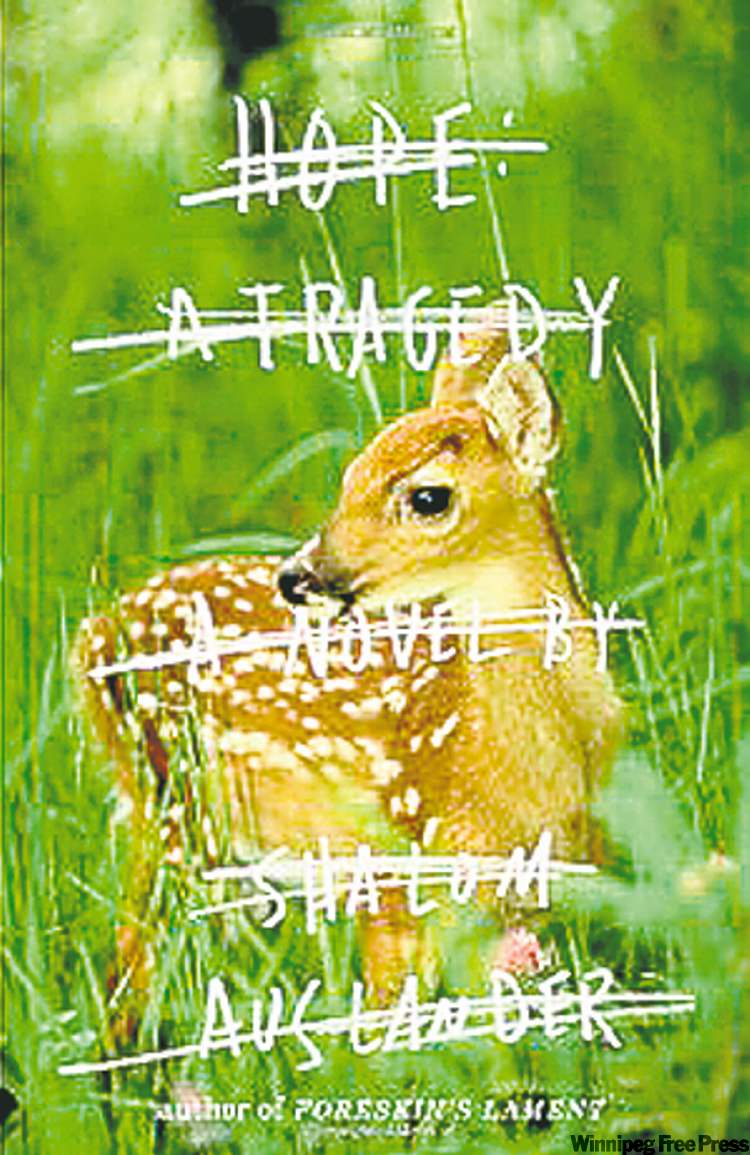
Auslander’s first novel (he has also written a short-story collection) doesn’t stray far from his wheelhouse. Hope: A Tragedy is a comedy about a conflicted, secular Jew trying to escape his history; both his personal past and the history of his people.
Solomon Kugel and his wife and young son have moved to a farmhouse in Stockton, N.Y., a place notable only for the fact that nothing notable has ever happened there.
Unfortunately, Kugel’s aging mother, whom doctors assure him is on the brink of death, has moved with him, and her moaning and bemoaning and “Oy gevalt”-ing are a constant reminder that fresh starts are impossible.
Kugel’s mother has survivor syndrome — except she was born in 1945 in America and never saw the inside of a death camp, except on a tour with her son.
And yet she clings to the twisted fantasy that her immediate family all perished in the camps and she torments her son with the notion that it could happen again.
“Where will we hide if they come for us?” she asks.
“Who?” says Kugel.
“Whoever,” she responds.
“This is your grandfather,” she says, brandishing a lampshade.
“It says ‘Made in Taiwan’,” Kugel protests.
“What, they’re going to write ‘Made in Buchenwald’?” she says.
And other things are amiss in Kugel’s world. There’s an arsonist targeting farmhouses in Stockton; a strange tapping is emanating from the heating vents (not to mention a stench); his son is frail and sickly; he’s in debt; and he suffers from gluten allergies.
And then he discovers the source of the tapping, which turns out to be the typing of a wizened old crone who claims to be a rather famous Holocaust victim.
Oy gevalt indeed.
The circumstances are obviously somewhat ridiculous, but they allow Auslander to do what he does best: question our existence, muse about the futility of dreams and generally kvetch.
Kugel visits a therapist, Dr. Jove, who counsels against hope in any form, pointing out that depressives are realists. The world is slowly but surely going to hell in a handbasket and to look for the good in mankind is pure folly.
Jove tells Kugel to visit the zoo’s monkey cage. “They’re terrifying, your greatest grandparents. Look at the warnings they post on the cages. .. No other species requires such caution as the one from which we came. They’re missing only one sign, the most important sign of all: Do Not Evolve From This Species.”

The novel is full of pithy, thoughtful observations and laugh-out-loud one-liners, but the plot itself is just a convenient framework from which the author can hang his existential meditations. The characters are at the mercy of his world view, only there to illustrate his points.
That’s not to say the book isn’t diverting, thought-provoking and, as the title indicates, tragic.
Auslander has a bitterly witty take on life that is utterly quotable but that goes beyond glib epigrams (although some of Kugel’s observations would look great embroidered on a pessimist atheist’s throw pillows).
It’s just that he needs a better sense of plot, and a stronger grasp of humanity, to make his story more than an embellished essay.
Jill Wilson is a Free Press copy editor.
Jill Wilson is the editor of the Arts & Life section. A born and bred Winnipegger, she graduated from the University of Winnipeg and worked at Stylus magazine, the Winnipeg Sun and Uptown before joining the Free Press in 2003. Read more about Jill.
Jill oversees the team that publishes news and analysis about art, entertainment and culture in Manitoba. It’s part of the Free Press‘s tradition, since 1872, of producing reliable independent journalism. Read more about Free Press’s history and mandate, and learn how our newsroom operates.
Our newsroom depends on a growing audience of readers to power our journalism. If you are not a paid reader, please consider becoming a subscriber.
Our newsroom depends on its audience of readers to power our journalism. Thank you for your support.
Book review
Hope: A Tragedy
- By Shalom Auslander
- Penguin Group, 304 pages, $31
Jill Wilson is the editor of the Arts & Life section. A born and bred Winnipegger, she graduated from the University of Winnipeg and worked at Stylus magazine, the Winnipeg Sun and Uptown before joining the Free Press in 2003. Read more about Jill.
Jill oversees the team that publishes news and analysis about art, entertainment and culture in Manitoba. It’s part of the Free Press‘s tradition, since 1872, of producing reliable independent journalism. Read more about Free Press’s history and mandate, and learn how our newsroom operates.
Our newsroom depends on a growing audience of readers to power our journalism. If you are not a paid reader, please consider becoming a subscriber.
Our newsroom depends on its audience of readers to power our journalism. Thank you for your support.
Related Articles
PAPER CHASE: Thomas to write in Berton House

Advertisement Advertise With Us
Advertisement Advertise With Us