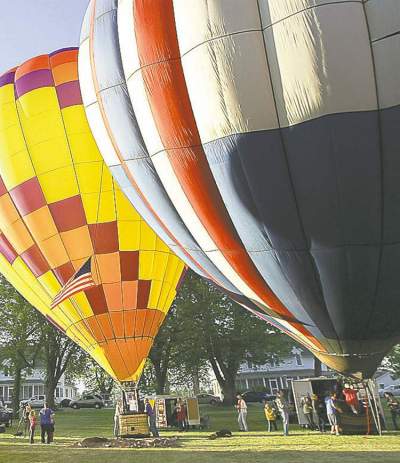
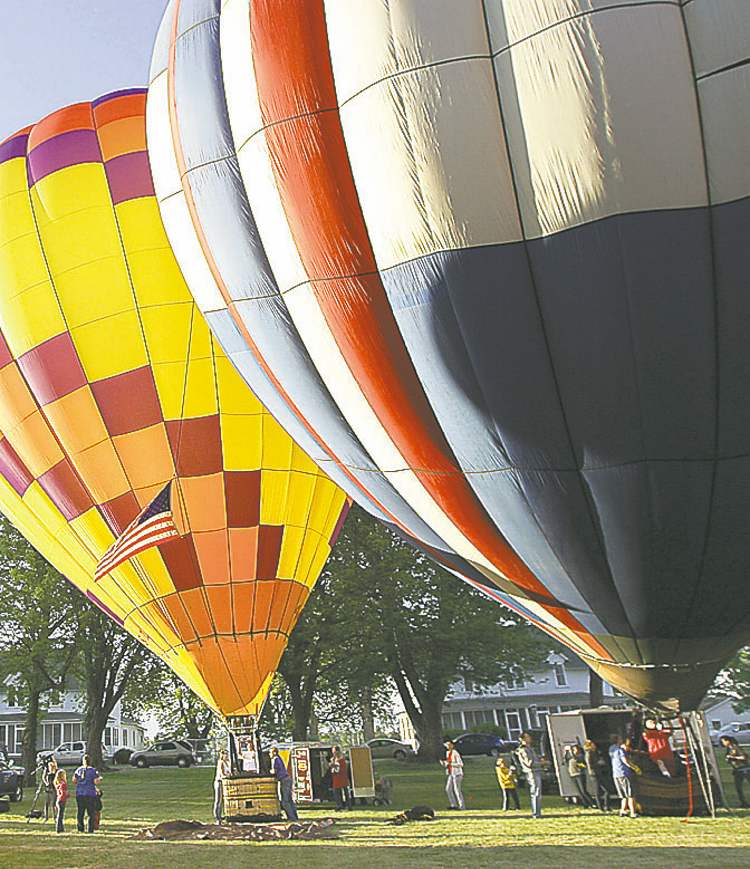
Sky-high balloons anchored to earthly history
Advertisement
Read this article for free:
or
Already have an account? Log in here »
To continue reading, please subscribe:
Digital Subscription
One year of digital access for only $1.44 a week*
- Enjoy unlimited reading on winnipegfreepress.com
- Read the E-Edition, our digital replica newspaper
- Access News Break, our award-winning app
- Play interactive puzzles
*Billed as $5.77 plus GST every four weeks. After 52 weeks, price increases to the regular rate of $19.95 plus GST every four weeks. Offer available to new and qualified returning subscribers only. Cancel any time.
To continue reading, please subscribe:
Add Free Press access to your Brandon Sun subscription for only an additional
$1 for the first 4 weeks*
- Enjoy unlimited reading on winnipegfreepress.com
- Read the E-Edition, our digital replica newspaper
- Access News Break, our award-winning app
- Play interactive puzzles
*Your next Brandon Sun subscription payment will increase by $1.00 and you will be charged $17.95 plus GST for four weeks. After four weeks, your payment will increase to $24.95 plus GST every four weeks.
Read unlimited articles for free today:
or
Already have an account? Log in here »
Hey there, time traveller!
This article was published 25/05/2013 (4893 days ago), so information in it may no longer be current.
One might be excused for thinking of a balloon in the sky, its basket high above the horizon, as a uniquely distant and detached thing.
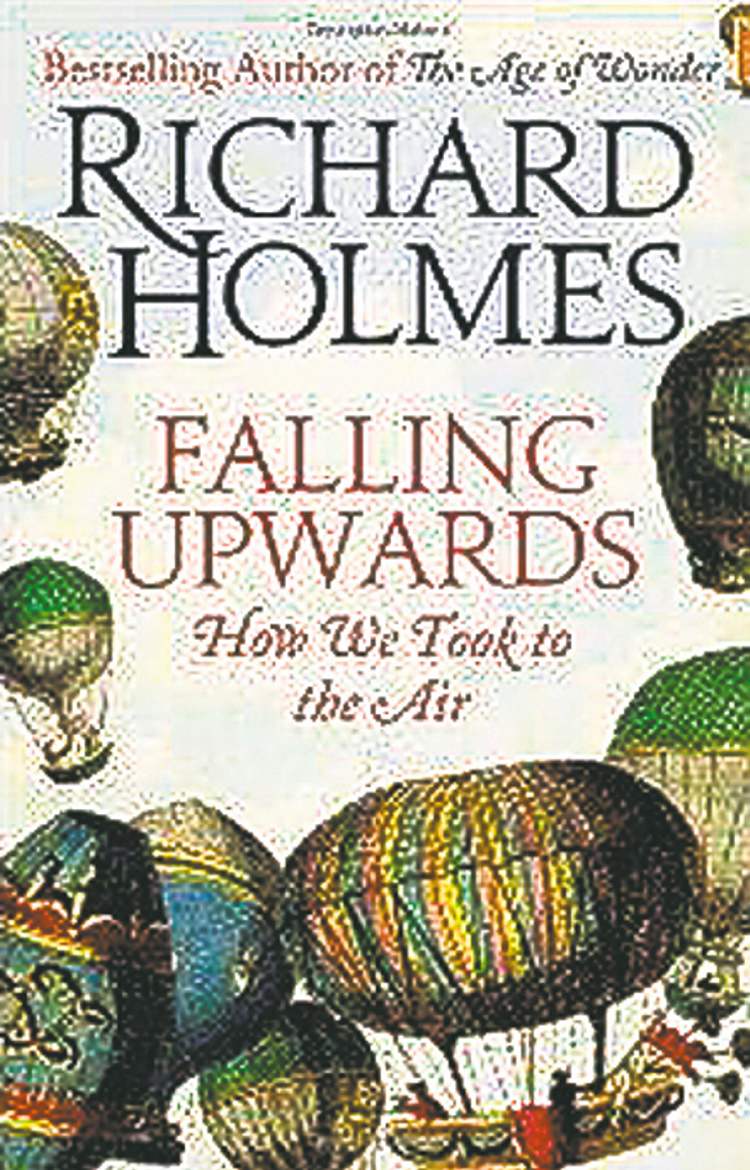
After all, a launched balloon seems above and apart from the grind of daily life. Falling Upwards, a fascinating new history of the dangerous early days of balloon flight, challenges this notion. Its author, British academic Richard Holmes, is intrigued by pioneers of ballooning and by their journeys to hazardous heights.
His accounts of these journeys show that balloons are best understood as tethered to earth, sometimes literally but always figuratively. Connecting ballooning to a wide range of political, technological and cultural developments, Holmes reminds us that balloons are anchored to history and that they bear the significant weight of the needs and desires of the innovative societies that built and launched them.
Holmes is a biographer who specializes in the Romantic era, the age of Keats, Coleridge and Wordsworth. His recent bestseller, The Age of Wonder, won Britain’s Royal Society Prize for science books, appealing to a wide readership with its engaging discussion of connections between literary and scientific developments. Holmes takes a similar approach in this book; his ability to mix the cultural and the scientific is on show throughout.
For instance, in a gutsy preface, Holmes shares some of the extraordinary things that have been said and written about ballooning, gathering together the bon mots of such major figures as Charles Dickens, Victor Hugo, George Sand, Benjamin Franklin and Charles Darwin. It’s a hard act to follow: these quotations create an appetite in readers for both poetic prose and carefully contextualized information. Holmes delivers on both counts.
His opening chapter is structured by a selection of engaging anecdotes, some from the recent past. One concerns a priest from Brazil who lost his life in 2008 to an ill-fated fundraising effort involving a chair and a thousand helium party balloons. Another describes the 1979 escape from East Germany of two families who worked together to secretly build a hot-air balloon. Huddled together on a flimsy platform, their only guardrail made of clothesline, they launched their homemade balloon under the cover of darkness and, with the youngest passenger in his mother’s arms, floated across the heavily guarded border to land safely in the West.
While recent history plays a part, the focus of the book is the first century and a half of ballooning, a practice that took on cultural prominence in the 1780s with widely reported on ascents of manned, gas-filled balloons. In the decades that followed, balloons were launched in pursuit of the thrill of flight but were also launched for more pragmatic reasons.
Pleasure, science and politics all play a role in the history of the balloon, a fact suggested by the payloads of early balloons, which consisted of things as varied as cases of champagne, fragile scientific and photographic equipment, bags of smuggled letters and propaganda pamphlets.
The book is illustrated and contains several stunning images of early ballooning. There are some wonderfully fanciful engravings but the photographs the book contains are particularly memorable.

Among them are a pair of photographs taken of a crash that grounded an ill-fated attempt to reach the North Pole by balloon. In 1897, a trio of Swedish adventurers set out to conquer the pole but things went badly, as is often the way with polar expeditions, and their remains were discovered three decades later.
Among the carefully wrapped up belongings found near their bodies were sealed tins of exposed film. The photographs produced from them were taken by the youngest member of the trio, Nils Strindberg, and they are haunting.
They show Strindberg’s fellow explorers examining their grounded balloon against a backdrop of white snow and low cloud, a painful portrait of the landscape that would claim their lives weeks later.
Holmes focuses on the dangers faced by others, but he took a noteworthy risk of his own when he decided to write a history of ballooning that is both surprisingly poetic and very personal. Achieving something that the cultural history genre aspires to but rarely achieves, Falling Upwards traces what might be dismissed as a fad but in doing so manages to transform our understanding of an age.
Vanessa Warne teaches English at the University of Manitoba.