Exiled journalist details three decades of unrest in Iran

Advertisement

Advertise with us

"What's your name?" asks journalist Nazila Fathi.

Read this article for free:


or

Already have an account? Log in here »

To continue reading, please subscribe:

Subscribe and receive a limited-edition Free Press branded hat or tote.

Digital Subscription

One year of digital access for only $205*

  • Enjoy unlimited reading on winnipegfreepress.com
  • Read the E-Edition, our digital replica newspaper
  • Access News Break, our award-winning app
  • Play interactive puzzles

*First annual payment billed as $205.00 + GST for one year. This annual subscription will automatically renew at $233.00 + GST every 52 weeks (10% off the regular annual price of $259.35). Offer available to new and qualified returning subscribers only. Cancel any time.

To continue reading, please subscribe:

Add Free Press access to your Brandon Sun subscription for only an additional

$1 for the first 4 weeks*

  • Enjoy unlimited reading on winnipegfreepress.com
  • Read the E-Edition, our digital replica newspaper
  • Access News Break, our award-winning app
  • Play interactive puzzles
Start now

*Your next Brandon Sun subscription payment will increase by $1.00 and you will be charged $17.95 plus GST for four weeks. After four weeks, your payment will increase to $24.95 plus GST every four weeks.

Hey there, time traveller!
This article was published 17/01/2015 (4222 days ago), so information in it may no longer be current.

“What’s your name?” asks journalist Nazila Fathi.

“We all have the same name,” replies the young female protester, “Iran.”

The year is 2009, and the streets of Tehran and cities across the country spill over with Iranians outraged by the obvious fraud in the election that has returned incumbent president Mahmoud Ahmadinejad to power. Their demand for a genuine democratic voice is the same demand Iranians have been making for generations.

HASAN SARBAKHSHIAN / The Candian Press files
Iranian women attend a funeral ceremony for the remains of the bodies of unidentified Iranian soldiers killed during the Iran-Iraq War of 1980-88, in Tehran, Iran on Monday Feb. 16, 2009.
HASAN SARBAKHSHIAN / The Candian Press files Iranian women attend a funeral ceremony for the remains of the bodies of unidentified Iranian soldiers killed during the Iran-Iraq War of 1980-88, in Tehran, Iran on Monday Feb. 16, 2009.

Students of Iranian history and armchair historians alike will be satisfied with Iranian-born New York Times reporter Nazila Fathi’s in-depth account of three extraordinary decades.

Drawing on news reports, YouTube videos, historical and academic sources, interviews, and her own detailed memories, Fathi pairs her personal story with the story of modern Iran, beginning with the overthrow of the shah in 1979, then as a young adult during the chaotic establishment of the new Islamic Republic of Iran, and finally as a reporter for the New York Times, forced to flee Iran in the events leading up to the Green Movement in 2009.

In a skilful balance of personal history and academic research, Fathi brings to life the complex social, economic and political upheaval of the transition from the shah of Iran’s western-oriented, oil-drunk secular society, to the Ayatollah Khomeini’s vision of a cloistered Shiite Islamic republic.

Fathi was eight in 1979 when a “teary-eyed shah” boarded a plane for Egypt, a plane he piloted himself, never to return. Fathi effectively contrasts her middle-class family’s suspicious reaction to Khomeini’s return from exile that year with that of their poor, uneducated housekeeper’s excited reverence. It is both prophetic and fatal that families like Fathi’s saw Khomeini’s promises as “outlandish,” while the poor and uneducated, like the housekeeper, believed Khomeini was “the savior of the poor.”

Fathi has had remarkable access to significant and diverse Iranian voices: scholars such as writer and philosopher Abdolkarim Soroush; insiders such as the Ayatollah Khomeini’s right-hand man Ali-Akbar Mohtashamipour; and activists such as feminist Nobel Peace Prize recipient Shirin Ebadi are all heard and considered here.

The result is a detailed, vivid chronicle of three decades of oppression, complex power struggle and, as Fathi makes clear, a people who will not be silenced.

The effect of the revolution and its aftermath on her fellow Iranians is Fathi’s primary focus. Fathi underscores an essential paradox of Iranian society by lining up stomach-wrenching details of the new Islamic Republic’s campaign to cleanse the mofsed-fel-arz (“corrupt on earth”), via torture and terror, alongside the domestic lives of average citizens quietly enjoying black-market VHS episodes of Baywatch.

For Westerners, perceptions of Iranian society may always be prejudiced by the iconic television images of the 444-day American hostage crisis, and Hollywood’s version of it: Argo. The jeering, cheering crowds astonished us: who are these people and why do they hate us? Yet Fathi allots it a mere two lines of attention.

Another crisis — a war with Iraq and Saddam Hussein — absorbed the attention of most Iranians.

Fathi’s analysis of the politicization and abuse of women through their clothing makes this book essential reading. Fathi was just 10 years old when obligatory veiling was passed into law. Forced into the black, head-to-toe chador that simultaneously symbolizes both tradition and revolution, her bitterness is palpable.

In the end, her work as a journalist for the New York Times makes her an enemy of her own government. In a dramatic conclusion, Fathi is warned that her “photo has been given to snipers.” She escapes to Canada with her husband and children.

The Lonely War makes an important, highly enjoyable contribution to the understanding of modern Iran.


Charlotte Duggan is a teacher librarian in Winnipeg.

History

Updated on Saturday, January 17, 2015 8:15 AM CST: Formatting.
Report Error Submit a Tip

More Stories

The true costs of your pet — for everyone

Jerry Storie 5 minute read Preview

The true costs of your pet — for everyone

Jerry Storie 5 minute read Yesterday at 2:00 AM CDT

Pets are a problem, but few will discuss the downsides of pet ownership.

Read
Yesterday at 2:00 AM CDT

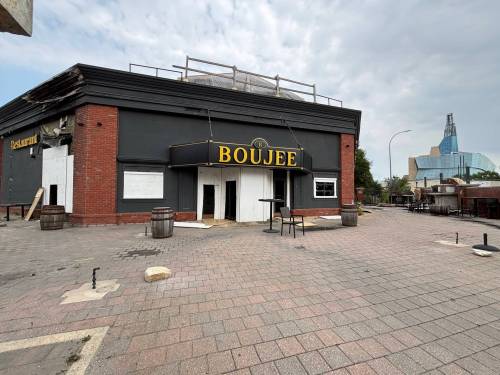
Main Street restaurant Boujee burns for the second time in one week

Aaron Epp 2 minute read Preview

Main Street restaurant Boujee burns for the second time in one week

Aaron Epp 2 minute read 3:15 PM CDT

A former restaurant on Main Street is set to be demolished after a fire broke out for the second time in less than a week.

Winnipeg Fire Paramedic Service crews responded to reports of a fire at Boujee Restaurant and Bar, a vacant, single-storey building on the 100 block of Main Street shortly before 6 a.m. Saturday. The same building was most recently damaged in a fire last Sunday.

At the scene, crews found heavy smoke coming from the building. After attacking the fire using aerial ladders that sprayed water from above, firefighters arranged an emergency demolition of the building. Demolition is expected to be completed today, the WFPS said in a news release.

No injuries were reported and the fire is under investigation.

Read
3:15 PM CDT

Trucking operation linked to fatality in Brandon shut down by Alberta government

Malak Abas 5 minute read Preview

Trucking operation linked to fatality in Brandon shut down by Alberta government

Malak Abas 5 minute read Yesterday at 5:24 PM CDT

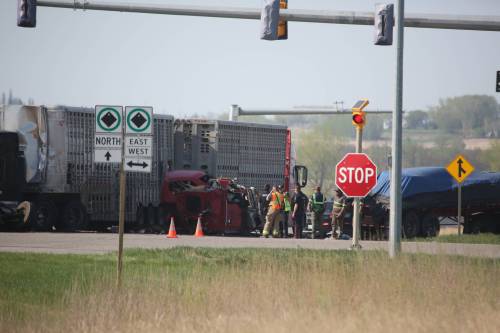
The Alberta government has shut down Conquer Transport Inc., the trucking company linked to a crash near Brandon in which a 49-year-old woman, who had the right of way, was killed.

Devin Dreeshen, Alberta’s transport minister, said the province launched an investigation into Conquer Transport after one of its semi-trucks ran a stop sign on May 27, 2026 at Highway 110 at Richmond Avenue East.

The semi hit an SUV driven by Xiaoyun Zhang, a Chinese immigrant who worked at the nearby pork processing plant. She died at the scene and the truck driver, 35-year-old Brijpal Panwar, has been charged with dangerous driving causing death.

“Our investigative team went out and … saw numerous non-compliance issues, whether it was hours of service with their drivers not being recorded properly, vehicle maintenance and inspections being insufficient, their safety program also being insufficient.”

Read
Yesterday at 5:24 PM CDT

The view from here: Phyllis Green. Boob Tree, 1975

2 minute read Preview

The view from here: Phyllis Green. Boob Tree, 1975

2 minute read 2:01 AM CDT

Staycation: The Art of Being Here feautres more than 100 Manitoba-related artworks from the Winnipeg Art Gallery-Qaumajuq collection, spanning the past 50 years. These pieces reveal how the places around us are layered with memory, story and lived experience. Over the coming weeks, the Free Press will spotlight works from this eclectic exhibition, each one offering a new way of seeing home. Experience it in person and enjoy some staycation time at the gallery, on view until December.

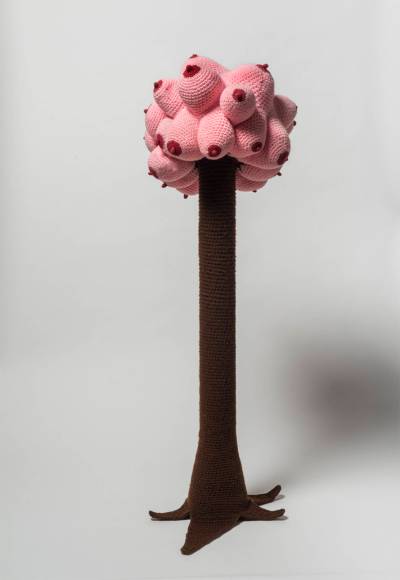
Phyllis Green. Boob Tree, 1975

(Yarn, wood. Collection of the Winnipeg Art Gallery; Acquired with funds from the Estate of Mr. and Mrs. Bernard Naylor, funds administered by The Winnipeg Foundation, 2014-128. Photo: Ernest Mayer.)

The year 1975 was designated International Women’s Year by the United Nations, and in celebration, the WAG staged the show Images of Women, which explored how women had historically been depicted, an impressive selection but by mostly male artists. Amid pushback from the community, Sharron Zenith Corne and Marian Yeo organized a second exhibition, Woman as Viewer, which challenged those portrayals by only featuring works by women. It was called the first Canadian exhibition of feminist art. American artist Phyllis Green’s Boob Tree, a four-foot-tall crochet sculpture of a cluster of breasts, adorned the exhibit posters, which were so popular they were snatched by passersby! The sculpture is playful and unsettling, re-appropriating the objectification of women’s bodies.

Read
2:01 AM CDT

50 years of rare tall grass prairie celebrated

Aaron Epp 4 minute read Preview

50 years of rare tall grass prairie celebrated

Aaron Epp 4 minute read 7:11 PM CDT

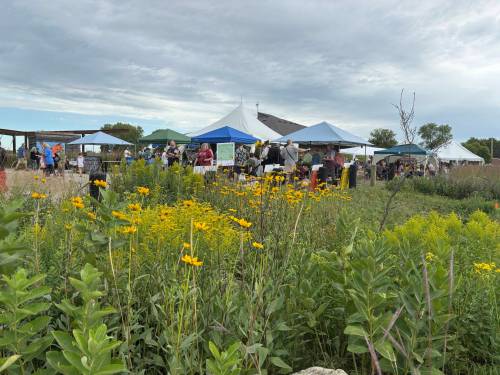
Kristin Bestvater is always glad when she heads to Winnipeg’s St. James neighbourhood and visits the Living Prairie Museum.

“It’s beautiful,” Bestvater said of the 13-hectare site, which is one of the last remaining tall grass prairies in North America. “I don’t know how many other cities would have something like this.”

The Island Lakes resident and her nine-year-old son were among the hundreds of people who gathered at the museum on Saturday to celebrate its 50th anniversary.

Designated a park in 1974, it officially became the Living Prairie Museum in 1976 with the opening of an interpretive centre which houses a gallery of exhibits, a gift shop and an observation deck.

Read
7:11 PM CDT

Lac du Bonnet slowly healing from devastating fire

Nicole Buffie 6 minute read Preview

Lac du Bonnet slowly healing from devastating fire

Nicole Buffie 6 minute read Yesterday at 6:32 PM CDT

LAC DU BONNET — Fifteen months after devastating wildfires ripped through Lac du Bonnet, claiming two lives and destroying more than a dozen homes, residents are trying their best to build back better.

Along the winding gravel path that is Wendigo Road outside Lac du Bonnet, new timber peeks through patches of charred forest. Homes and cottages are beginning to take shape after fire raced through the neighbourhood at record speed and levelled at least 18 homes on the road.

Table saws and nail guns ring in the distance while Brian Curtis plots out where his new cottage will go. Curtis bought his previous cottage 19 years ago and had recently levelled the foundation.

He and his wife, Pam, had been thinking about long-term renovations when the May 13, 2025 fire swept away all their work and memories.

Read
Yesterday at 6:32 PM CDT