Barrelling over falls brings family together

Advertisement
Read this article for free:
or
Already have an account? Log in here »
To continue reading, please subscribe:

Digital Subscription
One year of digital access for only $205*
- Enjoy unlimited reading on winnipegfreepress.com
- Read the E-Edition, our digital replica newspaper
- Access News Break, our award-winning app
- Play interactive puzzles
*First annual payment billed as $205.00 + GST for one year. This annual subscription will automatically renew at $233.00 + GST every 52 weeks (10% off the regular annual price of $259.35). Offer available to new and qualified returning subscribers only. Cancel any time.
To continue reading, please subscribe:
Add Free Press access to your Brandon Sun subscription for only an additional
$1 for the first 4 weeks*
- Enjoy unlimited reading on winnipegfreepress.com
- Read the E-Edition, our digital replica newspaper
- Access News Break, our award-winning app
- Play interactive puzzles
*Your next Brandon Sun subscription payment will increase by $1.00 and you will be charged $17.95 plus GST for four weeks. After four weeks, your payment will increase to $24.95 plus GST every four weeks.
Read unlimited articles for free today:
or
Already have an account? Log in here »
Hey there, time traveller!
This article was published 19/07/2016 (3728 days ago), so information in it may no longer be current.
Amy Jones’ debut novel We’re All in This Together is a whirlwind ride, blazing through four days in Thunder Bay, Ont. in a tale narrated by 10 characters connected to a single family.
At the book’s core is Serafina (Finn)Parker, working hard to live an unremarkable solitary life in a nondescript suburb of Toronto. Finn is called back to a complicated family situation she fled years earlier in Thunder Bay when her mother, Kate, goes over goes over Kakabeka Falls — “the Niagara of the North” — in a barrel, barely surviving and becoming a viral video sensation.
Once Finn returns to Thunder Bay, the book’s narration is shared among Finn and her father, her twin sister, her niece, her adopted brother, his wife, and others: in total 10 separate narrators, each with their own clear voice. The family members’ accounts layer, cross and converge, each person seeing the weekend’s events through the lens of their memories of past events.
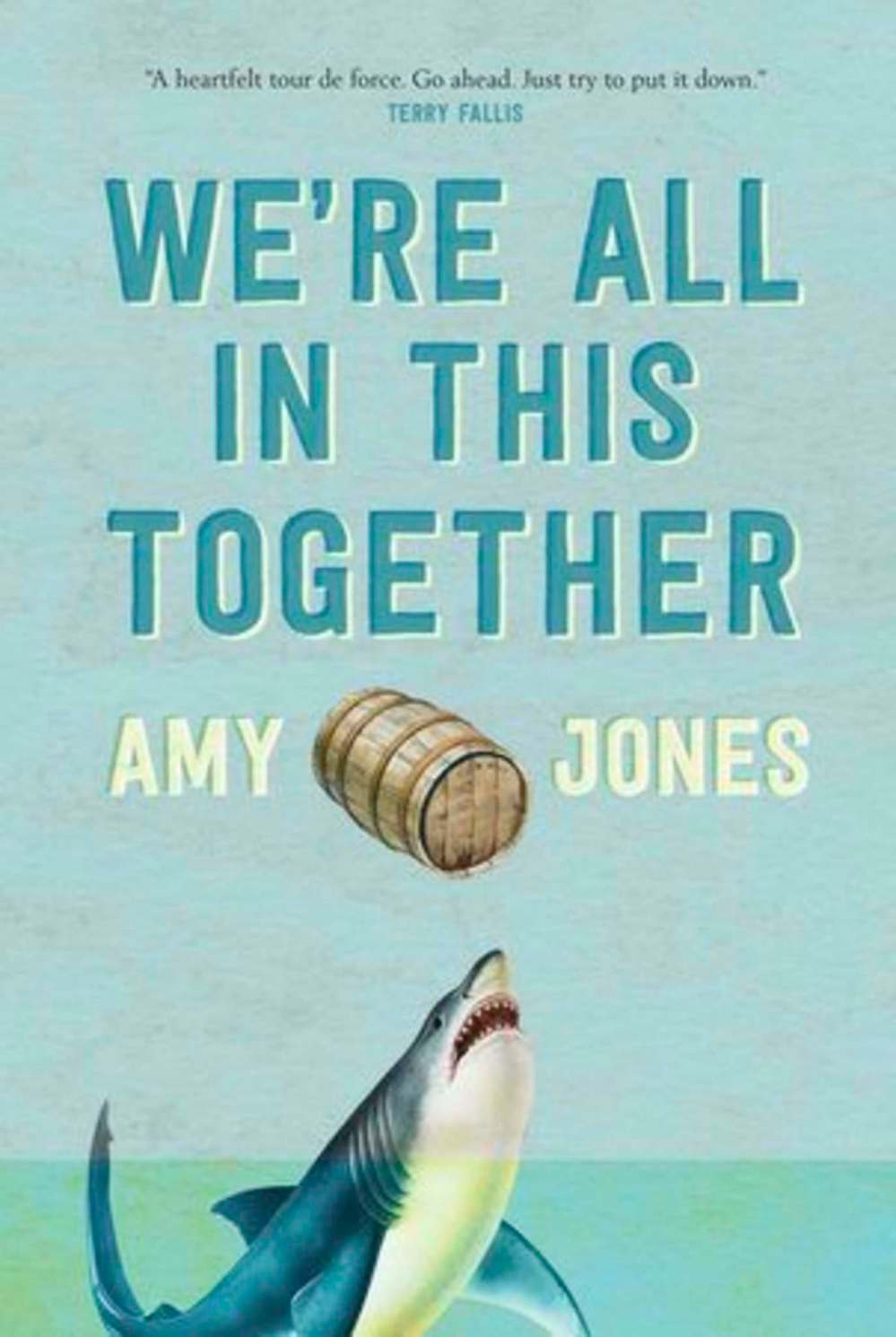
We’re All in This Together brings Thunder Bay to life so faithfully the reader could follow the characters’ steps on a map. Jones, a native of Halifax and only recently of Thunder Bay, does a beautiful job of bringing small-city living to life: “She is all about the downtown north core, that two-block radius of stores and restaurants that can make you feel like you’re in a real city until you realize you have walked the entire length of the neighbourhood in less than a minute,” she writes of one character’s commitment to condo living. “Still, if you never left that two-block radius, if you lived and worked and partied there, you might be able to forget where you are.”
Jones draws her characters in bold strokes: all are three-dimensional individuals who sometimes try to do their best, but whose actions are also often motivated by rage or loss, jealousy or fear.
Beyond Kate and Finn, fully half of the book’s narrators are modern female protagonists in the Gone Girl/ Girl on the Train vein: conflicted, sometimes foul-mouthed women who work to balance what society expects of them with that they want for themselves.
Indeed, the strength of the women characters shines a light on perhaps the only quibble with the complex narrative structure: the lack of explanation of what a couple of key male characters are thinking. Among the detailed accounting of the memories and thought processes of so many people, Finn’s ex-boyfriend and brother-in-law appear in silhouette, the reader left to guess at their motivations.
While dealing with the acute problem of Kate’s trip over the waterfall, the Parker family is struggling to come to terms with her worsening dementia. Kate herself strives to hide her condition from her family, while her husband and children deal with the spectre of the decline of the family matriarch while doing their best to pretend it’s not happening.
Kate’s particular illness — semantic dementia, which causes sufferers to lose language skills — is shared by Jones’ mother in real life, and some of the the book’s most resonant writing is in Kate’s voice as she navigates her new mental landscape: “Kate begins to remember little snippets from the previous day… There was a drive, the girl, something about a sandwich. A deer. The girl is searching for someone. The girl is her granddaughter. Her name is on the tip of Kate’s tongue.” The view from inside Kate’s head is bewildering; the reader roots for her.
Jones takes a messy knot of a family and carefully draws out each strand, examining the way it connects with the others. The result is a nuanced examination of the ties that bind a family together.
Wendy Sawatzky is associate editor digital news for winnipegfreepress.com and commander-in-chief at wendysawatzky.com.
Wendy Sawatzky
Associate Editor Digital News
Wendy Sawatzky is associate editor of digital news for the Free Press. A born-and-bred Manitoban, she has degrees from the University of Winnipeg and the University of King’s College. She joined the Free Press in 2008. Read more about Wendy.
Wendy oversees the team that publishes news on the Free Press’s website and apps. It’s part of the Free Press‘s tradition, since 1872, of producing reliable independent journalism. Read more about Free Press’s history and mandate, and learn how our newsroom operates.
Our newsroom depends on a growing audience of readers to power our journalism. If you are not a paid reader, please consider becoming a subscriber.
Our newsroom depends on its audience of readers to power our journalism. Thank you for your support.
We’re All In This Together
By Amy Jones
McClelland & Stewart, 417 pages, $25
Wendy Sawatzky
Associate Editor Digital News
Wendy Sawatzky is associate editor of digital news for the Free Press. A born-and-bred Manitoban, she has degrees from the University of Winnipeg and the University of King’s College. She joined the Free Press in 2008. Read more about Wendy.
Wendy oversees the team that publishes news on the Free Press’s website and apps. It’s part of the Free Press‘s tradition, since 1872, of producing reliable independent journalism. Read more about Free Press’s history and mandate, and learn how our newsroom operates.
Our newsroom depends on a growing audience of readers to power our journalism. If you are not a paid reader, please consider becoming a subscriber.
Our newsroom depends on its audience of readers to power our journalism. Thank you for your support.
Advertisement Advertise With Us
Advertisement Advertise With Us