Manhattan murder mystery a real-life marvel

Advertisement

Advertise with us

It’s 6:30 on a Sunday morning — Oct. 24, 1943. The story begins with the victim, 22-year-old Patricia Burton Lonergan; rich, pretty, vivacious, possessor of an insatiable appetite for the finer things in life. The reader is left outside the locked bedroom door of her lush New York brownstone with a mysterious sense of dread. The body of “Patsy,” bloody and brutalized by blows from matching heavy candelabras, will not be discovered for many hours.

Read this article for free:


or

Already have an account? Log in here »

To continue reading, please subscribe:

Subscribe and receive a limited-edition Free Press branded hat or tote.

Digital Subscription

One year of digital access for only $205*

  • Enjoy unlimited reading on winnipegfreepress.com
  • Read the E-Edition, our digital replica newspaper
  • Access News Break, our award-winning app
  • Play interactive puzzles

*First annual payment billed as $205.00 + GST for one year. This annual subscription will automatically renew at $233.00 + GST every 52 weeks (10% off the regular annual price of $259.35). Offer available to new and qualified returning subscribers only. Cancel any time.

To continue reading, please subscribe:

Add Free Press access to your Brandon Sun subscription for only an additional

$1 for the first 4 weeks*

  • Enjoy unlimited reading on winnipegfreepress.com
  • Read the E-Edition, our digital replica newspaper
  • Access News Break, our award-winning app
  • Play interactive puzzles
Start now

*Your next Brandon Sun subscription payment will increase by $1.00 and you will be charged $17.95 plus GST for four weeks. After four weeks, your payment will increase to $24.95 plus GST every four weeks.

Hey there, time traveller!
This article was published 02/01/2021 (2049 days ago), so information in it may no longer be current.

It’s 6:30 on a Sunday morning — Oct. 24, 1943. The story begins with the victim, 22-year-old Patricia Burton Lonergan; rich, pretty, vivacious, possessor of an insatiable appetite for the finer things in life. The reader is left outside the locked bedroom door of her lush New York brownstone with a mysterious sense of dread. The body of “Patsy,” bloody and brutalized by blows from matching heavy candelabras, will not be discovered for many hours.

Patsy was a flamboyant member of the city’s Cafe Society — a culture in which the wealthy smoked, drank and danced all night, and often slept guiltlessly through the next day.

But the future heiress is not the focus of this true crime story. The spotlight shifts quickly to a possible suspect in her murder: Patsy’s Canadian husband of two years, Wayne Lonergan. Their marriage had dissolved acrimoniously not long before she was bludgeoned to death.
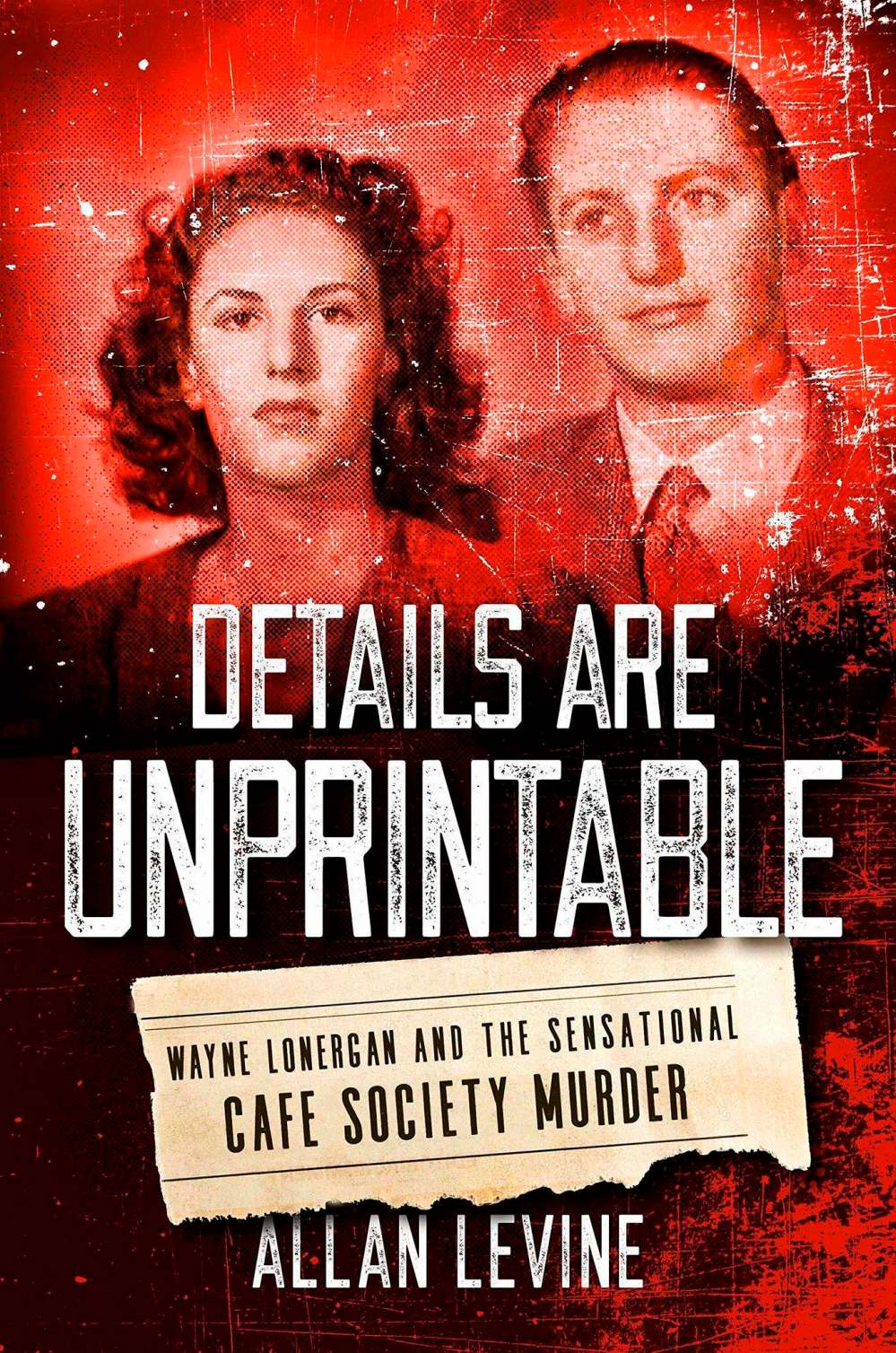
Winnipeg writer Allan Levine, noted scholar, prolific social historian and Winnipeg Free Press columnist, was looking for a new story to tell when he stumbled across a 1948 issue of Cosmopolitan magazine online. In it, master crime writer Raymond Chandler had cited “The Ten Greatest Crimes of the Century” which included the murder of Patricia Burton. Levine had found the crime, the characters and the criminal he was seeking.

After more than seven decades, the Lonergan case still offers everything to readers of non-fiction who want to be to shocked, appalled and frightened while remaining in the comfort and safety of their own homes. Details Are Unprintable is the classic legal procedural, with the bonus of Levine’s exceptional ability to see and explain what a single story says about an entire society.

The Lonergans were a handsome couple and neither of them had jobs, but otherwise they were a study in contrasts. She was wealthy, while he depended completely on her for both money and status. They both loved clubbing, seeing and being seen, yet each seemed to resent the pleasure of the other. Rumours circulated about Wayne’s sexual orientation; it was believed he was the former lover of Patsy’s bisexual father, the latter having introduced Wayne into the luxurious New York “high society” and to his daughter.

But Levine’s interest in the Lonergan story is much broader than mere divorce and murder among the glamorous. He deftly captures the ambiance of New York in 1930s and ’40s, including the little-known and complex anti-Semitism of a city now celebrated worldwide for Jewish leadership and culture. Levine’s research reveals that media coverage of the murder, the marriage and the trials (there were two) was so sensational and spellbinding that it briefly knocked the Second World War off the front pages of newspapers around the world. It was, as Levine suggests, a show “bigger than Broadway.”

Ultimately, Wayne Lonergan was found guilty of murdering his wife and spent the next 22 years of his life in jail, some of it in the notorious Sing Sing prison. Yet there was not a shred of physical evidence linking him to the crime.

How could that happen? In answering that question, Details Are Unprintable provides a heart-wrenching reminder of former grotesque attitudes towards any sexual orientation other than righteous heterosexuality.

Much of the media interest in the case stemmed from the likelihood that Lonergan was a closeted homosexual. In that era, homosexuality was regarded as criminal perversion, perhaps more loathsome than the communist hiding under the bed.

Lonergan appears to have confessed to the crime of murder in order to stop his public humiliation; he claimed he simply wanted to end his shaming. He later recanted this confession, but it was too late. The jury seemed eager to punish him.

Was Wayne Lonergan guilty? Levine has a convincing answer, but to share it would be a major spoiler.

On his release from prison in 1965, Lonergan was deported to Canada. Returning to Toronto, he caught the sympathetic attention of journalist Scott Young, father of musician Neil Young, and appeared on the edgy CBC TV show This Hour Has Seven Days. He also caught the attention of Canadian actress and comedian Barbara Hamilton, who became his companion and provided his financial support until his death from cancer in 1986.

Wayne Lonergan told the Globe and Mail in 1972 that “There’s a really good book in this incident.” He was correct, and Details Are Unprintable is that book.

Lesley Hughes is a Winnipeg writer.

Report Error Submit a Tip

More Stories

Rainbow Stage star relates to Elle Woods’ perseverance

Ben Waldman 4 minute read Preview

Rainbow Stage star relates to Elle Woods’ perseverance

Ben Waldman 4 minute read 5:00 AM CDT

Nearly 9,000 aspiring barristers and solicitors cross their fingers and send in their LSAT scores to Harvard University each year, but less than 10 per cent of applicants wind up on campus in Cambridge, Mass.

In Legally Blonde, the musical opening tonight at Rainbow Stage, Elle Woods (Claire Mac Master) defies the undercutting judgment of her blue-blood boyfriend Warner (Duncan Cox) to earn a spot in the Ivy League, leaving her doubters aghast and crimson-faced.

“What?” asked Elle — played by Reese Witherspoon in the 2001 film version — “Like it’s hard?”

The New York-born Mac Master never had any aspirations to pursue a law career, but can relate to her character’s plucky self-determination based on her experience at Toronto Metropolitan University’s undergraduate acting program, which accepts 25 applicants each year from an international pool of hundreds.

Read
5:00 AM CDT

Differing goals of religion, politics

John R. Wiens 5 minute read 2:00 AM CDT

Kudos to David Driedger for modelling a more appropriate and constructive role for religion in politics than the one that has become commonplace today (“Take care of them; there is enough”, Think Tank, July 27).

Resisting the temptation to preach, coerce and control, he has chosen to remind, persuade and challenge. It could hardly more different to what we are witnessing everyday to the south of us. I thank him for his humility, courage and sense of responsibility to humanity.

Our recent experiences with religion’s forays into the political realm, both in the U.S. and parts of Canada have done little to endear us to either one. Religious fundamentalism, in its many forms, has wrought untold havoc on governments across the globe, with some of the most toxic iterations being right on our doorsteps — we might even call it a form of domestic terrorism.

In the U.S., Christian nationalism, represented by MAGA, has contaminated government and ordinary lives like a hazardous toxin escaping containment — corroding and poisoning the presidency, the legislature, the court system and law enforcement, and in the process threatening the very relationships which make a civilized society possible. Simply put, the positive ideal of godliness in the American constitution, which emphasized tolerance for, acceptance of and upheld the equal worth of all peoples is in peril.

Manhattan murder mystery a real-life marvel

Reviewed by Lesley Hughes 5 minute read Preview

Manhattan murder mystery a real-life marvel

Reviewed by Lesley Hughes 5 minute read Saturday, Jan. 2, 2021

It’s 6:30 on a Sunday morning — Oct. 24, 1943. The story begins with the victim, 22-year-old Patricia Burton Lonergan; rich, pretty, vivacious, possessor of an insatiable appetite for the finer things in life. The reader is left outside the locked bedroom door of her lush New York brownstone with a mysterious sense of dread. The body of “Patsy,” bloody and brutalized by blows from matching heavy candelabras, will not be discovered for many hours.

Patsy was a flamboyant member of the city’s Cafe Society — a culture in which the wealthy smoked, drank and danced all night, and often slept guiltlessly through the next day.

But the future heiress is not the focus of this true crime story. The spotlight shifts quickly to a possible suspect in her murder: Patsy’s Canadian husband of two years, Wayne Lonergan. Their marriage had dissolved acrimoniously not long before she was bludgeoned to death.

Winnipeg writer Allan Levine, noted scholar, prolific social historian and Winnipeg Free Press columnist, was looking for a new story to tell when he stumbled across a 1948 issue of Cosmopolitan magazine online. In it, master crime writer Raymond Chandler had cited “The Ten Greatest Crimes of the Century” which included the murder of Patricia Burton. Levine had found the crime, the characters and the criminal he was seeking.

Read
Saturday, Jan. 2, 2021

A new chapter: Renamed Winnipeg Book Festival takes to The Forks this fall

Ben Sigurdson 5 minute read Preview

A new chapter: Renamed Winnipeg Book Festival takes to The Forks this fall

Ben Sigurdson 5 minute read Tuesday, Aug. 11, 2026

Winnipeg’s long-running annual literary festival returns this fall, once again featuring a slate of authors, local and beyond, ready to engage with readers.

New this year is pretty much everything else, including a new name, executive director and team of staff — as well as a shift to a tight, condensed timeline and a move to hold all events under one roof.

The festival formerly known as Thin Air/Livres en fête is now the Winnipeg Book Festival; the event takes place Oct. 1-4 at The Forks Market, with most events offering free admission.

It’s a lot of changes for the stalwart literary festival, which was run for more than two decades by Charlene Diehl, who stepped away in late 2025.

Read
Tuesday, Aug. 11, 2026

Meeting shines spotlight on internet safety

Maggie Macintosh 5 minute read 3:00 AM CDT

Concerns about status-quo literacy curriculum and website terms-of-service were repeatedly raised at a public consultation on how the provincial government can better protect internet users.

Roughly 50 people gathered in Winnipeg to weigh-in on how local governments should regulate personal data collection and artificial intelligence on Wednesday.

“The average person that selects ‘cookies’ has no idea what that means,” said Alan Campbell, a father of two and longtime school trustee who attended the evening event at St. Vital’s Norberry-Glenlee Community Centre.

Manitoba’s innovation and new technology department has hired KPMG to collect feedback and compile a report on recommendations for future AI use and cybersecurity incident reporting in the public sector.

A Winnipeg home with a mountain view? You won’t find a real one, but AI-generated visual suggests otherwise

Gabrielle Piché 6 minute read Preview

A Winnipeg home with a mountain view? You won’t find a real one, but AI-generated visual suggests otherwise

Gabrielle Piché 6 minute read Tuesday, Aug. 11, 2026

Manitoba’s mountain range peeked out behind a Scotia Street home.

At least, it did in a photo attached to a real estate listing for 232 Scotia St. in Winnipeg’s (flat) Seven Oaks neighbourhood.

Another picture — now removed — showed a cartoon cityscape viewable from the bungalow’s front porch.

Both photos had tags in their bottom left corners: “AI-generated content.”

Read
Tuesday, Aug. 11, 2026