Near-future pandemic story packs a punch

Advertisement

Advertise with us

Robert McGill’s second novel, 2013’s Once We Had a Country, was one of those books that should have sat high on all the Canadian prize shortlists. A wise, uncompromising novel, it is set during the time of the Vietnam War, as a young would-be filmmaker and her draft-dodging boyfriend start a commune in Canada, and then watch their utopian dream slowly implode.

Read this article for free:


or

Already have an account? Log in here »

To continue reading, please subscribe:

Subscribe and receive a limited-edition Free Press branded hat or tote.

Digital Subscription

One year of digital access for only $205*

  • Enjoy unlimited reading on winnipegfreepress.com
  • Read the E-Edition, our digital replica newspaper
  • Access News Break, our award-winning app
  • Play interactive puzzles

*First annual payment billed as $205.00 + GST for one year. This annual subscription will automatically renew at $233.00 + GST every 52 weeks (10% off the regular annual price of $259.35). Offer available to new and qualified returning subscribers only. Cancel any time.

To continue reading, please subscribe:

Add Free Press access to your Brandon Sun subscription for only an additional

$1 for the first 4 weeks*

  • Enjoy unlimited reading on winnipegfreepress.com
  • Read the E-Edition, our digital replica newspaper
  • Access News Break, our award-winning app
  • Play interactive puzzles
Start now

*Your next Brandon Sun subscription payment will increase by $1.00 and you will be charged $17.95 plus GST for four weeks. After four weeks, your payment will increase to $24.95 plus GST every four weeks.

Hey there, time traveller!
This article was published 25/06/2022 (1563 days ago), so information in it may no longer be current.

Robert McGill’s second novel, 2013’s Once We Had a Country, was one of those books that should have sat high on all the Canadian prize shortlists. A wise, uncompromising novel, it is set during the time of the Vietnam War, as a young would-be filmmaker and her draft-dodging boyfriend start a commune in Canada, and then watch their utopian dream slowly implode.

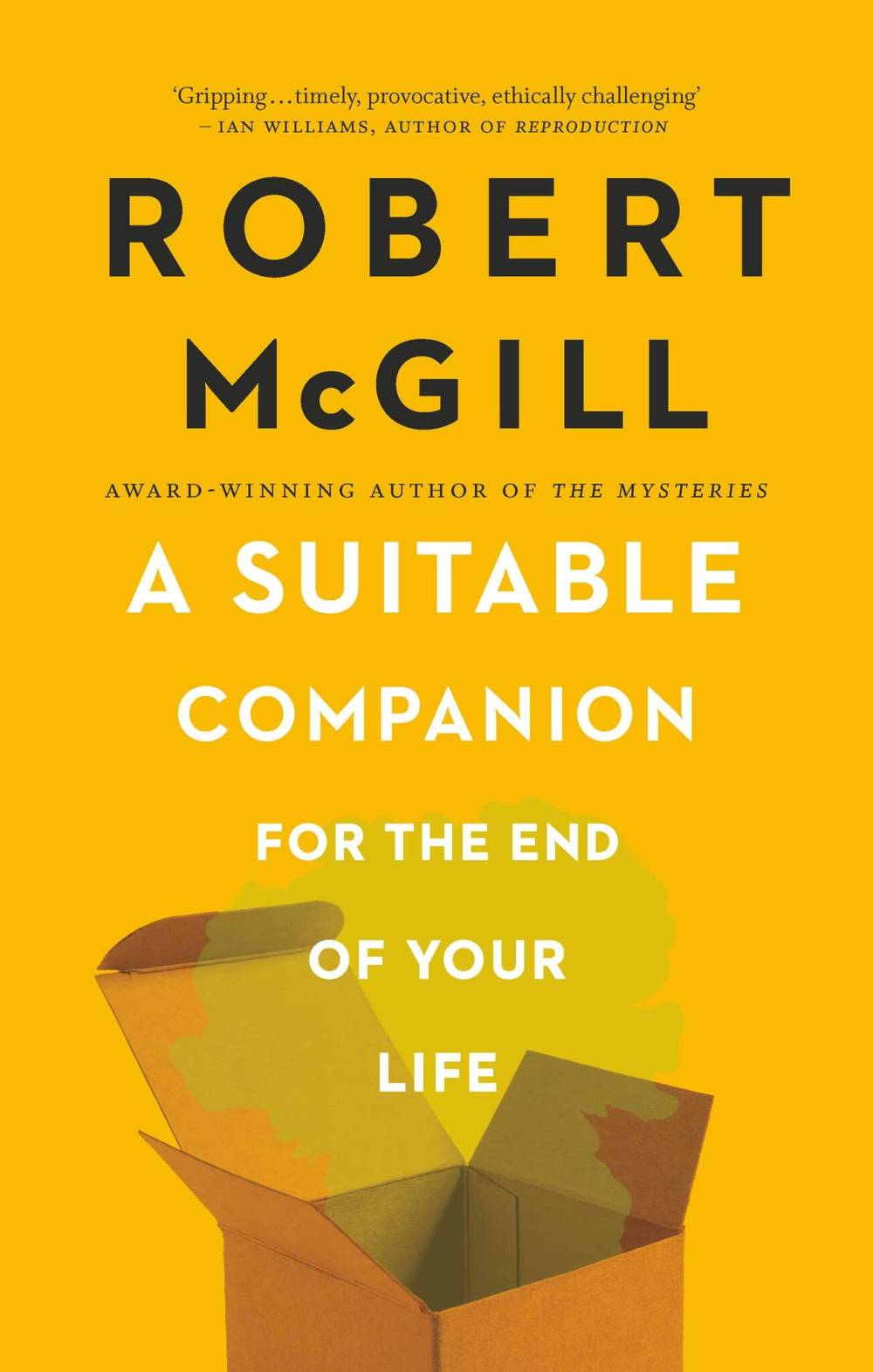
A Suitable Companion for the End of Your Life, a much slimmer book, still packs a punch. McGill once again lets his characters struggle with the kinds of moral problems that make his work so compelling. But this time, instead of looking back to 1972 before his birth, he looks forward into a near-future.

The novel takes place in Tkaronto — the place names (Oronhyatekha, Wonscotonach Valley) having been indigenized, though Rosedale is still hanging onto its old name. In McGill’s future, 18-year-old Regan wants to die. Her selfish father wants to escape drug rehab, her mother remains distant in both senses of the word, and Regan herself feels that she is nowhere. Choosing among the online suicide options, she orders a flatpack to be delivered to her home.
A Suitable Companion for the End of Your Life

Flatpacks are McGill’s black-humour updating of cryogenics. If you’re an Eastern European dying of a plague — “the worm” — you can pay to have your body undergo a chemical process that deflates you like a leftover Christmas yard ornament and sends you to the West. In A Suitable Companion, the hope is that once a cure for “the worm” is found you can be reinflated, cured and continue merrily on your way. Of course, it’s mostly people from poorer countries who need flatpacking.

Re-animation commences when someone blows into a little spigot behind the flatpack’s ears. But the flatpacks also apparently exude fatal gases; bad news for most blowers, good news for potential suicides.

To Regan, a flatpack seems, an easy route to a painless death; the seller has assured her flatpacks don’t remember their pasts, so she doesn’t think of these sacks as persons. But Ülle, the flatpack who is deposited at Regan’s door, starts calling Regan “Mama,” and then recovers bits of her past life.

Through “the worm,” McGill makes visceral and distressful the global division between haves (able to depend on strong health-care systems) and have-nots (who can’t evade “the worm”). He is at his best with the slow awakening of Ülle to consciousness, and with the moral struggle in Regan as she recognizes this peculiar immigrant as a person. Although Regan initially grapples with assisted suicide, her awareness slowly expands from justifiable self-centred concerns to questions of human rights, as she begins to see past her own troubles.

The novel is told both through Regan and through a woman who recounts Ülle’s life, and whose identity is a mystery until the very end. In Ülle’s section, we see what might make flatpacking enticing even for those without “the worm”: the difficulty of making a living, familial control, and videos of flatpacked people “being cared for by American families” and “cavorting with dogs and children.”

In its last quarter, the novel veers into thriller territory — exciting, but not necessarily a recommendation. The real interest lies in Regan and Ülle’s surprising, yet convincing, development of a surrogate mother/daughter relationship. That’s where McGill delivers.

Reinhold Kramer is a Brandon University English professor. His most recent book is Are We Postmodern Yet? And Were We Ever?


Report Error Submit a Tip

More Stories

Creative powerhouse Perry Rosemond never lost Winnipeg roots

Ben Waldman 7 minute read Preview

Creative powerhouse Perry Rosemond never lost Winnipeg roots

Ben Waldman 7 minute read Yesterday at 6:00 AM CDT

He created King of Kensington, directed the troops in the Royal Canadian Air Farce, and his creative eye was behind the lens for television shows starring Johnny Cash, Tom Jones, Mr. Dress-Up and the Friendly Giant.

He also wrote and developed the Canadian version of Sesame Street during his time as the head of school and preschool programming for CBC in Toronto, and directed a televised special in 2002 for Winnipeg sketch comedy troupe Royal Liechtenstein Theatre Company.

But before his name featured in the credits of some of the most iconic and influential pieces of the Cancon canon, Perry Rosemond was an only child living in a crammed, multi-generational home in Winnipeg’s North End, racing each day to beat the morning bell next door at William Whyte School.

In memoirs that have yet to be published, the late television producer recalled his childhood. “(T)here were 14 of us in the house at 193 Andrews St., and it wasn’t that big of a house,” he writes.

Read
Yesterday at 6:00 AM CDT

Puzzles Palace

1 minute read Monday, Jul. 27, 2026

To solve our puzzles, please subscribe with this special offer: |

Volunteer pop-up library axed from Manitoba Youth Centre

Matthew Frank 4 minute read Preview

Volunteer pop-up library axed from Manitoba Youth Centre

Matthew Frank 4 minute read Updated: Yesterday at 11:25 AM CDT

Manitoba Corrections has cancelled a pop-up library program at the Manitoba Youth Centre, leaving inmates without librarian services and fewer options to borrow certain books.

The Prison Libraries Committee, part of the non-profit Manitoba Library Association, operated and funded the volunteer program since 2024 before it was shut down by the province last month. The group previously partnered with the province to offer the service because the facility has no dedicated library of its own.

“It is concerning that community members who are incarcerated, especially youth, are losing out on meaningful programming, access to information and rehabilitation efforts, which are offered at no cost to (Manitoba) Corrections. We urge Manitoba Justice to promote more library services and programming, not less,” said a Sept. 24 letter from the non-profit addressed to the justice minister.

Ashley Huot, chair of the Prison Libraries Committee, said she was puzzled when she received an email last month from Manitoba Corrections stating that the pop-up library was no longer needed.

Read
Updated: Yesterday at 11:25 AM CDT

Record participation, funds raised in 2026 breast cancer awareness race

Maggie Macintosh 4 minute read Preview

Record participation, funds raised in 2026 breast cancer awareness race

Maggie Macintosh 4 minute read Updated: 7:08 PM CDT

It’s become a tradition for the West End Legends to gather, get dressed up in hot pink and gab about their late girlfriend on the first Sunday of Breast Cancer Awareness Month.

“Mary was a beauty, a brain, an athlete and a friend,” said Linda Opalko, a 67-year-old member of the fundraising team founded in honour of Mary Stawychny.

Stawychny’s last breath was taken the same day the group — made up of friends the career teacher maintained since she grew up on Ingersoll Street more than 50 years ago — got together for the 2022 CIBC Run for the Cure.

“We were walking as she was leaving us four years ago,” Opalko said as she and fellow fundraisers strolled down Wellington Crescent on Sunday morning.

Read
Updated: 7:08 PM CDT

Six high school hockey programs ceased operations following new Hockey Manitoba policy

Joshua Frey-Sam 7 minute read Preview

Six high school hockey programs ceased operations following new Hockey Manitoba policy

Joshua Frey-Sam 7 minute read Friday, Oct. 2, 2026

She lived the best of both worlds.

For the last three years, the 17-year-old wore a sweater for two different hockey programs — her high school team and AAA club in the Manitoba Female Hockey League — and was preparing to flourish in both colours again this winter.

Recently, however, the blue-liner was disappointed to learn she is no longer eligible to play her Grade 12 season with her school owing to a new policy imposed by Hockey Manitoba that bans players from participating in the Manitoba Women’s High School Hockey League if they are rostered on a U18 AAA team.

The rule applies to all athletes who play for both Winnipeg-based and rural AAA teams.

Read
Friday, Oct. 2, 2026

Near-future pandemic story packs a punch

Reviewed by Reinhold Kramer 4 minute read Preview

Near-future pandemic story packs a punch

Reviewed by Reinhold Kramer 4 minute read Saturday, Jun. 25, 2022

Robert McGill’s second novel, 2013’s Once We Had a Country, was one of those books that should have sat high on all the Canadian prize shortlists. A wise, uncompromising novel, it is set during the time of the Vietnam War, as a young would-be filmmaker and her draft-dodging boyfriend start a commune in Canada, and then watch their utopian dream slowly implode.

A Suitable Companion for the End of Your Life, a much slimmer book, still packs a punch. McGill once again lets his characters struggle with the kinds of moral problems that make his work so compelling. But this time, instead of looking back to 1972 before his birth, he looks forward into a near-future.

The novel takes place in Tkaronto — the place names (Oronhyatekha, Wonscotonach Valley) having been indigenized, though Rosedale is still hanging onto its old name. In McGill’s future, 18-year-old Regan wants to die. Her selfish father wants to escape drug rehab, her mother remains distant in both senses of the word, and Regan herself feels that she is nowhere. Choosing among the online suicide options, she orders a flatpack to be delivered to her home.

Flatpacks are McGill’s black-humour updating of cryogenics. If you’re an Eastern European dying of a plague — “the worm” — you can pay to have your body undergo a chemical process that deflates you like a leftover Christmas yard ornament and sends you to the West. In A Suitable Companion, the hope is that once a cure for “the worm” is found you can be reinflated, cured and continue merrily on your way. Of course, it’s mostly people from poorer countries who need flatpacking.

Read
Saturday, Jun. 25, 2022