Islanders legend Trottier opens up
Hockey Hall of Famer shares story of incredible career and life
Advertisement
Read this article for free:
or
Already have an account? Log in here »
To continue reading, please subscribe:

Digital Subscription
One year of digital access for only $205*
- Enjoy unlimited reading on winnipegfreepress.com
- Read the E-Edition, our digital replica newspaper
- Access News Break, our award-winning app
- Play interactive puzzles
*First annual payment billed as $205.00 + GST for one year. This annual subscription will automatically renew at $233.00 + GST every 52 weeks (10% off the regular annual price of $259.35). Offer available to new and qualified returning subscribers only. Cancel any time.
To continue reading, please subscribe:
Add Free Press access to your Brandon Sun subscription for only an additional
$1 for the first 4 weeks*
- Enjoy unlimited reading on winnipegfreepress.com
- Read the E-Edition, our digital replica newspaper
- Access News Break, our award-winning app
- Play interactive puzzles
*Your next Brandon Sun subscription payment will increase by $1.00 and you will be charged $17.95 plus GST for four weeks. After four weeks, your payment will increase to $24.95 plus GST every four weeks.
Read unlimited articles for free today:
or
Already have an account? Log in here »
Hey there, time traveller!
This article was published 27/10/2022 (1423 days ago), so information in it may no longer be current.
Bryan Trottier was inducted into the Hockey Hall of Fame in 1997, his first year of eligibility. He was an instrumental force on teams that won six Stanley Cups and served as an assistant coach on another.
None of that might have happened if not for the perseverance of Dave (Tiger) Williams, his childhood friend and junior teammate.
In his new book, All Roads Home: A Life On and Off the Ice, Trottier recounts the tale of quitting the WHL’s Swift Current Broncos at the midpoint of his 16-year-old season, only to be cajoled, gently, by his father Buzz, and eventually driven back to the team in a snowstorm by Williams.
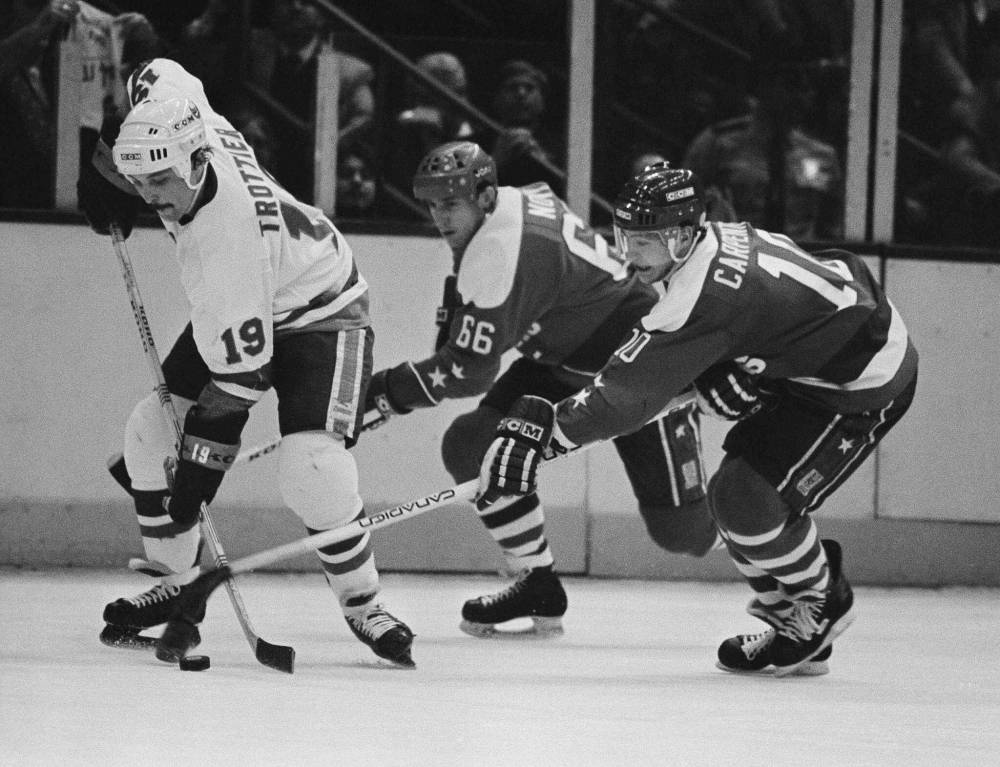
Brian Trottier would help to form one of the finest forward lines in hockey history — the fabled Trio Grande that also included right-winger Mike Bossy and left-winger Clark Gillies — that powered the New York Islanders to four consecutive Stanley Cup championships in the 1980s. (Richard Drew / Associated Pres files)
Williams, often portrayed as the outrageous madman who played NHL enforcer for 16 seasons, has never looked so good. This Tiger was wise and steadfast.
“I know the two Tigers and I love them both,” said Trottier, by phone Wednesday, in the midst of a national promotional tour that will bring him to Winnipeg’s McNally Robinson Booksellers on Nov. 7. “They’re both a big part of my life. If he’s not that guy, I’m out of hockey because I wasn’t going back. I was mad as a hornet that whole day. I was mad at the world. I was mad at Dad and Mom and mad at Tiger.
“But I think Dad had the right words — I don’t know, it just softened me enough to get in that car. Once I got back out on the ice and Tiger was playing left wing with me, hockey was fun again. Because he was underrated as a player… So I needed that buddy. I needed that big brother.”
Fearless and feisty, Willams made room for Trottier’s game to breath and take flight.
“The Western League was a gladiator league in the early ’70s and take no prisoners,” said Trottier. “Line brawls and bench-clearing brawls were the norm and hockey wasn’t fun for me as a 16-year-old, being small, scared and homesick and all that stuff… Tiger made me tough. Every day we would grapple. Nobody could touch me.”
The smooth, playmaking centre would help to form one of the finest forward lines in hockey history — the fabled Trio Grande that also included right-winger Mike Bossy and left-winger Clark Gillies — that powered the New York Islanders to four consecutive Stanley Cup championships in the 1980s.
It’s a record of achievement that places him in elite company and now, at 66, he’s taken the time to write about his early life growing up on a ranch near Val Marie, Sask., and the preposterously successful career that followed. It’s a fascinating read – and not just for the hockey nerd.
About four years ago, he began the process of collecting ideas for a memoir, eventually collaborating with veteran author Stephen Brunt.
“I’ve been chased here for 40-some years to write a book and there was no way I was gonna write a book,” said Trottier. “I was just too private, too guarded. I didn’t want to give away strategies… I think where I am in life and I think at my age I don’t feel as guarded anymore.”
Whatever ambivalence he had felt earlier evaporated as he remembered the early influences of junior coaches such as Stan Dunn and Earl Ingerfield to the transformative experiences of playing for Al Arbour with the Islanders and Pittsburgh Penguins head coach (Badger) Bob Johnson.
“Everybody has their own memories,” he said. “For me, I sure like my memories. I love how I feel about my friends and mentors and people that have guided me through to the NHL. My mom and dad and my brothers and sisters, they all knew me, good and bad.”

Penguin Random House Canada
There were tough times, too. In 1993-94, his final season as a player, Trottier was diagnosed with clinical depression.
“I knew I was sick — I just didn’t know what it was,” he said. “I was low energy and wasn’t eating, couldn’t sleep and went to the doc and he said, ‘You’ve gotta like do some introspection here. Take a good hard look at yourself.’ When you do that kind of therapy and reflection on yourself, holy cow, it was a little mini-journey in one sense, but the same time you lean on your friends. My kids were the biggest thing (that) pulled me out.”
Trottier, the son of a Cree-Metis-Chippewa father and an Irish-Canadian mother, said the guidance of his parents, Buzz and Mary, was the stable foundation he needed. He helps to celebrate his heritage by touring northern communties with a group of Indigenous NHL alumni players that also includes Reggie Leach and John Chabot.

“No one ever made me feel like I was different,” said Trottier. “I was a part of our community. I was part of a hockey team. No one ever made me feel like I was over to the side because of my native heritage, because we were taught early on when people called you names it was jealousy.”
Trottier lost a big part of his past earlier this year when Gillies and Bossy were both struck down by cancer. Not a day goes by when he doesn’t miss his old friends.
“Mike was different and Clark was different,” said Trottier. “They were a big part of my success on the ice and there was a different kind of chemistry, bond, friendship, trust and all that stuff that we had that just came natural… I say to myself, ‘This can’t happen, they’re too young and I need them in my life.’”
mike.sawatzky@freepress.mb.ca
Twitter: @sawa14