

‘First of its kind’ Illinois law will penalize libraries that ban books
Advertisement
Read this article for free:
or
Already have an account? Log in here »
To continue reading, please subscribe:

Digital Subscription
One year of digital access for only $205*
- Enjoy unlimited reading on winnipegfreepress.com
- Read the E-Edition, our digital replica newspaper
- Access News Break, our award-winning app
- Play interactive puzzles
*First annual payment billed as $205.00 + GST for one year. This annual subscription will automatically renew at $233.00 + GST every 52 weeks (10% off the regular annual price of $259.35). Offer available to new and qualified returning subscribers only. Cancel any time.
To continue reading, please subscribe:
Add Free Press access to your Brandon Sun subscription for only an additional
$1 for the first 4 weeks*
- Enjoy unlimited reading on winnipegfreepress.com
- Read the E-Edition, our digital replica newspaper
- Access News Break, our award-winning app
- Play interactive puzzles
*Your next Brandon Sun subscription payment will increase by $1.00 and you will be charged $17.95 plus GST for four weeks. After four weeks, your payment will increase to $24.95 plus GST every four weeks.
Read unlimited articles for free today:
or
Already have an account? Log in here »
Hey there, time traveller!
This article was published 12/06/2023 (1220 days ago), so information in it may no longer be current.
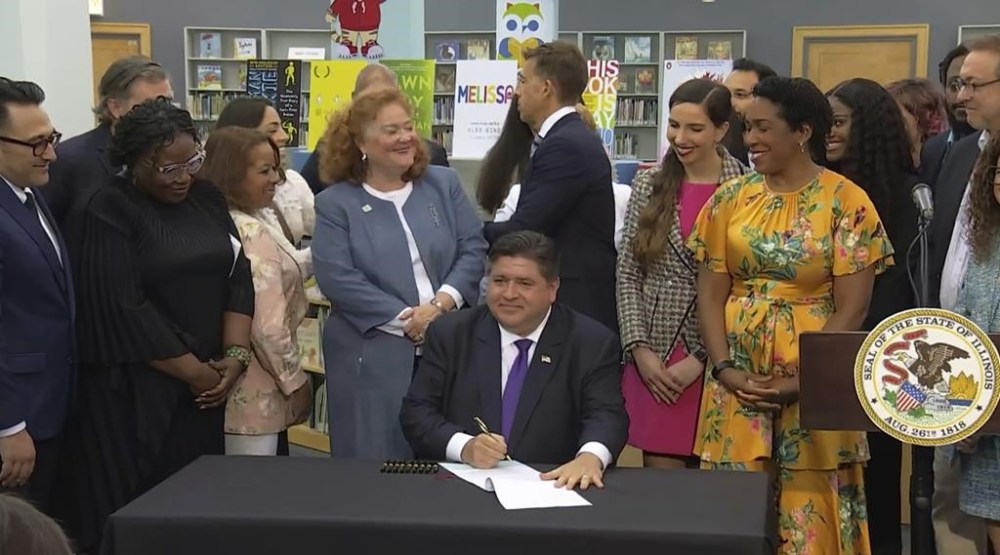
CHICAGO (AP) — Illinois Gov. J.B. Pritzker on Monday signed into law a bill that he says will make Illinois the first state in the nation to outlaw book bans.
Illinois public libraries that restrict or ban materials because of “partisan or doctrinal” disapproval will be ineligible for state funding as of Jan. 1, 2024, when the new law goes into effect.
“We are not saying that every book should be in every single library,” said Illinois Secretary of State Alexi Giannoulias, who is also the state librarian and was the driving force behind the legislation. “What this law does is it says, let’s trust our experience and education of our librarians to decide what books should be in circulation.”
The new law comes into play as states across the U.S. push to remove certain books in schools and libraries, especially those about LGBTQ+ themes and by people of color. The American Library Association in March announced that attempts to censor books in schools and public libraries reached a 20-year high in 2022 — twice as many as 2021, the previous record.
“Illinois legislation responds to disturbing circumstances of censorship and an environment of suspicion,” said Deborah Caldwell-Stone, director of the American Library Association’s Office for Intellectual Freedom and executive director of the Freedom to Read Foundation.
To be eligible for state funds, Illinois public libraries must adopt the American Library Association’s Library Bill of Rights, which holds that “materials should not be excluded because of the origin, background, or views of those contributing to their creation,” or subscribe to a similar pledge.
Downers Grove Democrat Rep. Anne Stava-Murray sponsored the legislation in the Illinois House of Representatives after a school board in her district was subject to pressure to ban certain content from school libraries.
“While it’s true that kids need guidance, and that some ideas can be objectionable, trying to weaponize local government to force one-size-fits-all standards onto the entire community for reasons of bigotry, or as a substitute for active and involved parenting, is wrong,” Stava-Murray said Monday at the bill’s signing, which took place at a children’s library in downtown Chicago.
Despite Giannoulias’ assertion that “this should not be a Democrat or Republican issue,” lawmakers’ approval of the bill splintered across party lines, with Republicans in opposition.
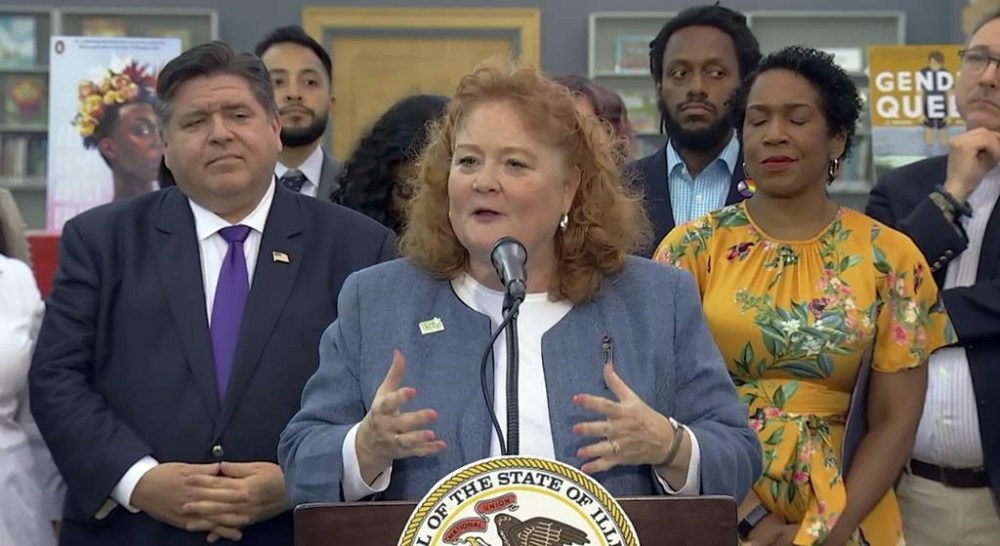
“I support local control,” said House Minority Leader Tony McCombie, a Republican who voted against the measure, in an emailed statement. “Our caucus does not believe in banning books, but we do believe that the content of books should be considered in their placement on the shelves.”
___
Savage is a corps member for the Associated Press/Report for America Statehouse News Initiative. Report for America is a nonprofit national service program that places journalists in local newsrooms to report on undercovered issues.




