Malaise mars writer’s golden years

Advertisement

Advertise with us

American writer Paul Auster’s previous, the Booker-shortlisted novel 4 3 2 1, explored four parallel versions of a man’s life from childhood on. It’s an interesting idea — to get to know the same person in four different iterations and explore how much of who we are is ingrained and how much is contingent on the outside circumstances that shape our experiences and decisions.

Read this article for free:


or

Already have an account? Log in here »

To continue reading, please subscribe:

Subscribe and receive a limited-edition Free Press branded hat or tote.

Digital Subscription

One year of digital access for only $205*

  • Enjoy unlimited reading on winnipegfreepress.com
  • Read the E-Edition, our digital replica newspaper
  • Access News Break, our award-winning app
  • Play interactive puzzles

*First annual payment billed as $205.00 + GST for one year. This annual subscription will automatically renew at $233.00 + GST every 52 weeks (10% off the regular annual price of $259.35). Offer available to new and qualified returning subscribers only. Cancel any time.

To continue reading, please subscribe:

Add Free Press access to your Brandon Sun subscription for only an additional

$1 for the first 4 weeks*

  • Enjoy unlimited reading on winnipegfreepress.com
  • Read the E-Edition, our digital replica newspaper
  • Access News Break, our award-winning app
  • Play interactive puzzles
Start now

*Your next Brandon Sun subscription payment will increase by $1.00 and you will be charged $17.95 plus GST for four weeks. After four weeks, your payment will increase to $24.95 plus GST every four weeks.

Hey there, time traveller!
This article was published 25/11/2023 (1031 days ago), so information in it may no longer be current.

American writer Paul Auster’s previous, the Booker-shortlisted novel 4 3 2 1, explored four parallel versions of a man’s life from childhood on. It’s an interesting idea — to get to know the same person in four different iterations and explore how much of who we are is ingrained and how much is contingent on the outside circumstances that shape our experiences and decisions.

In this concise and readable followup, Auster’s title character has only a single life to reflect on, and the page count is, appropriately enough, about one quarter of that of the preceding work. Long-time fans of the novelist can still make comparisons, weighing the fictional man’s 70-odd years against the author’s similar stretch of personal history. But it is unclear how valuable that may be; as a writer Auster is known for sharing autobiographical details with the characters he writes, but this does not necessarily mean he is writing about his own life.

What Auster is writing about here is a man, seemingly near the end of his span on Earth, who has already been marking time for almost a decade since his wife’s accidental death. The story covers only a couple of years within the present tense, and in that time Baumgartner, a philosophy professor and a writer, does comparatively little of great excitement. He spends his days poring over old love letters, attending to (or forgetting about) daily chores, ruminating on retirement and dozing in his lawn chair while reminiscing about his childhood and long-dead parents.
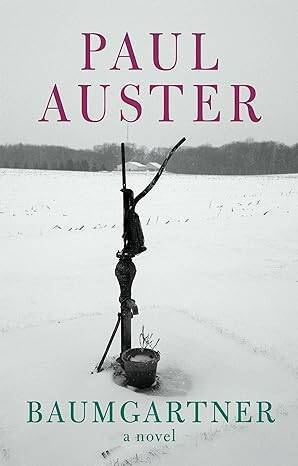
And for a while it seems like perhaps the contemporary Baumgartner is meant to serve merely as a framing device, a vehicle to introduce far richer past episodes that define this life that is, after all, essentially finished. But as subdued as these scenes are, the man is still going through something. Baumgartner is realizing two things simultaneously. First: he never fully made it through the process of grieving for his wife. Second: he has been functional but emotionally and spiritually shut down for a long time, but as long as his heart is still beating, there is still hope he can come back to life.

One can’t help but root for Baumgartner to find himself, find excitement for the future and have a long-delayed “third act.” But it’s by no means certain this will happen, and there is an increasing sense of foreboding as the story progresses. Despite the novel’s realistic, matter-of-fact style, a somewhat incongruous sense of dramatic irony begins to crown in around the narrative edges. This, along with the ambiguous and oddly framed ending, suggests a postmodernist sensibility that might seem more at home in the works of Milan Kundera rather than what the first two-thirds of Auster’s book seemed to be setting up.

Then again, it might still serve to make a good point. Real life is full of that same, very reasonable foreboding. Ultimately, we all get cut short, we all have just one more thing we wanted to do when time runs out. The tone of the story is true to life, if also a little discomfiting, in leaving the reader so uncertain to the last as to how or whether Baumgartner’s story will end by the final pages of the text.

Joel Boyce is a Winnipeg writer and educator.
Report Error Submit a Tip

More Stories

Puzzles Palace

1 minute read Monday, Jul. 27, 2026

To solve our puzzles, please subscribe with this special offer: |

‘We’re small, but we’re strong and mighty’: Lögberg-Heimskringla newspaper celebrates 140 years in Manitoba

Aaron Epp 6 minute read Preview

‘We’re small, but we’re strong and mighty’: Lögberg-Heimskringla newspaper celebrates 140 years in Manitoba

Aaron Epp 6 minute read 6:00 AM CDT

A “friend” of the Icelandic community is now 140 years old.

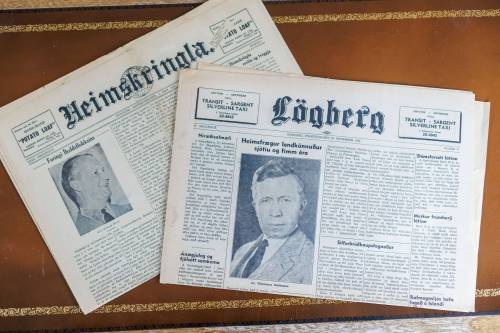
Lögberg-Heimskringla, a Winnipeg-based newspaper that serves the Icelandic diaspora throughout North America, has published continuously for nearly a century-and-a-half. Staff and supporters celebrated the anniversary Saturday afternoon during a gathering at the Scandinavian Cultural Centre.

“Whatever else it may be, Lögberg-Heimskringla is a friend in print — a familiar cultural institution that has enriched our lives and understanding, informing us and entertaining us at the same time,” editor Stefan Jonasson wrote in the paper’s anniversary issue, published on Sept. 15.

“It has served as a vessel to convey the Icelandic culture and heritage in North America through the course of several generations and changing circumstances, preserving memories from the past, imagining what lies ahead and reinventing itself along the way.”

Read
6:00 AM CDT

Thief steals almost $70K in Pokémon cards from flea-market owner

Scott Billeck 5 minute read Preview

Thief steals almost $70K in Pokémon cards from flea-market owner

Scott Billeck 5 minute read 2:11 PM CDT

The owner of a local flea market was left feeling disrespected and in disbelief after roughly $70,000 worth of Pokémon products were stolen over the weekend, but is vowing to rebuild.

Kenan Hyseni, who has owned and operated the popular Mulvey Market in South Osborne since 2022, said high-end sealed products and valuable individual cards from the massively popular collectible card game were stolen sometime between the market’s closing Friday night and midnight.

Hyseni believes someone hid inside the market until employees had left for the night, loaded up the merchandise and fled.

“The night finished, we locked up, did the usual thing, and then we went home and just before midnight, I got a call from the landlord and they said the alarm had been tripped, and that someone was seen leaving the market with bags,” Hyseni said.

Read
2:11 PM CDT

Today’s horoscope

Georgia Nicols 4 minute read Preview

Today’s horoscope

Georgia Nicols 4 minute read Yesterday at 2:00 AM CDT

MOON ALERT: There are no restrictions to shopping or important decisions today. The moon is in Capricorn.

ARIES (March 21-April 19)

Be aware that people notice you more than usual. In fact, some people will even know personal details about your private life. Consider this in case you have to do some damage control. This is a relaxed day and a chatty one.

TAURUS (April 20-May 20)

Read
Yesterday at 2:00 AM CDT

Malaise mars writer’s golden years

Reviewed by Joel Boyce 3 minute read Preview

Malaise mars writer’s golden years

Reviewed by Joel Boyce 3 minute read Saturday, Nov. 25, 2023

American writer Paul Auster’s previous, the Booker-shortlisted novel 4 3 2 1, explored four parallel versions of a man’s life from childhood on. It’s an interesting idea — to get to know the same person in four different iterations and explore how much of who we are is ingrained and how much is contingent on the outside circumstances that shape our experiences and decisions.

In this concise and readable followup, Auster’s title character has only a single life to reflect on, and the page count is, appropriately enough, about one quarter of that of the preceding work. Long-time fans of the novelist can still make comparisons, weighing the fictional man’s 70-odd years against the author’s similar stretch of personal history. But it is unclear how valuable that may be; as a writer Auster is known for sharing autobiographical details with the characters he writes, but this does not necessarily mean he is writing about his own life.

What Auster is writing about here is a man, seemingly near the end of his span on Earth, who has already been marking time for almost a decade since his wife’s accidental death. The story covers only a couple of years within the present tense, and in that time Baumgartner, a philosophy professor and a writer, does comparatively little of great excitement. He spends his days poring over old love letters, attending to (or forgetting about) daily chores, ruminating on retirement and dozing in his lawn chair while reminiscing about his childhood and long-dead parents.

And for a while it seems like perhaps the contemporary Baumgartner is meant to serve merely as a framing device, a vehicle to introduce far richer past episodes that define this life that is, after all, essentially finished. But as subdued as these scenes are, the man is still going through something. Baumgartner is realizing two things simultaneously. First: he never fully made it through the process of grieving for his wife. Second: he has been functional but emotionally and spiritually shut down for a long time, but as long as his heart is still beating, there is still hope he can come back to life.

Read
Saturday, Nov. 25, 2023

CMU instructor uses camper audio studio to capture stories of human connection in a time of isolation, alienation

Josiah Neufeld 7 minute read Preview

CMU instructor uses camper audio studio to capture stories of human connection in a time of isolation, alienation

Josiah Neufeld 7 minute read 6:00 AM CDT

GRUNTHAL — Last Sunday, David Balzer parked his vintage 1978 Triple E Surfside camper trailer on a church lot in town and, like an itinerant priest with a mobile confessional, prepared to hear people’s stories.

It was a crisp sunny morning. Inside the trailer were a pair of yellow mugs that matched the trailer’s egg yolk trim. On a table were two microphones.

Outside the trailer stood a sandwich board with an invitation: “Step in.”

Balzer doesn’t actually hear confessions, but he does perform what some might consider a priestly duty: helping people share their stories.

Read
6:00 AM CDT