Revisiting books that shape our lives

Advertisement
Read this article for free:
or
Already have an account? Log in here »
To continue reading, please subscribe:

Digital Subscription
One year of digital access for only $205*
- Enjoy unlimited reading on winnipegfreepress.com
- Read the E-Edition, our digital replica newspaper
- Access News Break, our award-winning app
- Play interactive puzzles
*First annual payment billed as $205.00 + GST for one year. This annual subscription will automatically renew at $233.00 + GST every 52 weeks (10% off the regular annual price of $259.35). Offer available to new and qualified returning subscribers only. Cancel any time.
To continue reading, please subscribe:
Add Free Press access to your Brandon Sun subscription for only an additional
$1 for the first 4 weeks*
- Enjoy unlimited reading on winnipegfreepress.com
- Read the E-Edition, our digital replica newspaper
- Access News Break, our award-winning app
- Play interactive puzzles
*Your next Brandon Sun subscription payment will increase by $1.00 and you will be charged $17.95 plus GST for four weeks. After four weeks, your payment will increase to $24.95 plus GST every four weeks.
Read unlimited articles for free today:
or
Already have an account? Log in here »
Hey there, time traveller!
This article was published 21/02/2024 (937 days ago), so information in it may no longer be current.
If we’re lucky, we’ll find books in our lives that leave a lasting imprint.
Books that change the way we think and see the world; ones that reveal indisputable truths or offer glimmers of hope at dark times.
I’ve been revisiting books that I’ve found to be influential and deeply meaningful; books that offer inspiration and wisdom when you most need them.
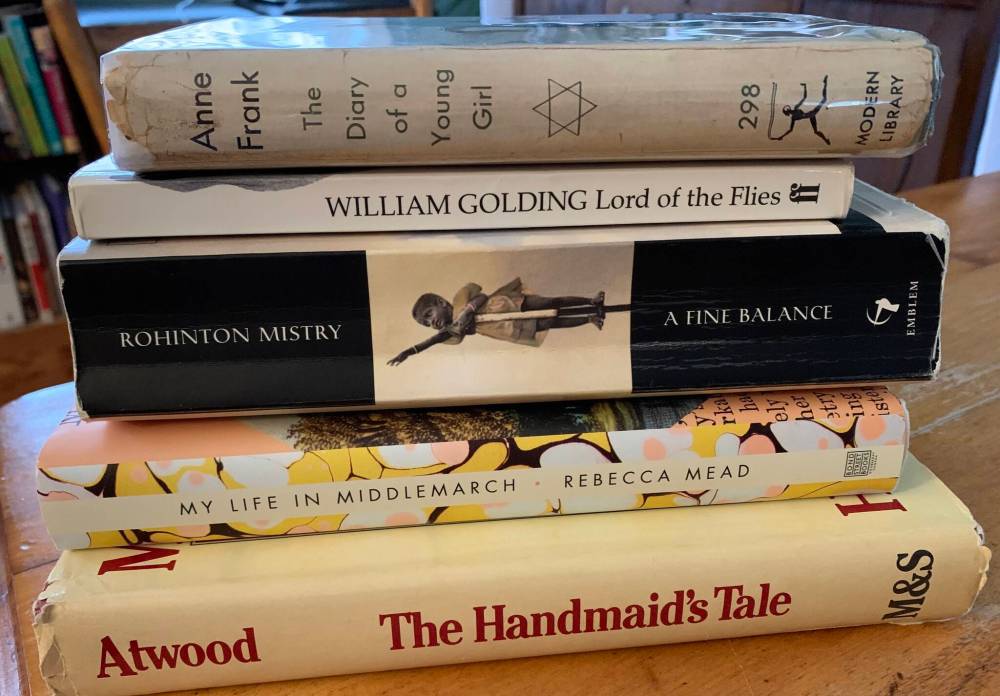
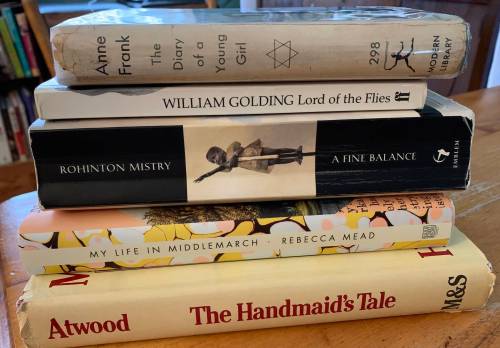
Pam Frampton photo
Just as human relationships mature and evolve, so can our relationships with favourite books.
And what I am learning — as others have before me — is that the books you return to change as you age and mature. Which makes sense, because you are reading them through different eyes at different times, depending on your life experience.
Why return to the same books when there are so many waiting to be read? It’s a good question. I am acutely aware that I may never get to read all the books in my house, let alone all those I’ve yet to acquire.
A couple of years ago, I read New Yorker writer Rebecca Mead’s My Life in Middlemarch, which explores her personal relationship with George Eliot’s classic 1871 novel. Mead’s reasons for revisiting a book that is seminal in her life match my own.
“I wanted to recover the sense of intellectual and emotional immersion in books that I had known as a younger reader, before my attention was fractured by the exigencies of being a journalist,” she writes. “I wanted to go back to being a reader.”
Of course, you don’t need to be a journalist to feel the intense demands of everyday life. For any of us, it can be deeply rewarding to spend time doing something that reminds you of who you were, and are.
What my 20-year-old self read as dystopian fiction in Margaret Atwood’s The Handmaid’s Tale feels more like harsh reality now.
Reading the passage where the handmaid Offred asks the Commander why the repressive Republic of Gilead was created, I thought of Afghanistan, and many other cultures where women and others on the margins are subjugated, their voices silenced.
The Commander tells Offred that men felt they could create a better society.
“Better never means better for everyone, he says. It always means worse, for some.”
William Golding’s Lord of the Flies was the first book I read where I understood there was subtext, not just story. I remember being profoundly shocked at age 12 by how quickly civility was dispelled and the children turned to cruelty on Golding’s deserted island.
Rereading it recently, now with decades of awareness of how unkind the world can be, I was newly chilled by how plausible it all was — the vicious “othering” of children who were different, the savagery in hunting, the violent pack mentality of boys gone rogue.
And once more, with the main character, Ralph, I “wept for the end of innocence, the darkness of man’s heart, and the fall through the air of the true, wise friend called Piggy.”
Anne Frank: The Diary of a Young Girl is still a relevant dire warning as fascism flourishes in today’s world.
I’ve read it more than any other book I own. My horror and anger at the atrocities of the Holocaust increase with each reading, but I am struck by different aspects of the memoir every time.
This time it felt as if Anne and I had both matured since last we met. She was still trying to nurture her inner optimist and was caught up in romance and household drama. But she was also incredibly self-aware, constantly shifting between her natural buoyancy and a terrible foreboding that she would die at the hands of the Nazis.
“I simply can’t imagine that the world will ever be normal for us again,” she wrote at 14, roughly 16 months before her death of typhus in a concentration camp. “I do talk about ‘after the war,’ but then it is only a castle in the air, something that will never really happen.”
Rohinton Mistry’s A Fine Balance was one of the bleakest books I had read by age 30, shortly after it was published.
Perhaps the heavy sadness of the tale of four people whose lives are marred by struggle and twists of fate matched my own as it was at that time, tinged by loss and unhappiness.

Rediscovering it in 2023, I found a book that had far more sunlight and humour countering the darkness and misery than I had recalled.
Like life, Mistry’s superb and sweeping novel maintains “a fine balance between hope and despair,” and it ends on notes of love and optimism.
As Rebecca Mead wrote of going back to Middlemarch again and again, “There are books that seem to comprehend us just as much as we understand them, or even more.”
Happy reading.
Pam Frampton is a freelance writer and editor who lives in St. John’s. Email pamelajframpton@gmail.com X: pam_frampton
Pam Frampton is a columnist for the Free Press. She has worked in print media since 1990 and has been offering up her opinions for more than 20 years. Read more about Pam.
Pam’s columns are built on facts, but offer her personal views through arguments and analysis. Every column Pam produces is reviewed by an editing team before it is posted online or published in print — part of the Free Press‘s tradition, since 1872, of producing reliable independent journalism. Read more about Free Press’s history and mandate, and learn how our newsroom operates.
Our newsroom depends on a growing audience of readers to power our journalism. If you are not a paid reader, please consider becoming a subscriber.
Our newsroom depends on its audience of readers to power our journalism. Thank you for your support.
Pam Frampton is a columnist for the Free Press. She has worked in print media since 1990 and has been offering up her opinions for more than 20 years. Read more about Pam.
Pam’s columns are built on facts, but offer her personal views through arguments and analysis. Every column Pam produces is reviewed by an editing team before it is posted online or published in print — part of the Free Press‘s tradition, since 1872, of producing reliable independent journalism. Read more about Free Press’s history and mandate, and learn how our newsroom operates.
Our newsroom depends on a growing audience of readers to power our journalism. If you are not a paid reader, please consider becoming a subscriber.
Our newsroom depends on its audience of readers to power our journalism. Thank you for your support.
Advertisement Advertise With Us
Advertisement Advertise With Us
History
Updated on Wednesday, February 21, 2024 6:23 AM CST: Adds missing word