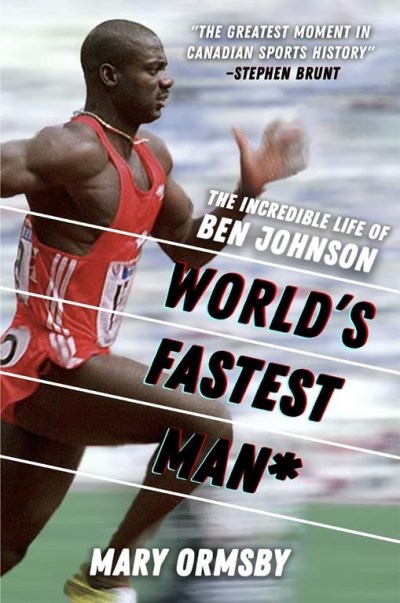
Ben Johnson biography uncovers untold story behind steroid scandal

Advertisement

Advertise with us

Newly uncovered documentation sparked a crucial question for author Mary Ormsby: Was Ben Johnson denied due process in Seoul?

Read this article for free:


or

Already have an account? Log in here »

To continue reading, please subscribe:

Subscribe and receive a limited-edition Free Press branded hat or tote.

Digital Subscription

One year of digital access for only $205*

  • Enjoy unlimited reading on winnipegfreepress.com
  • Read the E-Edition, our digital replica newspaper
  • Access News Break, our award-winning app
  • Play interactive puzzles

*First annual payment billed as $205.00 + GST for one year. This annual subscription will automatically renew at $233.00 + GST every 52 weeks (10% off the regular annual price of $259.35). Offer available to new and qualified returning subscribers only. Cancel any time.

To continue reading, please subscribe:

Add Free Press access to your Brandon Sun subscription for only an additional

$1 for the first 4 weeks*

  • Enjoy unlimited reading on winnipegfreepress.com
  • Read the E-Edition, our digital replica newspaper
  • Access News Break, our award-winning app
  • Play interactive puzzles
Start now

*Your next Brandon Sun subscription payment will increase by $1.00 and you will be charged $17.95 plus GST for four weeks. After four weeks, your payment will increase to $24.95 plus GST every four weeks.

Hey there, time traveller!
This article was published 16/04/2024 (910 days ago), so information in it may no longer be current.

Newly uncovered documentation sparked a crucial question for author Mary Ormsby: Was Ben Johnson denied due process in Seoul?

While researching her new book, “World’s Fastest Man: The Incredible Life of Ben Johnson,” released on Tuesday by Sutherland House Books, Ormsby unearthed details that led her to consider a new perspective on Johnson’s story.

“We could probably tell his story in a way that would correct the historical record and shed new context on his treatment,” she said. “Maybe make us think differently about his particular case and doping in general, and that was kind of the genesis of the book.
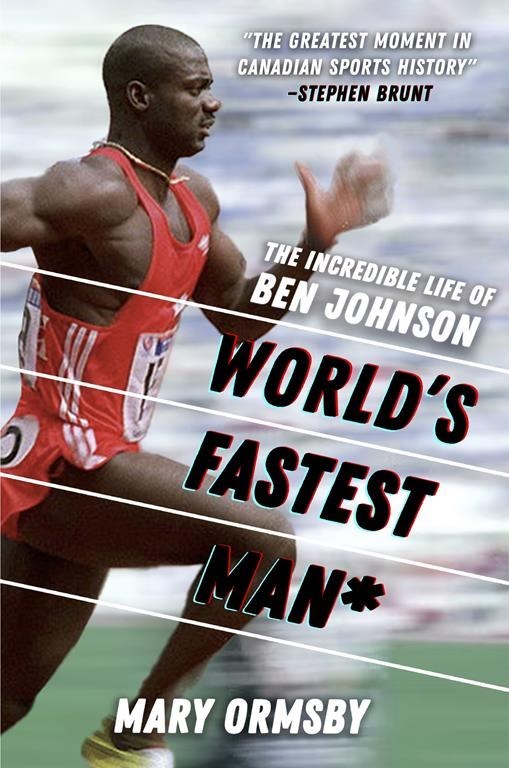
The cover of the book “World's Fastest Man: The Incredible Life of Ben Johnson” is shown in this handout image provided by Sutherland House Books. Newly uncovered documentation sparked a crucial question for author Mary Ormsby: Was Ben Johnson denied due process in Seoul? THE CANADIAN PRESS/HO-Sutherland House Books **MANDATORY CREDIT**

“Also asking the question, is it possible to railroad a guilty guy?”

The book details Johnson’s life in Jamaica, his birth country, where he was one of six children to Ben Johnson Sr. and Gloria Johnson, as well as his immigration to Canada in the spring of 1976.

Ben Jr.’s older brother Eddie introduced him to the Scarborough Optimists track club, where he was first coached by Charlie Francis in 1977.

That was the beginning of a successful partnership between Johnson and Francis that lasted over a decade.

Her book delves into Ben Johnson’s initial steroid use in late 1981, the era’s lax doping control, the widespread doping prevalence in the 1980s, and the methods used to evade and mask positive tests.

It also recounts the pivotal days in Seoul, South Korea, during the 1988 Summer Olympics, when Johnson’s positive test for the anabolic steroid stanozolol, after his record-breaking gold-medal win in the men’s 100 metres, changed history.

His gold medal was stripped, and the world record was wiped from the books.

“I really feel Ben was singled out for a lot of reasons, but in Seoul, he was the only track and field athlete to test positive,” said Ormsby, a former reporter with the Toronto Star. “One guy. And that I find puzzling because this was supposed to be a state-of-the-art drug lab with the smartest scientists, and they’re going to catch all the bad guys and girls.

“In the years later, we would find out that six of the eight men in that 100-metre final are linked directly or indirectly, to doping violations.”

In her book, Ormsby recounts several instances where this was evident.

Ormsby wrote: “Not only was Ben Johnson’s detailed lab report withheld by the IOC medical commission, but a second similar event occurred that same night in Seoul. An additional doping screen was conducted on the runner’s urine sample without his knowledge or consent. It was the endocrine profiling test, a pet project being developed by (drug testing pioneer) Manfred Donike.”

She added: “Neither the test’s existence nor its results were disclosed to the Canadians in advance of Johnson’s hearing in Seoul. Endocrine profiling was not an authorized IOC anti-doping tool at the time. What’s more, endocrine profiling had never before been used to confirm a positive doping result. Johnson was singled out as the lone athlete out of more than eight thousand in Seoul to be subjected to the test.”

Ormsby also highlighted “unusual aspects” of Johnson’s lab reports in the book, noting that no one in the Canadian group complained about the lack of disclosure or challenged the validity of this new test.

“Unsigned handwritten alterations riddle the thirty-one pages — a series of revisions, deletions, question marks, switched lab codes, calculation doodles, and, oddly, the name of a different anabolic steroid, oxandrolone,” she wrote. “The records of an IOC-accredited lab were expected to be of the highest integrity and beyond reproach.”

A deep dive into Johnson’s return to track and field years after, and more sanctions that followed, are also detailed along with his life off the track and into his retirement.

In between all of that, however, is a behind-the-scenes look at the famed Dubin Inquiry, which opened the public’s eyes to the world of doping in sport, alongside the backlash Johnson faced alone and the many who turned on him as a Canadian, calling him Jamaican instead

“That’s an important part of the book because Canadians think they’re very, very tolerant,” Ormsby said. “And in this case they weren’t. … So the backlash after his disqualification was severe and harsh and there was a lot of racist comments about him.

“The Canadian government also stepped in and said you are banned for life, you will never represent Canada again at a national team level. So all of this helped define this very crushing moment for him.”

This report by The Canadian Press was first published April 16, 2024.
Report Error Submit a Tip

More Stories

Today’s horoscope

Georgia Nicols 4 minute read Preview

Today’s horoscope

Georgia Nicols 4 minute read Sunday, Oct. 11, 2026

MOON ALERT: Avoid shopping (except food and gas) and important decisions until after 10:45 a.m. After that, the moon moves from Libra into Scorpio.

ARIES (March 21-April 19)

You have a choice. You can either get embroiled in disputes about shared property, debt, insurance issues or inheritances; or instead, relax and have a playful day featuring sporting events, social outings and fun activities with kids.

TAURUS (April 20-May 20)

Read
Sunday, Oct. 11, 2026

Ben Johnson biography uncovers untold story behind steroid scandal

Abdulhamid Ibrahim, The Canadian Press 5 minute read Preview

Ben Johnson biography uncovers untold story behind steroid scandal

Abdulhamid Ibrahim, The Canadian Press 5 minute read Tuesday, Apr. 16, 2024

Newly uncovered documentation sparked a crucial question for author Mary Ormsby: Was Ben Johnson denied due process in Seoul?

While researching her new book, "World's Fastest Man: The Incredible Life of Ben Johnson," released on Tuesday by Sutherland House Books, Ormsby unearthed details that led her to consider a new perspective on Johnson's story.

“We could probably tell his story in a way that would correct the historical record and shed new context on his treatment,” she said. “Maybe make us think differently about his particular case and doping in general, and that was kind of the genesis of the book.

“Also asking the question, is it possible to railroad a guilty guy?”

Read
Tuesday, Apr. 16, 2024

Creatures’ comfort key to coping with loss

Maureen Scurfield 5 minute read 2:00 AM CDT

DEAR MISS LONELYHEARTS: Not long ago I lost my husband to illness at far too young an age. My spouse was a great guy, but I do want another one.

I just want to pass on a little tip. When my husband was dying, he encouraged me to bring home warm and loving pets to our acreage just outside the city. They were my saviours when my husband was ill.

Since he has died, they continue to help me keep warm, happy and affectionate. They were my greatest comfort in the later stages when my man was in too much pain to hold me or be held. The cats and the dog would welcome me home from the hospital and transfer their cuddling to me, giving me all the attention I needed, and I always felt so loved.

I have been dating a fair bit for a fairly recent widow because I’m ready to be held and loved, and I feel my husband and the pets saying, “Way to go.”

Comparing the Iran and Vietnam Wars

Peter McKenna 5 minute read Preview

Comparing the Iran and Vietnam Wars

Peter McKenna 5 minute read 2:00 AM CDT

The other day I asked my students in U.S. foreign policy to think about the relevance of the Vietnam War in relation to the ongoing war in Iran. More specifically, I wanted them to identify the similarities and differences between the two wars.

What is immediately striking is how domestic politics played such a seminal role in both conflicts. While American public opinion was generally in favour of U.S. military involvement in Vietnam in the early years, things started to turn very sour after U.S. soldiers started arriving stateside in flag-draped coffins and body bags. As for Iran, just about every single poll and TV newscast since the first few weeks of the war have illustrated an overwhelming public repudiation of President Trump’s military adventurism.

The electoral implications were also quite apparent for the two wars. The U.S.-Iran War is clearly having a positive effect on the Democratic Party’s electability, as it looks set to capture both the House of Representatives and the Senate in the Nov. 3 midterm elections. Democratic President Lyndon Johnson, reading the political tea leaves from the Vietnam fallout, opted not to contest the 1968 U.S. presidential election.

Equally interesting, the U.S. press had a crucial, and mostly negative, impact on both the Vietnam and Iran conflicts. Who could forget Gen. William Westmoreland — the commander of U.S. forces in Vietnam (1964-1968) — maintaining that it was the media’s fault the U.S. lost the war in Vietnam. While I take issue with his thesis, I do believe the news coverage and visuals of the first televised war served to raise serious concerns about why the U.S. was at war in Southeast Asia.

Read
2:00 AM CDT

RJ Mitte, ‘Breaking Bad’ actor and disability rights champion, dies at 34

Andrew Dalton, The Associated Press 3 minute read Preview

RJ Mitte, ‘Breaking Bad’ actor and disability rights champion, dies at 34

Andrew Dalton, The Associated Press 3 minute read Updated: Yesterday at 10:23 PM CDT

LOS ANGELES (AP) — Actor and disability rights advocate RJ Mitte, who brought a lifetime of experience with cerebral palsy to fictional family struggles in an essential role on “Breaking Bad,” died Monday at age 34, authorities and his representatives said.

Cameron County Justice of the Peace Cyndi Hinojosa told The Associated Press she declared Mitte dead at about 1:30 p.m. at what she believed was his home in Brownsville, Texas. She said she was unable to provide a cause, but an autopsy will be performed.

Mitte played Walter White Jr., the son of Bryan Cranston's chemistry teacher-turned-meth dealer Walter White on nearly every episode of the five seasons of the AMC show, which recently ranked as the best of the 21st century in a New York Times poll.

Cranston said he is in “deep despair” for the loss of his “sweet son.”

Read
Updated: Yesterday at 10:23 PM CDT

Israel and Palestine: 30 wasted years

Gwynne Dyer 5 minute read 2:00 AM CDT

Here is how the high command of the Israel Defence Forces (IDF) laid down the rules for “remotely” killing suspected Palestinian activists in the densely populated Gaza Strip after the surprise Hamas attack on Israel on Oct. 7, 2023.

Israeli forces were told that up to 20 Palestinian civilians could be killed in a strike against a single suspected member of Hamas, even one of the lowest rank and importance. For a more “senior” Hamas member, the permissible number of non-combatants who could be ‘accidentally’ killed in the process went up to 100.

The order went out only hours after the attack, when there were not yet any IDF troops on the ground in Gaza and all strikes had to be remote, but most strikes have remained remote right down to the present because using drones and artillery keeps Israeli casualties very low.

The drone operators or artillery gunners who delivered the high explosives did not choose the targets themselves. An AI system called Lavender did that, using a network of surveillance devices that generated tens of thousands of likely targets, some known by name, some just “acting suspiciously.” Human operators spent about 20 seconds confirming each one.