Ceremony season
Summer’s warmth heralds reconnection, reflection for Indigenous communities

Advertisement
Read this article for free:
or
Already have an account? Log in here »
To continue reading, please subscribe:
Digital Subscription
One year of digital access for only $1.44 a week*
- Enjoy unlimited reading on winnipegfreepress.com
- Read the E-Edition, our digital replica newspaper
- Access News Break, our award-winning app
- Play interactive puzzles
*Billed as $5.77 plus GST every four weeks. After 52 weeks, price increases to the regular rate of $19.95 plus GST every four weeks. Offer available to new and qualified returning subscribers only. Cancel any time.
To continue reading, please subscribe:
Add Free Press access to your Brandon Sun subscription for only an additional
$1 for the first 4 weeks*
- Enjoy unlimited reading on winnipegfreepress.com
- Read the E-Edition, our digital replica newspaper
- Access News Break, our award-winning app
- Play interactive puzzles
*Your next Brandon Sun subscription payment will increase by $1.00 and you will be charged $17.95 plus GST for four weeks. After four weeks, your payment will increase to $24.95 plus GST every four weeks.
Read unlimited articles for free today:
or
Already have an account? Log in here »
Hey there, time traveller!
This article was published 25/05/2024 (880 days ago), so information in it may no longer be current.
Excerpt from Wînipêk: Visions of Canada from an Indigenous Centre (McClelland & Stewart, 2024), by Niigaan Sinclair. A book launch will be held May 30 at McNally Robinson Booksellers, beginning at 7 p.m.
Niibin — summer — is coming. In this place, that means ceremony time. When the days are longest and the sun is at its peak, peoples from all walks of life renew ourselves in events like Sundances, lodge gatherings, Treaty Days, and hundreds of other informal and formal gatherings across Turtle Island. It’s also when the powwow circuit ramps up.
Summer is a big deal for everyone but particularly Indigenous Peoples. It’s the time of year when the past is reflected upon and exhaustive preparations are made for the coming season(s). For Indigenous communities, this is the time when everything is refreshed. My family has been attending ceremonies all my life. Our home lodge, called the Three Fires Midéwiwin Lodge, is based in Wisconsin and in particular Madeline Island — a sacred spot for Anishinaabeg. Before the COVID-19 pandemic messed up the world, my family travelled to attend gatherings there four times a year. Revitalized in the 1970s by the late Bawdaywidun Banaise, or Edward Benton-Benai, the Three Fires Midéwiwin Lodge has been in operation for centuries and went underground during the years our traditional practices were outlawed. Now, our membership includes thousands and ceremonies are held throughout the Anishinaabeg nation (including in Winnipeg). The Three Fires Midéwiwin lodge, of course, is not the only Midé lodge in existence; there are many others. Some of our members, in fact, have gone on to help their own Anishinaabe communities revitalize their own lodges and ceremonies too.
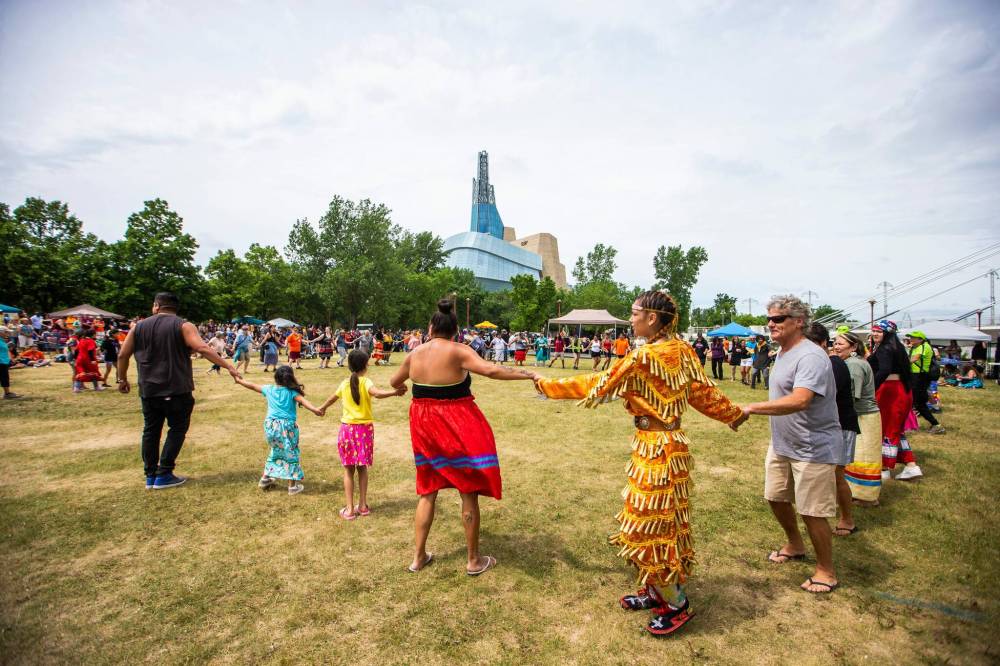
MIKAELA MACKENZIE / FREE PRESS files
A group round dance kicks off the National Indigenous Peoples’ Day Powwow at The Forks in June 2023.
Not all Indigenous Peoples attend traditional ceremonies, of course, but if my social media feed is a litmus test, more are attending all the time. Also, Indigenous ceremonies aren’t just for Indigenous Peoples. Non-Indigenous peoples participate in ceremonies, too. Some of the strongest Sundancers in Manitoba, for instance, are non-Indigenous peoples. Many Indigenous Christians also attend traditional ceremonies too and don’t see Christianity as antithetical to Indigenous ways and knowing. After all, it was not Indigenous Peoples who forced individuals to choose between traditional ways and living a Christian life. It was non-Indigenous Christians who wanted Indigenous Peoples — and particularly children — to cut their hair, burn their drums, stop speaking their languages, and forget their traditions. Some Indigenous Christians, as a result, circulate similar, divisive beliefs even as their own cultures find ways to reconcile traditional and biblical paths. Many, like my great-grandmother, live dynamic, interesting, and rich lives carrying both sets of teachings; picking Midé medicines in the morning then attending church in the afternoon.
Not all ceremonies are the same. Some are for specific communities and have stringent rules when it comes to who can and cannot participate and use medicines, songs, and stories. Some are more open and liberal with who can participate and incorporate “foreign” materials like metal, plastic, and English. Some demand more “natural” objects and medicines. Some ceremonies have content and experiences people can speak about publicly while others are private and shouldn’t be shared without the consent of those who participated.
● ● ●
Naming ceremonies are my favourite. Nothing else quite comes close to watching a person, standing with their family, hearing their name unveiled by a name giver. When a name is spoken for the first time, the entire community joins in to announce the name to all four directions. For Anishinaabe, it’s said that once a name is announced, Creation sees a person clearly for the first time and understands their direction and purpose. This is why people might get a new name during certain times of their life, like a name to use during childhood and another to use during adult years. Some names shape a person’s role or are a gift they spend a lifetime learning about. Some receive a new name after a moment of growth or change, like a death or a dream, and many Indigenous people carry multiple names in use throughout their lives. My name, Niigaanwewidam, means the sound of the future, the sound of the beginning, or the sound that starts the day.
I’m still trying to live up to it.
Places also have names. These are intended to help us understand the meaning of a place and what happens there — like how the name Winnipeg illustrates the sacred ecology we live within. Manitoba comes from two names. The first, Manitou Api, means “Where Creator Sits” or “Placed Life Down” and refers to the rock formations — also called “petroforms” — in the Whiteshell Provincial Park. In these recordings, it is said, are the teachings and natural laws of this place and how life is best articulated in the ceremonies and beings who live here. The second, Manitowapow, means the “Life in the Water” and refers to the sound of the waves at the Narrows. These sounds are said to be what create all the colour, hue, and life in this place. Together, both these names demonstrate Manitoba’s history and how life proceeds here.
When he met Assiniboine communities near Lake Manitoba, French explorer La Vérendrye heard the name he called “Mini-tobow” and translated it to mean “Lac des Prairies” (“Lake of the Prairies”). It wasn’t until 1867 that Thomas Spence was the first to “officially” use the term Manitobans know today after forming a council and declaring the settlement the Republic of Manitobah. While Spence’s republic collapsed, and he and his followers would later join Louis Riel’s Métis Council, the name endured.

In 1870, a Métis-led delegation from the Council went to Ottawa to negotiate with Canada over the jurisdiction of the growing and lucrative Red River Settlement. The territory at that time was mostly known as Assiniboia, but Riel never liked the name. On April 19, 1870, he sent the following letter to delegate Father Noël- Joseph Ritchot:
“The name of the country is already written in all hearts, that of Red River. Fancy delights in that of “Manitoba,” but the situation seems to demand that of “North-West.” Friends of the old government are pleased with that of Assiniboia (but) it is not generally enough liked to be kept. Choose one of the two names “Manitoba” or “North- West.”
That same year, the Canadian parliament passed the Manitoba Act — cementing the name citizens of the province recognize and use today.
Whether Manitou Api, Manitowapow, or Manitoba, the name evokes a ceremony of multiplicity, encapsulating the water, earth, and actions of a vibrant and ever-changing home. This is where people for years have travelled by canoe, shoreline, and on foot, creating communities, holding gatherings, and forging relationships among themselves and with beings throughout the universe. Like all names that embody this place, Manitoba is a term that represents a story about dynamic and creative relationships that started long before even human arrival and continues today. Manitoba did not begin with Europeans, a government, or even Indigenous Peoples, but is a spirit found in the land, water, and life that exists here — in all of its complicated parts.
Niigaan Sinclair, an assistant professor at the University of Manitoba, is a columnist for the Free Press.
Niigaan Sinclair is Anishinaabe from Peguis First Nation and a professor in the Department of Indigenous Studies at the University of Manitoba. He’s been a columnist for the Free Press since 2018. Read more about Niigaan.
Every piece of writing Niigaan produces is reviewed by an editing team before it is posted online or published in print — part of the Free Press‘s tradition, since 1872, of producing reliable independent journalism. Read more about Free Press’s history and mandate, and learn how our newsroom operates.
Our newsroom depends on a growing audience of readers to power our journalism. If you are not a paid reader, please consider becoming a subscriber.
Our newsroom depends on its audience of readers to power our journalism. Thank you for your support.
Niigaan Sinclair is Anishinaabe from Peguis First Nation and a professor in the Department of Indigenous Studies at the University of Manitoba. He’s been a columnist for the Free Press since 2018. Read more about Niigaan.
Every piece of writing Niigaan produces is reviewed by an editing team before it is posted online or published in print — part of the Free Press‘s tradition, since 1872, of producing reliable independent journalism. Read more about Free Press’s history and mandate, and learn how our newsroom operates.
Our newsroom depends on a growing audience of readers to power our journalism. If you are not a paid reader, please consider becoming a subscriber.
Our newsroom depends on its audience of readers to power our journalism. Thank you for your support.
Advertisement Advertise With Us
Advertisement Advertise With Us