Essays on sailing and writing anchored in emotional resonance
Advertisement
Read this article for free:
or
Already have an account? Log in here »
To continue reading, please subscribe:

Digital Subscription
One year of digital access for only $205*
- Enjoy unlimited reading on winnipegfreepress.com
- Read the E-Edition, our digital replica newspaper
- Access News Break, our award-winning app
- Play interactive puzzles
*First annual payment billed as $205.00 + GST for one year. This annual subscription will automatically renew at $233.00 + GST every 52 weeks (10% off the regular annual price of $259.35). Offer available to new and qualified returning subscribers only. Cancel any time.
To continue reading, please subscribe:
Add Free Press access to your Brandon Sun subscription for only an additional
$1 for the first 4 weeks*
- Enjoy unlimited reading on winnipegfreepress.com
- Read the E-Edition, our digital replica newspaper
- Access News Break, our award-winning app
- Play interactive puzzles
*Your next Brandon Sun subscription payment will increase by $1.00 and you will be charged $17.95 plus GST for four weeks. After four weeks, your payment will increase to $24.95 plus GST every four weeks.
Read unlimited articles for free today:
or
Already have an account? Log in here »
Hey there, time traveller!
This article was published 30/11/2024 (674 days ago), so information in it may no longer be current.
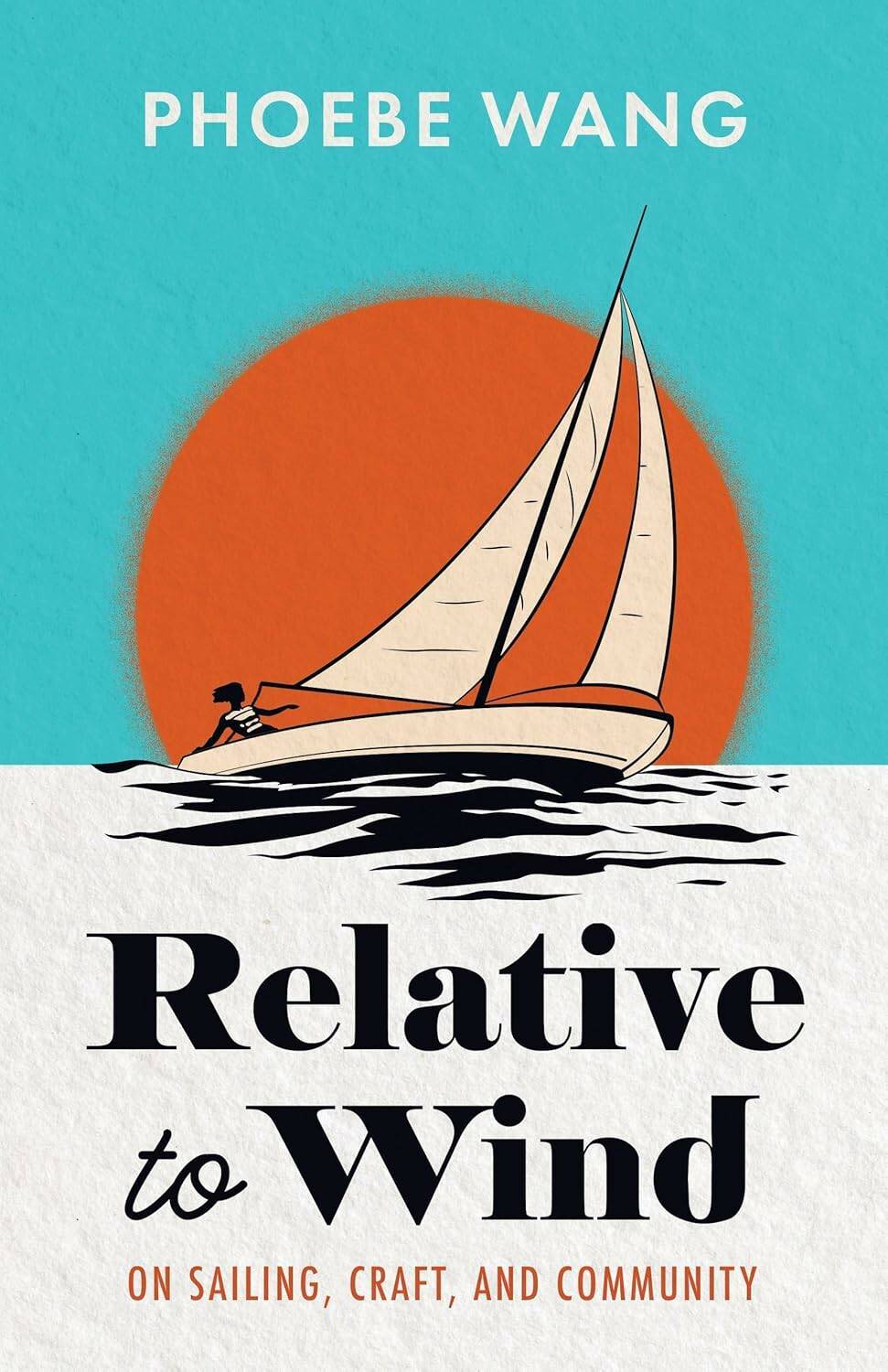
In the opening essay of her first collection Relative to Wind, Toronto author Phoebe Wang writes “Language can function both as a barrier and an entry point into an identity, and in the case of the language of sailing, it kept me out before it let me in.”
This experience, of being kept out before being allowed in, informs the approaches Wang takes to sailing itself, and sailing as a way to reveal something about writing, community and more.
In a essay called Race Log later in the collection, Wang weaves accounts of racing on Wednesday nights with thoughts on writing craft. Like her relationship to sailing and to her sailing club, she speaks of the “knowns and unknowns in writing” and the way in which these shift through a writer’s practice.
Relative to Wind
This craft essay isn’t proscriptive; rather, Wang invites readers to consider the way their bodily experiences and their intutions contribute to their own practice. While she gives cues, these are rooted in her own bodily experiences: “I only know that if the work has a quality of soundness, like a bell, and when I no longer have the desire to climb back into it and rewrite it, then it has integrity for me.”
Among the many pleasures animating these essays, which will surprise no one who has read her two books of poetry, is the particular care Wang takes with language. She uses sound and rhythm to propel narratives and arguments, as well as to invite the reader’s curiosity. “A rope on a boat is never a rope — it’s a line, sheet, or halyard,” she begins. “I promise that when you get under sail, these names have textures and weights that will help you remember them.”
Not only does language have material connections to sailing’s present, but it brings its history to life. “Nautical terminology is rooted in Old and Middle English, imported by way of Germanic and Norse roots and sticky sounds harken back to the flexible, clinker-built Viking ships that wove their way through the Baltic Sea carying cargo or invaders,” Wang writes.
In her hands, this history is as alive with emotional resonance as is the present. “In boat words,” she writes, “I can hear the creak of wood timbers, commands shouted to crew across a vessel pitching in autumn winds, and the wind itself, knocking bodies and shoving objects about. I hear the romance of a life at sea and its accompanying perils.”

Wang uses the specifics of sailing’s vocabulary, its etymologies and the way it is deployed, as an entry to other preoccupations: violent colonial histories, writing and its rhythms, class, family and more. “Asking how sailing might be decolonized is like sailing into a hole — a word sailors use to describe a patch on open water where the wind has died,” she writes. “(E)very boat inevitably stalls. While crews on tall ships making voyages across the Atlantic drea ded being becalmed, I now think it can be necessary and useful to pause mid-voyage and reflect on the costs of the journey.”
If pausing for consideration before proceding on the journey in a boat seems an impossible project, the same holds true for a book. Here, Wang’s skills are more than up to the task. She steers the reader into waters that may seem becalmed and finds within them a propulsive breath.
While sailing clubs appear to outsiders to be the domain of white, upper-class men, Wang finds within those histories “fluid entities that shift with each new addition to the membership roster.” In particular, Queen City Yacht Club, out of which she sails, “started as a ‘working man’s club,’ as opposed to a club catering to Toronto’s upper crust.”
The essays in Relative to Wind contain within them an eclectic and shifting narrative of finding ways to belong.
Melanie brannagan frederiksen is a Winnipeg writer and critic.