Cultural history of late-’60s rock hits some sour notes
Advertisement
Read this article for free:
or
Already have an account? Log in here »
To continue reading, please subscribe:

Digital Subscription
One year of digital access for only $205*
- Enjoy unlimited reading on winnipegfreepress.com
- Read the E-Edition, our digital replica newspaper
- Access News Break, our award-winning app
- Play interactive puzzles
*First annual payment billed as $205.00 + GST for one year. This annual subscription will automatically renew at $233.00 + GST every 52 weeks (10% off the regular annual price of $259.35). Offer available to new and qualified returning subscribers only. Cancel any time.
To continue reading, please subscribe:
Add Free Press access to your Brandon Sun subscription for only an additional
$1 for the first 4 weeks*
- Enjoy unlimited reading on winnipegfreepress.com
- Read the E-Edition, our digital replica newspaper
- Access News Break, our award-winning app
- Play interactive puzzles
*Your next Brandon Sun subscription payment will increase by $1.00 and you will be charged $17.95 plus GST for four weeks. After four weeks, your payment will increase to $24.95 plus GST every four weeks.
Read unlimited articles for free today:
or
Already have an account? Log in here »
Hey there, time traveller!
This article was published 31/05/2025 (501 days ago), so information in it may no longer be current.
There’s a depth and richness in rock ‘n’ roll that, at its best, rivals other art forms.
But to reveal it, the music has to be placed in the broader texture and framework of culture and politics.
John Einarson is the Winnipeg author of more than 20 rock-music music biographies. His past subjects include Neil Young, Randy Bachman, John Kay, Ian & Sylvia, The Byrds and Buffalo Springfield.
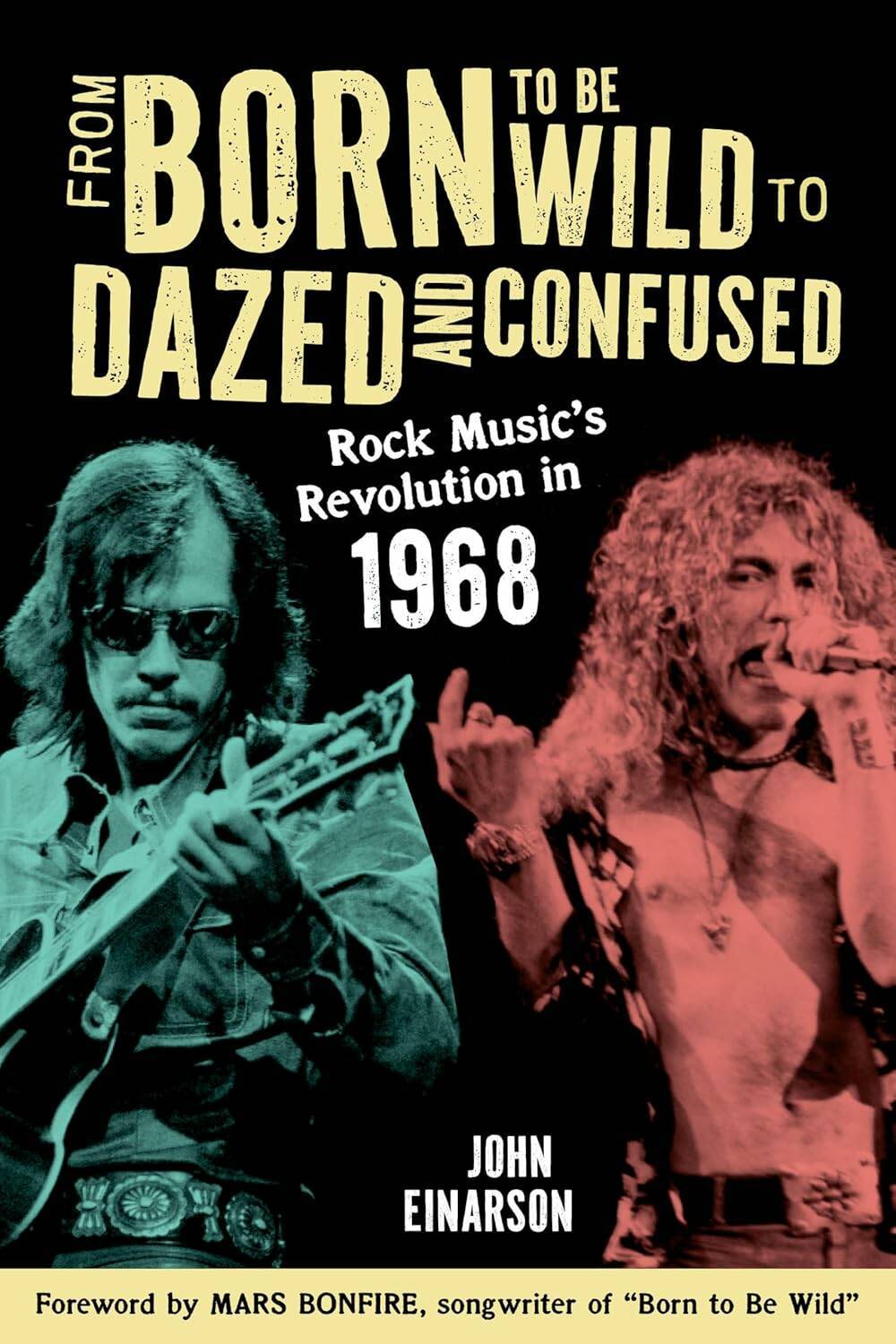
From Born to Be Wild to Dazed and Confused
Despite his literary output, he allows his crowning epitaph to be that “he opened for Led Zeppelin” as the 17-year-old guitarist of local band Euphoria at the Man-Pop Festival at Winnipeg Stadium in August 1970.
He’s clearly a rock-music musicologist of the first order. And he also knows the tech stuff inside out. As a former rock musician, he writes knowledgably about guitar makes and models, tunings, chord progressions and amplifier manufacturers and sizes.
But his focus this time round is conceptual, and much more ambitious than a rock bio. It’s a cultural history, viewed through the lens of rock music in the late 1960s.
He’s set himself a tall order — one he doesn’t fill, and which is handicapped by a dubious editorial choice in the book’s format.
Einarson traces the evolution of rock ‘n’ roll from psychedelia to heavy rock to heavy metal. Each of the three years he principally treats of — 1967, ‘68 and ‘69 — is introduced by a “Timeline of Significant Events,” multi-page month-by-month one- or two-sentence bulleted lists of significant historical or musical events of each year.
It’s the kind of pedagogical aid Einarson, a former schoolteacher, might employ for instructing middle or high school students. But it has no business in a cultural history about rock music.
Some of the timeline potted summaries also surface in the chapters that follow. But far better if more of them were integrated into the music-driven narrative, and the bulleted lists nixed.
The net result: the music isn’t fully and seamlessly placed within the larger context of the times and shaping historical events.
The book’s title encompasses two songs Einarson considers signal recordings for the birth of hard rock — Steppenwolf’s Born to Be Wild, released in 1968, and Led Zeppelin’s Dazed and Confused, released in 1969.
But he begins the narrative in 1965, with the rise of psychedelic music. He charts how psychedelia’s gentler, more experimental ethos gave way through 1966-67 to a louder, heavier and more visceral sound, pioneered by the Who, the Jimi Hendrix Experience and Jeff Beck. It finally crystallized in the likes of Steppenwolf and Led Zeppelin, he maintains.
He links the evolution of psychedelic-cum-flower-power rock into a darker, heavier rock genre due to worsening geopolitical events — the Vietnam War’s Tet Offensive, the assassinations of Martin Luther King and Robert F. Kennedy, increasingly violent student and civil-rights protests, the presidential election of Richard Nixon. This heavy rock, often today dubbed “classic rock,” in turn gave way to a host of successor imitators, collectively known as heavy metal.
Heavy metal music’s intellectual quotient is near zero. It’s a kind of a soma, loudly lulling its fans into ignoring real-world issues.
Both early and later practitioners (Black Sabbath, Iron Maiden, Megadeath, Metallica) are weak derivatives of the pioneers of heavy rock (Jeff Beck, Cream, Led Zeppelin, Steppenwolf). What heavy metal imported was more overt sexual content, dilettantish dabbling in the occult, mysticism and Satanism, and adolescent proto-anarchism.

But Einarson renders neither a critical judgment nor an endorsing defence of the genre, remaining pretty much mute on its merits or lack of same.
This is an intelligent record of rock music’s evolution in the late 1960s.
But while it’s an interesting chronicle, there’s a dearth of considered scrutiny. The music’s interaction with politics and geopolitics is thin. The music’s interaction with contemporary books, movies, plays and television is negligible to non-existent. The broader context of the music is too often missing.
As cultural history, it’s criticism lite.
Douglas J. Johnston is a Winnipeg lawyer and writer.