Banff bison brought back from the brink of extinction
Advertisement
Read this article for free:
or
Already have an account? Log in here »
To continue reading, please subscribe:

Digital Subscription
One year of digital access for only $205*
- Enjoy unlimited reading on winnipegfreepress.com
- Read the E-Edition, our digital replica newspaper
- Access News Break, our award-winning app
- Play interactive puzzles
*First annual payment billed as $205.00 + GST for one year. This annual subscription will automatically renew at $233.00 + GST every 52 weeks (10% off the regular annual price of $259.35). Offer available to new and qualified returning subscribers only. Cancel any time.
To continue reading, please subscribe:
Add Free Press access to your Brandon Sun subscription for only an additional
$1 for the first 4 weeks*
- Enjoy unlimited reading on winnipegfreepress.com
- Read the E-Edition, our digital replica newspaper
- Access News Break, our award-winning app
- Play interactive puzzles
*Your next Brandon Sun subscription payment will increase by $1.00 and you will be charged $17.95 plus GST for four weeks. After four weeks, your payment will increase to $24.95 plus GST every four weeks.
Read unlimited articles for free today:
or
Already have an account? Log in here »
There were some in Winnipeg who swear they saw buffalo roaming their city streets during the memorable 1966 blizzard in March that smothered both cars and commuters and brought everything to a snow-filled standstill.
What they really saw in the blizzard were police officers in their marvellous 11-kilogram buffalo coats helping people survive. (If police were chasing someone on foot, they’d throw off the coat and let somebody return it for a finder’s fee. Winnipeg Police stopped using buffalo coats in the early 1970s.)
This anecdote isn’t in Karsten Heuer’s Buffalo Lessons, but it helps illustrate our kinship with a wild animal that used to carpet the Canadian Prairies, as lovingly described by Heuer in the saga of an animal that covered much of North America, like wall-to-wall shag carpet, until early settlers from Europe just about wiped all of them out. They were as close to extinction as the carrier pigeon.
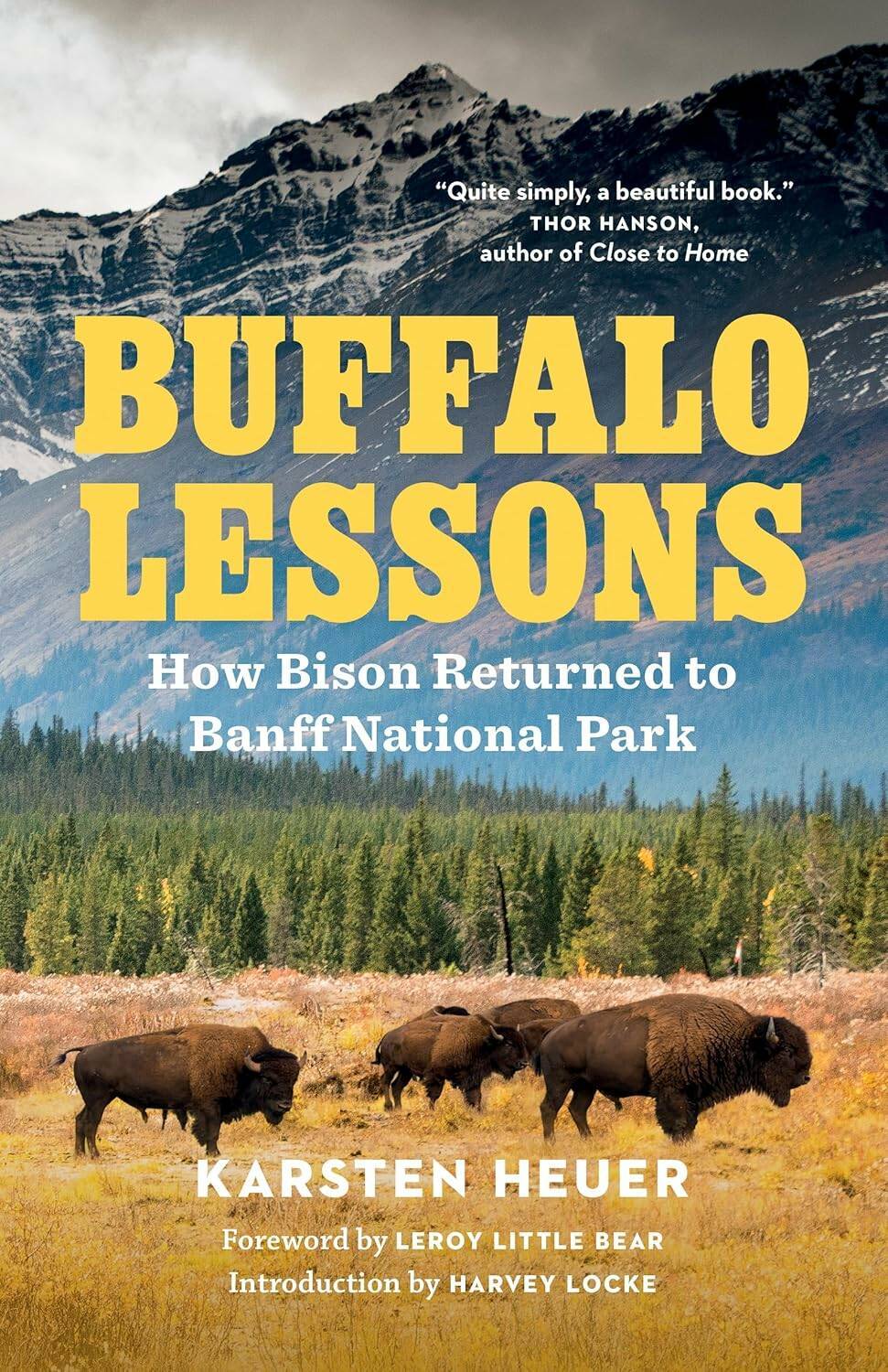
Buffalo Lessons
Buffalo Lessons is the story of the relocation of plains bison to Banff National Park starting in 2017. Heuer, a conservationist, biologist, author and filmmaker, was head of the project. He died at age 56, shortly after finishing the manuscript.
Bison are remarkable animals. Bulls can weigh up to 1,000 kilograms and run 55 kilometres an hour, faster than a horse (so don’t try to outrun one). They can leap nearly two metres, and bulls can be two metres tall and nearly twice as long. They are the largest land animal in North America.
Enormous herds of buffalo, millions of them, roamed half of North America before European settlers nearly exterminated them in the 1800s. By the late 1880s, fewer than 100 buffalo remained. There are chilling photos out there of huge mounds of buffalo bones and proud marksmen skinning animals of their fur, leaving their carcasses to rot in the sun. It was an ecological nightmare.
What all this did to the Indigenous population who relied on the buffalo for sustenance and clothing is hardly imaginable.
“There is something about buffalo that makes them special,” says conservationist and writer Harvey Locke, in his introduction to Buffalo Lessons. “To the First Peoples of North America… these animals are central to their culture as teacher, provider, and main actor in their stories. ”
Heuer was the biologist picked to reintroduce bison in Banff, in one of the most ambitious conservation efforts in modern history. It began in 2017 and was completed in 2024.
The bison were trucked about 400 kilometres north from Elk Island National Park to Banff National Park. They were herded on horseback to attach tracking collars and airlifted to rugged backcountry in a remote part of the park.
There were exciting times during the transfer of the buffalo to Banff, including a chase on horseback, a helicopter-assisted translocation into the rugged terrain and the risky tracking of wayward bulls that scale steep, treacherous terrain.
In 2024, the year Heuer died, his herd had grown to over 100 bison, and late that year the first ceremonial Indigenous hunt in 150 years took place in the park.
Barry Craig is a retired journalist.