Early editions
Manitoba’s early newspapers painted province as rife with untapped potential — to the detriment of theIndigenous community
Advertisement
Read this article for free:
or
Already have an account? Log in here »
To continue reading, please subscribe:

Digital Subscription
One year of digital access for only $205*
- Enjoy unlimited reading on winnipegfreepress.com
- Read the E-Edition, our digital replica newspaper
- Access News Break, our award-winning app
- Play interactive puzzles
*First annual payment billed as $205.00 + GST for one year. This annual subscription will automatically renew at $233.00 + GST every 52 weeks (10% off the regular annual price of $259.35). Offer available to new and qualified returning subscribers only. Cancel any time.
To continue reading, please subscribe:
Add Free Press access to your Brandon Sun subscription for only an additional
$1 for the first 4 weeks*
- Enjoy unlimited reading on winnipegfreepress.com
- Read the E-Edition, our digital replica newspaper
- Access News Break, our award-winning app
- Play interactive puzzles
*Your next Brandon Sun subscription payment will increase by $1.00 and you will be charged $17.95 plus GST for four weeks. After four weeks, your payment will increase to $24.95 plus GST every four weeks.
Read unlimited articles for free today:
or
Already have an account? Log in here »
Historian Howard Zinn once compared the historian’s perspective to that of the mapmaker. We have the human tendency to see the world from our point of view, regardless of our best intentions and feigned attempts at objectivity.
Such is the same for newspapers, both historically and in their present form. Newspapers carry with them a certain perspective — a leaning of sorts that is inherent and molded in the perspective of owners, editorial boards and journalists themselves.
You can’t be neutral on a moving train, as Zinn would argue.
Mike Deal / Free Press files
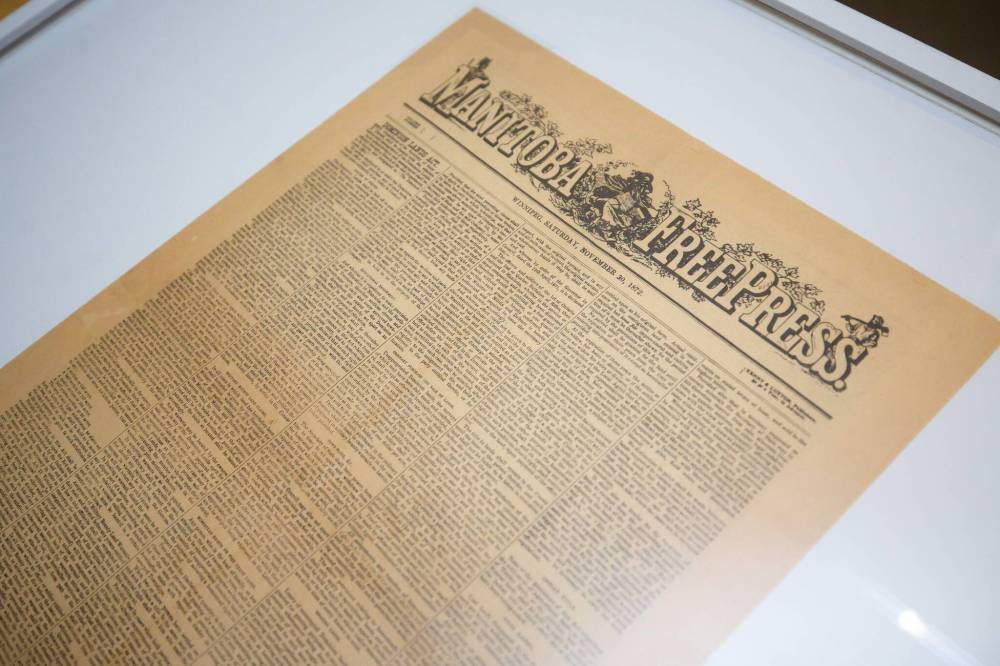
In the 19th century, however, newspapers notoriously and explicitly saw the world and tried to shape it from the perspective and agenda of its owners. George Brown’s Globe in Upper Canada, for example, was a classic example of a partisan media that used its platform to undermine rivals, the French and various governments.
Winnipeg, or Red River, was not immune to the partisan press, and in fact, according to University of Regina historian Shelisa Klassen, was shaped and colonized thanks in part to the messages and myths espoused by various editors and owners. In Imprinting Empire: Land and Settler Colonialism in Manitoba Newspapers, Klassen argues that newspapers and immigration pamphlets in the 1870s and 1880s helped create the conditions for land grabs, dispossession, erasure and the advent of a colonial experiment that has yet to fully reveal itself.
Drawn from her PhD dissertation, Klassen’s work also tells the story of Indigenous, and notably Métis, resistance to settler narratives — ones that suggested the prairie held nothing but vastness and untamed potential. In reality, the complexity, diversity and indigeneity of Red River and Manitoba (think postage stamp-sized Manitoba) in many ways defied the pace of the settler colonial project — and perhaps does to this day. Indigenous (First Nations and Métis) resistance and reclamation are at the heart of Winnipeg and Manitoba in 2026. As Klassen argues, Winnipeg, and Manitoba more broadly, had remained an Indigenous space, even as settlers arrived in ever-increasing numbers.
For Klassen, the power vacuum created by the Hudson’s Bay Company’s departure in 1869, coupled with Métis resistance, helped germinate a ubiquitous press — the amount of newspapers given the population at the time is mind-boggling — that “played an important role in the mythmaking project of creating settler colonialism.” Red River was isolated due to climate and a lack of rail, so life was incredibly difficult. Settler newspapers, controlled by the likes of William Luxton, Acton Burrows, William Coldwell, and John Christian Schultz, were set on creating a narrative for would-be immigrants that land was waiting and wealth impending.
But there were also newspapers focused on resisting the spread of the British empire. The Louis Riel’s government’s New Nation, which would later become Le Métis, would be highly critical of the motives of Canada’s colonial project. The voices of First Nations, not surprisingly, are systematically erased from newspapers — perhaps barely making an appearance in columns devoted to treaties. As Haitian historian Michel-Rolph Trouillot has noted, history can be silenced at many points, most notably at the source and in the creation of narratives. The conflation of the Métis experience with that of First Nations throughout history can misrepresent the experience of those on the prairies — both then and now.

Imprinting Empire
Klassen scours newspapers and pamphlets from Red River at the end of the 19th century to paint a picture of how we have come to our current nexus point in this city and province. Treaties were weaponized to remove First Nations from their land, and the Manitoba Act was systematically ignored to deny the Métis reserve land that was promised. As she posits, “intense levels of government control, surveillance, and forced assimilation were required in order to create a ‘liberal order’ for white settler Canadians.” And newspapers delivered the message, both locally and abroad.
In Imprinting Empire, Klassen carefully peels back the nuance of a media and capitalist oligarchy desperate for labour and investment, while new immigrants from Ontario and the United States soon realized the Eden-esque myths that were created were couched in colonial arrogance. “The white settlers of the 1870s had not arrived at the ‘blank slate’ many of them had optimistically imagined, and instead found themselves in a largely Indigenous province that was still dealing with the aftermath of their resistance to Canadian expansion,” she argues.
In 2026, Indigenous (First Nations) resistance is alive and well, and it would be wise for settlers to understand their place within this complexity. Honouring treaties and their spirit is most certainly the first step.
The second would be to listen — and allow space for Indigenous voices to continue to shape the narrative of this place. Providing space counters the colonial desire for the erasure of indigeneity and creates the conditions for everyone to thrive.
Matt Henderson is superintendent of the Winnipeg School Division.

Andrea Norberg
Shelisa Klassen