Hitler’s dismantling of Weimar Republic chronicled
Advertisement
Read this article for free:
or
Already have an account? Log in here »
To continue reading, please subscribe:

Digital Subscription
One year of digital access for only $205*
- Enjoy unlimited reading on winnipegfreepress.com
- Read the E-Edition, our digital replica newspaper
- Access News Break, our award-winning app
- Play interactive puzzles
*First annual payment billed as $205.00 + GST for one year. This annual subscription will automatically renew at $233.00 + GST every 52 weeks (10% off the regular annual price of $259.35). Offer available to new and qualified returning subscribers only. Cancel any time.
To continue reading, please subscribe:
Add Free Press access to your Brandon Sun subscription for only an additional
$1 for the first 4 weeks*
- Enjoy unlimited reading on winnipegfreepress.com
- Read the E-Edition, our digital replica newspaper
- Access News Break, our award-winning app
- Play interactive puzzles
*Your next Brandon Sun subscription payment will increase by $1.00 and you will be charged $17.95 plus GST for four weeks. After four weeks, your payment will increase to $24.95 plus GST every four weeks.
Read unlimited articles for free today:
or
Already have an account? Log in here »
In late January 1933, Adolf Hitler was appointed chancellor of Germany. He moved quickly to consolidate his power, effectively entrenching himself as an unchecked ruler within less than two months.
European historian Timothy Ryback recounts Hitler’s transformation of the German political system in 53 Days, an interesting but conventional narrative that does provides little in the way of original insights.
Ryback claims that he has invoked “fresh perspectives from previously unexplored archives and primary sources.” But there is little evidence of this in his retelling of a familiar story.
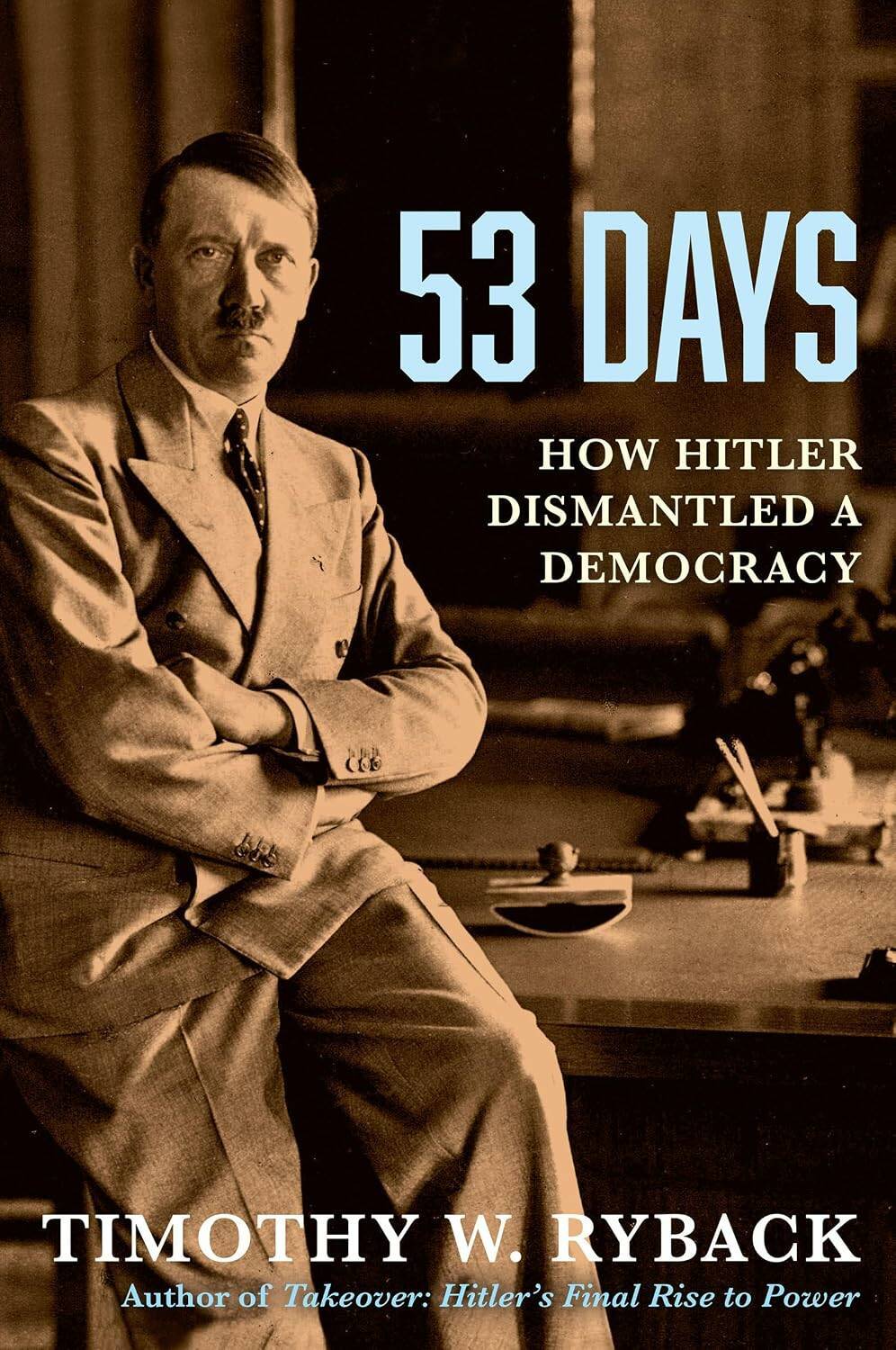
53 Days
Ryback details the steps which Hitler took to dismantle Germany’s democratic regime known as the Weimar Republic. The opposition press was suppressed, the civil service was purged and the infamous Reichstag fire was exploited to crack down on political opponents.
These measures culminated in an Enabling Act that was passed in the German parliament and gave Hitler dictatorial powers.
Thus Hitler maintained a veneer of legality in implementing his plan to create an authoritarian state with himself as leader, a state that would repudiate the “wheedling and finagling” of parliamentary democracy, which Hitler despised.
As Hitler’s chief propagandist, Joseph Goebbels, observed, “the big joke on democracy is that it provides its mortal enemies the means to its own destruction.”
In his quest to centralize power, Hitler was opposing the federal character of the Weimar constitution and much German history. This puts Ryback in the ironic position of defending states’ rights, a constitutional principle that he would be unlikely to endorse in the American context.
In 2016, a professor of Holocaust studies, Nathan Stoltzfus, published Hitler’s Compromises, an insightful book which argued that Hitler, when his policies aroused popular discontent, would change course, adopting a tack less likely to provoke disapproval.
Ryback provides an anecdote that confirms Stoltzfus’s thesis.
He notes that public concern over Nazi excesses prompted Hitler to try to rein in his followers. “I command you to observe the strictest discipline from now on,” Hitler said in a radio broadcast.
But Nazi thugs ignored this directive.
Ryback has written an engaging narrative, but its lack of originality makes it a disappointing effort. He may think that he has produced a cautionary tale for America, but he is only deluding himself.
Graeme Voyer is a Winnipeg writer.