In ’20 Days in Mariupol’ doc, the horrors of war illuminated

Advertisement

Advertise with us

PARK CITY, Utah (AP) — Associated Press video journalist Mstyslav Chernov had just broken out of Mariupol after covering the first 20 days of the Russian invasion of the Ukrainian city and was feeling guilty about leaving. He and his colleagues, photographer Evgeniy Maloletka and producer Vasilisa Stepanenko, had been the last journalists there, sending crucial dispatches from a city under a full-scale assault.

Read this article for free:


or

Already have an account? Log in here »

To continue reading, please subscribe:

Subscribe and receive a limited-edition Free Press branded hat or tote.

Digital Subscription

One year of digital access for only $205*

  • Enjoy unlimited reading on winnipegfreepress.com
  • Read the E-Edition, our digital replica newspaper
  • Access News Break, our award-winning app
  • Play interactive puzzles

*First annual payment billed as $205.00 + GST for one year. This annual subscription will automatically renew at $233.00 + GST every 52 weeks (10% off the regular annual price of $259.35). Offer available to new and qualified returning subscribers only. Cancel any time.

To continue reading, please subscribe:

Add Free Press access to your Brandon Sun subscription for only an additional

$1 for the first 4 weeks*

  • Enjoy unlimited reading on winnipegfreepress.com
  • Read the E-Edition, our digital replica newspaper
  • Access News Break, our award-winning app
  • Play interactive puzzles
Start now

*Your next Brandon Sun subscription payment will increase by $1.00 and you will be charged $17.95 plus GST for four weeks. After four weeks, your payment will increase to $24.95 plus GST every four weeks.

Hey there, time traveller!
This article was published 23/01/2023 (1350 days ago), so information in it may no longer be current.

PARK CITY, Utah (AP) — Associated Press video journalist Mstyslav Chernov had just broken out of Mariupol after covering the first 20 days of the Russian invasion of the Ukrainian city and was feeling guilty about leaving. He and his colleagues, photographer Evgeniy Maloletka and producer Vasilisa Stepanenko, had been the last journalists there, sending crucial dispatches from a city under a full-scale assault.

The day after, a theater with hundreds of people sheltering inside was bombed and he knew no one was there to document it. That’s when Chernov decided he wanted to do something bigger. He’d filmed some 30 hours of footage over his days in Mariupol. But poor and sometimes no internet connections made it extremely difficult to export anything. All told, he estimates only about 40 minutes of that successfully made it out to the world.

“Those shots which went out were very important. They went on the AP and then to thousands of news outlets,” Chernov said. “However, I had much more. … I thought I should do something more. I should do something more with that 30 hours of footage to tell a bigger story and more context to show the audience of the scale.”
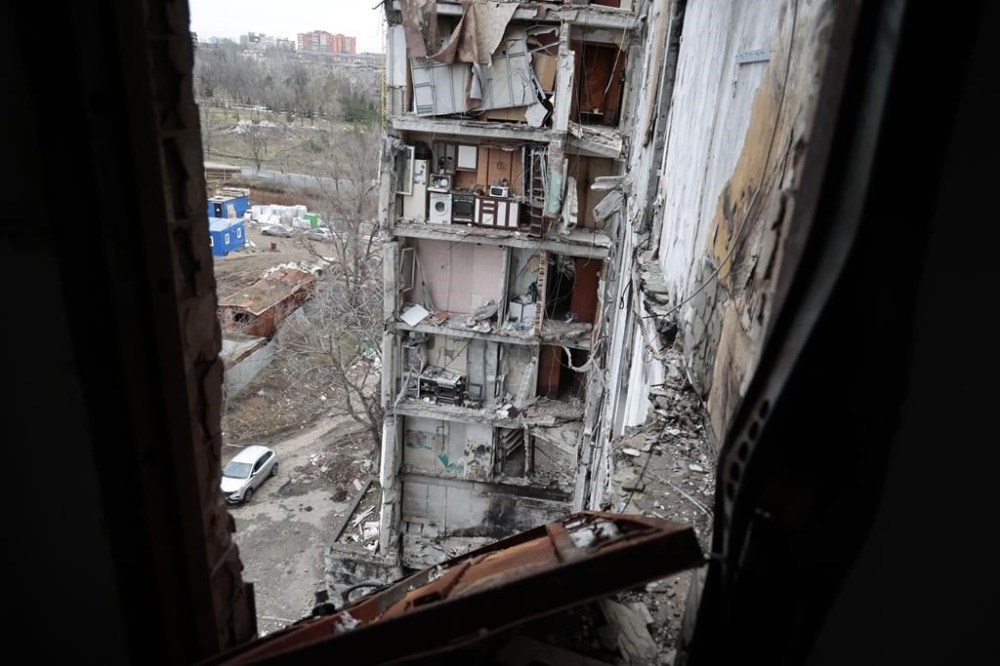
A view of an apartment building, damaged during a heavy fighting, in Mariupol, in Russian-controlled Donetsk region, eastern Ukraine, Thursday, Jan. 5, 2023. (AP Photo/Alexei Alexandrov)

Chernov decided then that he wanted to make a documentary. That film, “20 Days in Mariupol,” a joint project between The Associated Press and PBS “Frontline,” premiered Friday at the Sundance Film Festival in Park City, Utah, where it is playing in competition.

There were, he knew, many ways to tell this story. But he decided early on to keep it contained to those harrowing first 20 days that he and his colleagues were on the ground, to evoke the claustrophobic feeling of being trapped. He also chose to narrate it himself and tell the story as a journalist would.

“It’s just a lens through which we see the stories of Mariupol’s residents, the death, their suffering the destruction of their homes,” he said. “At the same time, I felt that I can do it. I’m allowed to do it because I’m part of the community. I was born in eastern Ukraine and (a) photographer who worked with me was born in the city which is right next to Maruipol, which got occupied. So this is our story too.”

As an AP employee, Chernov was extremely aware of maintaining neutrality and being unbiased.

“It’s OK to tell the audiences about your emotions,” he said. “It’s just important to not let those emotions dictate what you show and don’t show …. While narrated by me, I still tried to keep it fair.”

He encounters quite a few different reactions to him and his colleagues being on the ground. Some thanked them for doing their jobs. Some called them prostitutes. Some doctors urged them to film graphic scenes of injured and dead children to show the world what had been done.

After Chernov left Mariupol and was finally able to catch up with the news reports around the world, he was stunned by the effect their footage seemed to have had. They followed up with people they’d met during their time there, some of whom got out, some who didn’t, and asked whether or not they’d affected their lives.

Some said relatives had found them because of the footage, or that they’d been able to get help. Doctors and officials said it made it easier to negotiate the green corridor to safety.

“I don’t know how much of that is our footage, how much of that is just what happens,” Chernov said. “But I really would like to believe that we did make a difference, because I guess that’s what journalism is about, to inform people so they make certain decisions.”

Another mission for him was to provide historical evidence for potential war crimes. Chernov is keenly aware that the war is not even history yet. It is a painful reality that is ongoing.

At Sundance he’s been able to watch the film, edited by “Frontline’s” Michelle Mizner, with an audience two times. The film got a standing ovation at the premiere. And a subsequent screening he met several audience members who said they were from Mariupol and that their relatives were escaping the sieged city at the same time he was. The theaters, had counselors on standby in case anyone needed support.

“I hoped they will have emotional responses and they did. But at the same time to watch people crying, it’s hard,” he said. “When you place an audience for 90 minutes into this chaos and this mess and this violence, there is a risk of people getting too overwhelmed or even pushed back by the amount of this violence.

“You just really want to show how it really was,” he added. “That was the main challenge of making choices while assembling the film. How do you show the gravity but at the same time not push the audience away? … We had already two screenings and audience responses are very strong. People are crying, people are depressed and they express a wide range of feelings, from anger, to sadness, to grief. That is what I as a filmmaker intended to do. But at the same time, I realize that probably that’s not easy for everyone”

Now Chernov just wants to get back to work.

“I just want to go back,” he said. “After Sundance we will go back and go to the front line.”

___

Follow AP Film Writer Lindsey Bahr: www.twitter.com/ldbahr.

___

For a longer interview with Chernov about the film, watch: https://www.youtube.com/watch?v=4kf0EnlPlv8

___

For more coverage of the Sundance Film Festival, visit: https://apnews.com/hub/sundance-film-festival.

Report Error Submit a Tip

More Stories

Letters, Oct. 3

7 minute read Yesterday at 2:01 AM CDT

A morning in the life …

My very first lesson does not start when I walk into that lecture hall, oh no — it starts long before. It begins when I walk to my car, check the estimated arrival time to the University of Manitoba and hope that Winnipeg traffic agrees with it.

A drive that appears completely manageable changes almost immediately when I’m greeted by a tsunami of orange pylons and a line of cars that appears to go on forever. Traffic moves by the inch, lanes magically disappear and the detour I took yesterday now has a detour of its own. These factors make me do a calculation that I have become all too familiar with. How late can I arrive and still find parking, run to my class across campus and get to class with enough time left to make it worth it?

I have grown used to people saying, “Why not just leave earlier?” I do. But when I’m already leaving for my 8:30 a.m. class at 7 a.m., there’s only so much I can do. This drive that some would think is relaxing is one that feels like an assignment that I didn’t know I had to complete and is due at 8:30 a.m.

A day on the campaign trail: Winnipeg's mayor, seeking a second term, does double duty

Malak Abas 12 minute read Preview

A day on the campaign trail: Winnipeg's mayor, seeking a second term, does double duty

Malak Abas 12 minute read Friday, Oct. 2, 2026

In the weeks leading up to the civic election, Scott Gillingham has been performing a juggling act: he’s running to be Winnipeg’s 45th mayor, while still serving as its 44th.

“If someone asks me about the campaign, I’m going to answer them. But I think for most people, I’m the mayor of Winnipeg, even if I’m showing up as a candidate,” Gillingham, 58, says. “I try to do all I can to maintain that distinction.”

The Free Press joined Gillingham on a recent rainy September Saturday on the campaign trail, where he served in both roles during an event-laden day. City council’s final meeting before the Oct. 28 election was days earlier.

In Winnipeg, it’s rare for an incumbent to be defeated. But Gillingham knows his win in 2022 wasn’t exactly a landslide — he won with 27.5 per cent of the vote — and he’s been thinking about his second term ever since.

Read
Friday, Oct. 2, 2026

Today’s horoscope

Georgia Nicols 4 minute read Preview

Today’s horoscope

Georgia Nicols 4 minute read 2:00 AM CDT

MOON ALERT: Caution! Avoid shopping (except food and gas) and important decisions until after 6:30 p.m. today. After that, the moon moves from Cancer into Leo.

ARIES (March 21-April 19)

Don’t expect much co-operation from partners, spouses and close friends. This is why you might feel cut off from others or a bit lonely. There’s the sense a gulf exists between you and everyone else. But this is temporary. Courage!

TAURUS (April 20-May 20)

Read
2:00 AM CDT

Creative powerhouse Perry Rosemond never lost Winnipeg roots

Ben Waldman 7 minute read Preview

Creative powerhouse Perry Rosemond never lost Winnipeg roots

Ben Waldman 7 minute read Yesterday at 6:00 AM CDT

He created King of Kensington, directed the troops in the Royal Canadian Air Farce, and his creative eye was behind the lens for television shows starring Johnny Cash, Tom Jones, Mr. Dress-Up and the Friendly Giant.

He also wrote and developed the Canadian version of Sesame Street during his time as the head of school and preschool programming for CBC in Toronto, and directed a televised special in 2002 for Winnipeg sketch comedy troupe Royal Liechtenstein Theatre Company.

But before his name featured in the credits of some of the most iconic and influential pieces of the Cancon canon, Perry Rosemond was an only child living in a crammed, multi-generational home in Winnipeg’s North End, racing each day to beat the morning bell next door at William Whyte School.

In memoirs that have yet to be published, the late television producer recalled his childhood. “(T)here were 14 of us in the house at 193 Andrews St., and it wasn’t that big of a house,” he writes.

Read
Yesterday at 6:00 AM CDT

Brandonmeat packer thriving on its own

Abiola Odutola 3 minute read Preview

Brandonmeat packer thriving on its own

Abiola Odutola 3 minute read Yesterday at 2:01 AM CDT

BRANDON — Canada Packers has strengthened its business and laid the foundation for future growth during its first year as an independent company, its president says.

The Brandon-based pork producer, separated from Maple Leaf Foods in October 2025, established its own leadership, strategy, systems, culture and identity while continuing operations across its hog production farms and regional hog barns in southern and eastern Manitoba.

The company’s first year was focused on building a successful standalone business while continuing to serve customers, communities and shareholders, president Dennis Organ said.

“Market conditions over the past year have been more challenging than we anticipated when we became a separate entity,” he said in an email. “Despite that, we continued to execute against our priorities, including increasing processing volumes, maintaining disciplined operations and strengthening the business.”

Read
Yesterday at 2:01 AM CDT

Province looks to seize notorious drug den

Erik Pindera 5 minute read Preview

Province looks to seize notorious drug den

Erik Pindera 5 minute read Yesterday at 12:00 PM CDT

Provincial justice officials are trying to seize a Dominion Street drug den that has been the source of trouble in the West End for years.

The owner of 982 Dominion St., 45-year-old Robert Edward Johnson, was most recently arrested in June along with several others after a lengthy Winnipeg Police investigation into thefts and illicit drug sales connected to the house.

“The residence has a reputation within the neighbourhood as being a location where individuals habitually attend for the purpose of purchasing and/or consuming controlled substances,” reads a statement of claim filed by the province’s director of civil forfeiture in the Court of King’s Bench last week.

“For several years, the residence has been associated with criminal activity, violence, and disorder, resulting in numerous police attendances and complaints from members of the surrounding community.”

Read
Yesterday at 12:00 PM CDT