‘Almost authoritarian:’ Hawaii’s Cold War speech law may go

Advertisement

Advertise with us

HONOLULU (AP) — A Cold War-era law in Hawaii that allows authorities to impose sweeping restrictions on press freedoms and electronic communications during a state of emergency could soon be repealed by lawmakers over concerns about its constitutionality and potential misuse.

Read this article for free:


or

Already have an account? Log in here »

To continue reading, please subscribe:

Subscribe and receive a limited-edition Free Press branded hat or tote.

Digital Subscription

One year of digital access for only $205*

  • Enjoy unlimited reading on winnipegfreepress.com
  • Read the E-Edition, our digital replica newspaper
  • Access News Break, our award-winning app
  • Play interactive puzzles

*First annual payment billed as $205.00 + GST for one year. This annual subscription will automatically renew at $233.00 + GST every 52 weeks (10% off the regular annual price of $259.35). Offer available to new and qualified returning subscribers only. Cancel any time.

To continue reading, please subscribe:

Add Free Press access to your Brandon Sun subscription for only an additional

$1 for the first 4 weeks*

  • Enjoy unlimited reading on winnipegfreepress.com
  • Read the E-Edition, our digital replica newspaper
  • Access News Break, our award-winning app
  • Play interactive puzzles
Start now

*Your next Brandon Sun subscription payment will increase by $1.00 and you will be charged $17.95 plus GST for four weeks. After four weeks, your payment will increase to $24.95 plus GST every four weeks.

Hey there, time traveller!
This article was published 25/04/2023 (1247 days ago), so information in it may no longer be current.

HONOLULU (AP) — A Cold War-era law in Hawaii that allows authorities to impose sweeping restrictions on press freedoms and electronic communications during a state of emergency could soon be repealed by lawmakers over concerns about its constitutionality and potential misuse.

Those who are worried about the law, which allows a governor or mayor to suspend “electronic media transmissions” during a crisis, say that language could now also be interpreted to include social media posts, text messages and emails, as well as reporting by media outlets.

The Hawaii Association of Broadcasters says the existing law appears to be unique among all 50 states and violates the U.S. Constitution’s First Amendment.
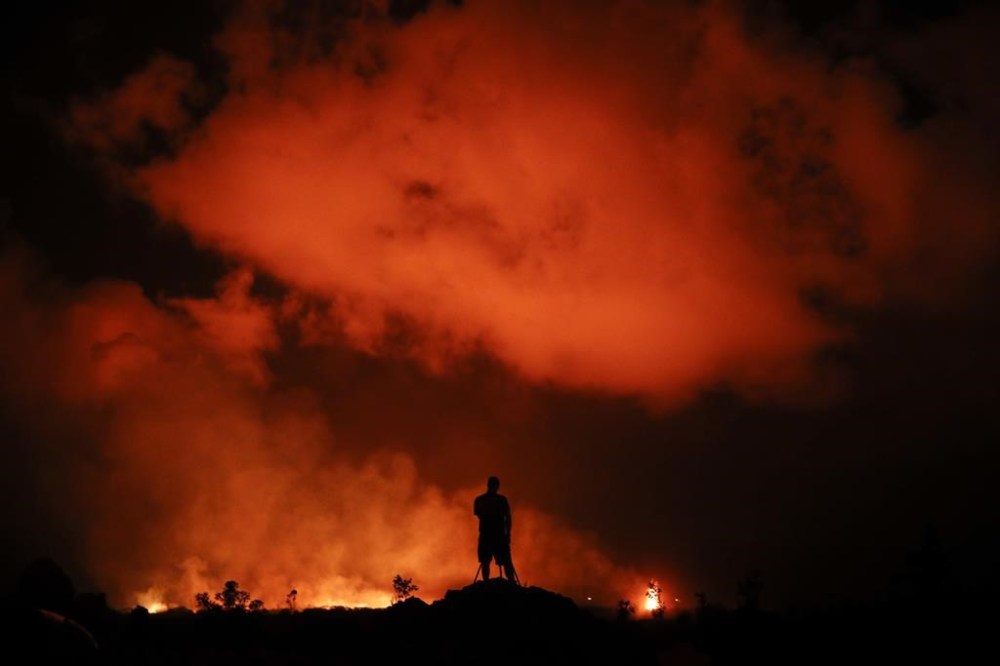
FILE - In this Friday, May 18, 2018 file photo, Peter Vance photographs lava erupting from the Kilauea volcano in the Leilani Estates subdivision near Pahoa, Hawaii, on May 18, 2018. A Cold War-era law in Hawaii that allows authorities to impose sweeping restrictions on press freedoms and electronic communications during a state of emergency could soon be repealed by lawmakers after concerns about its constitutionality and potential misuse in an era of increasing polarization. (AP Photo/Jae C. Hong, File)

“We get into a situation where … somebody could suspend electronic media because they don’t like what’s being said about them,” said Chris Leonard, the association’s president, who also operates a radio station on the Big Island.

Current state leaders haven’t invoked the law, but “Who knows who’s in office tomorrow?” he added.

Lawmakers in the state House and Senate have each passed versions of legislation to eliminate the decades-old rule and have a deadline this week to agree on language so the bill can move forward.

Christian Grose, a professor of political science and public policy at the University of Southern California, said the law “gives shockingly large amounts of power to the governor and mayors in ways that might be afoul of constitutional freedoms.”

“That’s sort of an unusual, almost authoritarian law that would allow such powers to be given to the governor or mayor,” Grose said.

Some do support leaving the law on the books.

James Barros, the head of the Hawaii Emergency Management Agency, said the law might still be needed to restrict electronic transmissions “that could trigger an explosive device or ignite volatile chemicals.”

The bill would eliminate the executive branch’s authority to take action that could save lives “based on a hypothetical restriction of free speech rights,” Barros said in written testimony.

The law appears to date to 1951, when the Cold War pitted the U.S. against the Soviet Union. There were concerns about radio frequency transmitters being used to identify bombing targets, said Leonard.

The law was revised about a decade ago to its current form, which allows a governor or mayor to: “Shut off water mains, gas mains, electric power connections, or suspend other services, and, to the extent permitted by or under federal law, suspend electronic media transmission.”
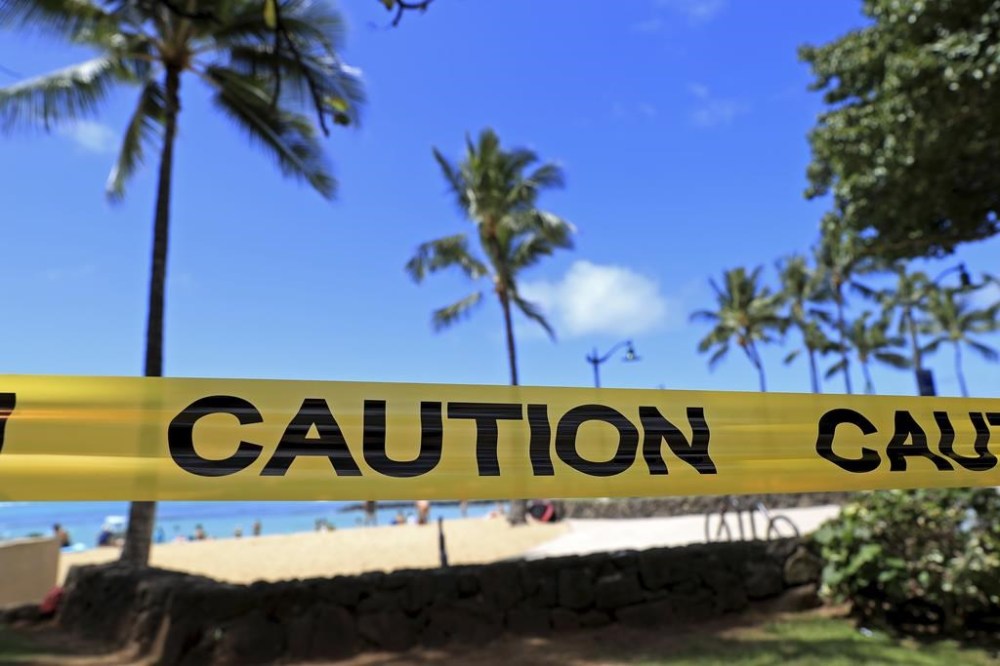
FILE - Yellow caution tape lines an area of Waikiki beach on March 20, 2020, in Honolulu during the COVID-19 pandemic. A Cold War-era law in Hawaii that allows authorities to impose sweeping restrictions on press freedoms and electronic communications during a state of emergency could soon be repealed by lawmakers after concerns about its constitutionality and potential misuse in an era of increasing polarization. (AP Photo/Marco Garcia, File)

Hawaii Emergency Management Agency spokesperson Adam Weintraub said Tuesday the agency agrees technology has evolved beyond what existed when the law was originated. He said the agency hopes to get to a compromise that addresses the broadcasters association’s concerns about speech restrictions.

The Hawaii County Council on the Big Island discovered the law last year when it was reviewing its own county code to align it with state law.

Information has helped calm people and make decisions during the 2018 eruption of Kilauea volcano and the COVID-19 pandemic, Ashley Lehualani Kierkiewicz, a county council member, explained in testimony to state legislators.

“In times of emergency and natural disasters, the public needs more information — not less — and communication should flow through all possible channels as frequently as possible,” she said in written testimony.

It’s notable that Hawaii’s lawmakers are considering taking away executive power because the trend in the U.S. government and in some other states has been for the executive to amass power without legislators stopping them, Grose said.

“So the fact that Hawaii’s is doing this is big,” he said.

Report Error Submit a Tip

More Stories

Driver of stolen vehicle facing impairment, other charges after fatal high-speed crash in West Kildonan Sunday

Scott Billeck 2 minute read Preview

Driver of stolen vehicle facing impairment, other charges after fatal high-speed crash in West Kildonan Sunday

Scott Billeck 2 minute read Monday, Sep. 21, 2026

A 19-year-old man faces impaired driving and other charges after a crash involving a stolen vehicle in north Winnipeg killed a 20-year-old woman and another left another woman with life-threatening injuries.

Read
Monday, Sep. 21, 2026

Audited public accounts show Manitoba's deficit last year half of predicted $1.67 billion

Carol Sanders 6 minute read Preview

Audited public accounts show Manitoba's deficit last year half of predicted $1.67 billion

Carol Sanders 6 minute read Monday, Sep. 21, 2026

Manitoba’s audited public accounts for the last fiscal year show the province is “moving in the right direction,” NDP Finance Minister Adrien Sala said Monday.

The provincial deficit for fiscal 2025-26 was $832 million, nearly half the $1.67-billion deficit forecast in December, and in line with the $794-million estimate in Budget 2026.

“I’m particularly proud of this final result, (given the potential) implications of tariffs on our economy, the worst wildfire season in 30 years — which resulted in significant emergency expenditures — and, of course, a significant drought,” Sala said at a news conference.

The province reported revenues of $25.1 billion and expenses of $25.9 billion, resulting in the $832-million deficit. Manitoba’s net debt is $36.5 billion and costs the province $2.3 billion a year in debt-servicing charges.

Read
Monday, Sep. 21, 2026

AC/DC leaves Winnipeg crowd thunderstruck

Rob Williams 5 minute read Preview

AC/DC leaves Winnipeg crowd thunderstruck

Rob Williams 5 minute read Monday, Sep. 21, 2026

AC/DC proved once again that rock ‘n’ roll ain’t noise pollution.

A rowdy stadium of about 35,000 people at Princess Auto Stadium couldn’t agree more as the Australian rock legends made their first trip to the city since 2015 on their PWR/UP tour, cranking out two hours and 20 minutes of raw and raunchy high-voltage material, a mix of blues, crunchy power chords, melodic riffs and double entendres that spanned five decades.

Their wide-ranging appeal was apparent in the demographic makeup of the crowd, which ranged from young children to seniors, many clad in $30 glowing devil horns from the well-stocked merch booth that also offered posters, banners, beer koozies, lanyards, tour books and T-shirts.

There is no one in music quite like guitar god Angus Young. He is 71, but onstage he is ageless, a hyperactive teenager dressed in his signature blue schoolboy uniform and yellow and blue cap, running around, duck-walking and leaping in the air while cranking out riff after riff and extended solos on his trusty black Gibson SG.

Read
Monday, Sep. 21, 2026

Jets goaltender collects victory in first start for new team

Mike McIntyre 7 minute read Preview

Jets goaltender collects victory in first start for new team

Mike McIntyre 7 minute read Monday, Sep. 21, 2026

He received the loudest ovation on the team before the puck had even been dropped, with chants of “Stuuuuu” ringing out inside Canada Life Centre during pre-game introductions.

And he heard the love time and time again — with each and every save, in fact — as the evening progressed.

Yes, the Stuart Skinner era is off to a strong start, as the new No. 1 man in net for the Winnipeg Jets made a great first impression on Monday in front of an announced crowd of 13,363.

Skinner stopped 31 of 32 shots he faced in a 3-1 pre-season victory for the Jets over a very young, inexperienced Colorado Avalanche squad.

Read
Monday, Sep. 21, 2026

Disgraced former law dean arrested, facing extradition to Canada: report

Morgan Modjeski 2 minute read Preview

Disgraced former law dean arrested, facing extradition to Canada: report

Morgan Modjeski 2 minute read Yesterday at 10:26 PM CDT

Jonathan Black-Branch, the disgraced former dean of law at the University of Manitoba, has been arrested in Europe and is awaiting extradition to Canada on fraud charges, according to a media report.

Black-Branch, who failed to defend himself in a lawsuit filed by the U of M and his disbarment proceedings, was ordered in May 2025 to repay more than $682,000 in misspent expense funds.

Winnipeg police confirmed his arrest and pending extradition, CTV Winnipeg reported Tuesday.

Black-Branch left the university in 2020 amid allegations he had misspent public dollars and schemed to evade oversight while running Robson Hall from 2016 to 2020.

Read
Yesterday at 10:26 PM CDT

Revealing statements by Trump about courts

Editorial 4 minute read Preview

Revealing statements by Trump about courts

Editorial 4 minute read 2:00 AM CDT

Analyzing the utterances of U.S. President Donald Trump may seem like the ultimate sort of mug’s game — they are varied, contradictory, rambling, pugilistic, sometimes wheedling and the list goes on.

But even so, some things occasionally jump right out of the background noise. Not because they are particularly different, but because they sound unwittingly honest.

Last week, the president was reacting to a decision by the U.S. Supreme Court on an executive order regarding the U.S. Postal Service and restricting voting by mail.

Neil Gorsuch, Amy Coney Barrett and Brett Kavanaugh, all nominated by Trump, were among the judges that opposed the plan.

Read
2:00 AM CDT