Ed Dwight was to be the first Black astronaut. At 90, he’s finally getting his due

Advertisement

Advertise with us

NEW YORK (AP) — Ed Dwight grew up in segregated 1930s Kansas on a farm on the edge of town. An airfield was within walking distance, and, as a boy, he’d often go to marvel at the planes and gawk at the pilots. Most were flying back from hunting trips and their cabins were messy with blood and empty beers cans on the floor.

Read this article for free:


or

Already have an account? Log in here »

To continue reading, please subscribe:

Subscribe and receive a limited-edition Free Press branded hat or tote.

Digital Subscription

One year of digital access for only $205*

  • Enjoy unlimited reading on winnipegfreepress.com
  • Read the E-Edition, our digital replica newspaper
  • Access News Break, our award-winning app
  • Play interactive puzzles

*First annual payment billed as $205.00 + GST for one year. This annual subscription will automatically renew at $233.00 + GST every 52 weeks (10% off the regular annual price of $259.35). Offer available to new and qualified returning subscribers only. Cancel any time.

To continue reading, please subscribe:

Add Free Press access to your Brandon Sun subscription for only an additional

$1 for the first 4 weeks*

  • Enjoy unlimited reading on winnipegfreepress.com
  • Read the E-Edition, our digital replica newspaper
  • Access News Break, our award-winning app
  • Play interactive puzzles
Start now

*Your next Brandon Sun subscription payment will increase by $1.00 and you will be charged $17.95 plus GST for four weeks. After four weeks, your payment will increase to $24.95 plus GST every four weeks.

Hey there, time traveller!
This article was published 09/02/2024 (968 days ago), so information in it may no longer be current.

NEW YORK (AP) — Ed Dwight grew up in segregated 1930s Kansas on a farm on the edge of town. An airfield was within walking distance, and, as a boy, he’d often go to marvel at the planes and gawk at the pilots. Most were flying back from hunting trips and their cabins were messy with blood and empty beers cans on the floor.

“They’d say to me, ‘Hey kid, would you clean my airplane? I’ll give you a dime,’” Dwight, 90, recalls. But when he was 8 or 9, Dwight asked for more than a dime. He wanted to fly.

“My first flight was the most exhilarating thing in the world,” says Dwight, smiling. “There were no streets or stop signs up there. You were free as a bird.”
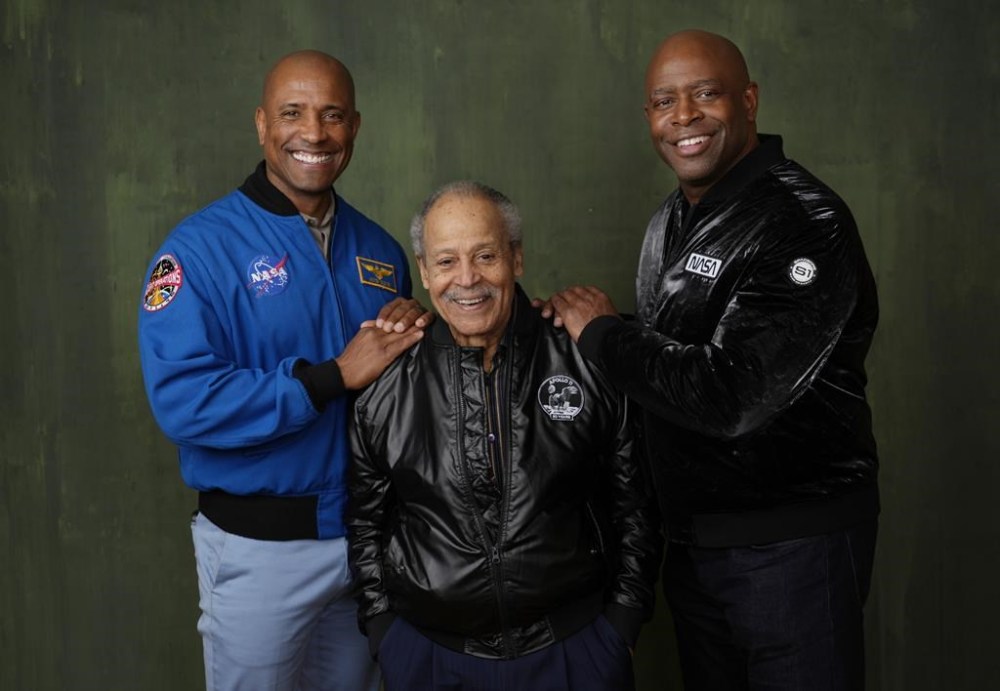
NASA astronauts Victor Glover, from left, Ed Dwight and Leland Melvin pose for a portrait to promote the National Geographic documentary film
NASA astronauts Victor Glover, from left, Ed Dwight and Leland Melvin pose for a portrait to promote the National Geographic documentary film "The Space Race" during the Winter Television Critics Association Press Tour, Thursday, Feb. 8, 2024, at The Langham Huntington Hotel in Pasadena, Calif. (AP Photo/Chris Pizzello)

It would be years before Dwight entertained the idea of himself becoming a pilot. “It was the white man’s domain,” he says. But while in college, he saw in a newspaper, above the fold, an image of a downed Black pilot in Korea.

“I said, ‘Oh my God, they’re letting Black people fly,’” Dwight says. “I went straight to the recruitment office and said, ‘I want to fly.’”

With that decision, Dwight set in motion a series of events that would very nearly lead to him being among the first astronauts. As Dwight progressed through the Air Force, he was handpicked by President John F. Kennedy’s White House to join Chuck Yeager’s test pilot program at Edwards Air Force Base in California’s Mojave Desert.

That fabled astronaut breeding ground, site of “The Right Stuff,” might have turned Dwight into one of the most famous Americans and the first Black man in space. But at Edwards, Dwight was discriminated against even with Kennedy championing him. Dwight eventually departed for civilian life and largely receded from history.

But in recent years, Dwight is finally being celebrated. The new National Geographic documentary “The Space Race,” which premieres Monday on National Geographic Channel and streams Tuesday on Disney+ and Hulu, chronicles the stories of Black astronauts — and their first pioneer, Dwight.

“When I left, everyone said, ‘Well, that’s over. We got rid of that dude. He’s off the map,’” Dwight said in an interview by Zoom from his home in Denver. “Now it comes back full force as one of these I-didn’t-know stories.”

It wasn’t until 1983 that the first African American, Guion Bluford, reached space. But two decades earlier, Dwight found himself at a fulcrum of 20th Century America, where the space race and the struggle for social justice converged.

In “The Space Race,” astronaut Bernard Harris, who became the first Black man to walk in space in 1995, contemplates what a difference it might have made if Dwight had become an astronaut in the tumultuous ’60s.

“Space really allows us to realize the hope that’s within all of us as human beings,” Harris says. “So to see a Black man in space during that period in time, it would have changed things.”

“Ed is so important for everyone who’s followed after, to recognize and embrace the shoulders they stand on,” says Lisa Cortés, who directed the film with Diego Hurtado de Mendoza. “There’s the history we know and the history that’s not had the opportunity to be highlighted.”

In 1957, when the Soviet Union launched Sputnik into orbit, it jolted its Cold War rival into action.

As the U.S. began pursuing a space program, political leaders were conscious of the image its astronauts could project of American democracy. The first astronauts, the Mercury Seven, were all male and white.

When the Aerospace Research Pilot School was established that November, the White House urged the Air Force to select a Black officer. Only Dwight met the criteria.

That November, Dwight received a letter out of the blue inviting him to train to be an astronaut. Kennedy called his parents to congratulate them.
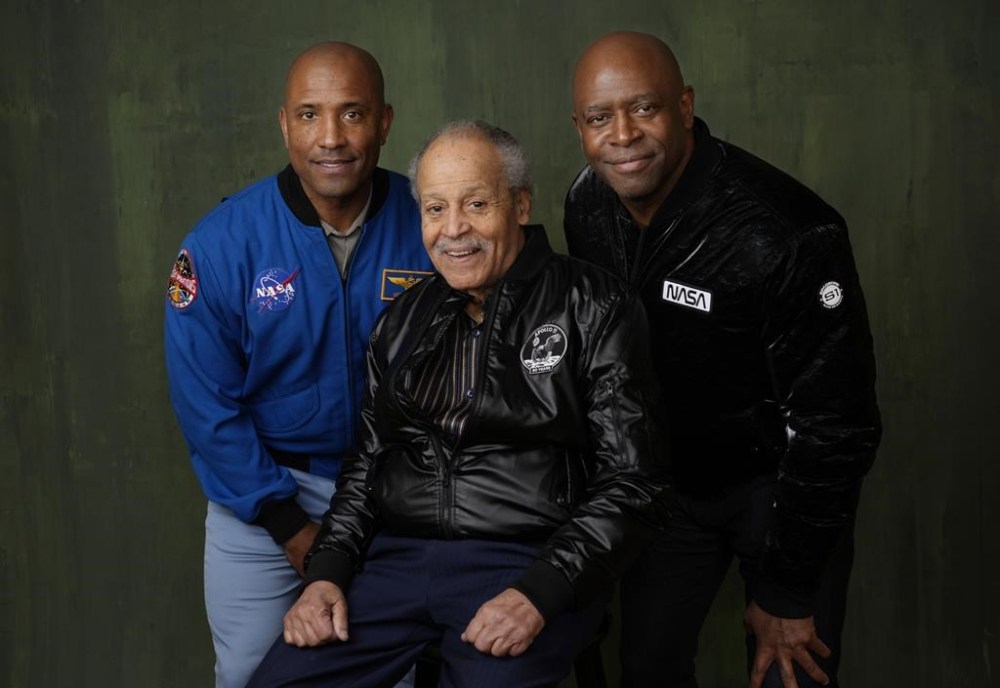
NASA astronauts Victor Glover, from left, Ed Dwight and Leland Melvin pose for a portrait to promote the National Geographic documentary film
NASA astronauts Victor Glover, from left, Ed Dwight and Leland Melvin pose for a portrait to promote the National Geographic documentary film "The Space Race" during the Winter Television Critics Association Press Tour, Thursday, Feb. 8, 2024, at The Langham Huntington Hotel in Pasadena, Calif. (AP Photo/Chris Pizzello)

Despite reservations, Dwight joined up. He was celebrated on the covers of Black magazines like Jet and Sepia. Hundred of letters hailing him as a hero poured in. But in training, he was treated with hostility by officers.

“They were all instructed to give me the cold shoulder,” Dwight says. “Yeager had a meeting with the students and the staff in the auditorium and announced it — that Washington was trying to shove this N-word down our throats.”

Yeager, who died in 2020, maintained Dwight simply wasn’t as good as the other pilots.

Dwight was among the 26 potential astronauts recommended to NASA by the Air Force. But in 1963, he wasn’t among the 14 selected. Dwight astronaut future took a more drastic turn when Kennedy was assassinated on Nov. 22, 1963.

Kennedy was killed on a Friday. By Monday, Dwight says, he had papers in his mailbox shipping him out to Germany. He quickly met with Bobby Kennedy in Washington, who had the Pentagon cancel those orders.

Ultimately, Dwight was stationed at Wright-Patterson in Ohio in January of 1964. He graduated the program and totaled some 9,000 hours of air time, but never became an astronaut. He left the Air Force in 1966.

Asked if he was bitter about his experience, Dwight exclaims, “God no!”

“Here you get a little 5-foot-four guy who flies airplanes and the next thing you know this guy is in the White House meeting all these senators and congressmen, standing in front of all these captains of industry and have them pat me on the back and shake my hand,” Dwight says. “Are you kidding me? What would I be bitter about? That opened the world to me.”

In 1977, he earned his Master of Fine Arts in Sculpture from the University of Denver. Much of his work is of great figures from Black history such as Louis Armstrong, Duke Ellington and Barack Obama. Several of his sculptures have flown into space, most recently one aboard the vessel Orion. NASA named an asteroid after him.

Dwight is filled with gratitude. His one recommendation is that every congressman and senator be flown on a sub-orbital flight so they can see the Earth from above. Everyone, he thinks, would realize the absurdity of racism from that height.

“I’d advise everybody to go through what I went through, and then they’d have a different view of this country and how sacred it is,” Dwight says. “We’re on this little ball flying around the galaxy.”

Report Error Submit a Tip

More Stories

Broadening prediction-market gambling a bad idea

Editorial 4 minute read Preview

Broadening prediction-market gambling a bad idea

Editorial 4 minute read Yesterday at 2:01 AM CDT

Let’s make a prediction: sooner or later, when Canadian governments find a way to take their own cut of the action, prediction-contract gambling on everything from sports to entertainment to political decisions is going to come to Canada.

And that’s a horrible, dangerous, pernicious idea.

Unless you have particular access to information — either inside information or strategic information based on skills or education — you’re not likely to make money at it. In fact, structurally, you’re likely to lose. In prediction markets, you basically pay an amount, plus fees from the company involved, to bet on whether something will or will not happen within a certain time frame. The amount you pay for your contract depends on how other people are also betting.

As Wealthsimple describes it, “You buy whichever side you think is right. Prices move with demand, so if the market leans towards one outcome, the more that side costs. If a lot of people are backing the TSX to finish above 38,000, yes gets more expensive and no gets cheaper.”

Read
Yesterday at 2:01 AM CDT

Moving drama at MTYP gives voice to boy who changed law

Holly Harris 4 minute read Preview

Moving drama at MTYP gives voice to boy who changed law

Holly Harris 4 minute read Yesterday at 2:37 PM CDT

The heroic true tale of Norway House Cree Nation-born Jordan River Anderson came home Friday night, as Manitoba Theatre for Young People presented Yvette Nolan’s Jordan.

The touring production, a collaboration with Geordie Theatre, runs weekends through Oct. 11, with additional stops in Toronto, Vancouver and Ottawa’s National Arts Centre.

Having several of Anderson’s family members witness the local première underscored the evening with poignancy. Elder and Pine Creek First Nation member Barbara Nepinak added her own dignified presence and prayers following MTYP artistic director Pablo Felices-Luna’s welcoming remarks.

The season-opener also marks the Winnipeg-raised playwright’s homecoming; the Algonquin playwright, director, dramaturg, actor and educator was a fixture in our local theatre community for many years before going on to serve as artistic director for Native Earth Performing Arts from 2003 to ‘11, among other contributions.

Read
Yesterday at 2:37 PM CDT

Khan should’ve taken high road: Goertzen

Carol Sanders 5 minute read Preview

Khan should’ve taken high road: Goertzen

Carol Sanders 5 minute read Friday, Oct. 2, 2026

The veteran Progressive Conservative who championed Obby Khan’s leadership bid says the former Blue Bomber dropped the ball by dissing his Tory teammates before he stepped down.

“I wouldn’t recommend it, and I didn’t recommend it,” Kelvin Goertzen (Steinbach) said in an interview Friday.

Khan resigned as PC leader and quit the caucus Monday saying some members were secretly plotting his ouster, even after he won a confidence vote on Sept. 25.

On Tuesday, Khan lashed out in a CJOB interview, naming the alleged plotters, saying constituents deserved to know which of their elected representatives “lacked moral integrity.” Khan told the Free Press he was “deeply emotionally hurt,” and felt stabbed in the back.

Read
Friday, Oct. 2, 2026

Winnipeggers witness unveiling of Japanese Canadian monument in B.C.

Morgan Modjeski 6 minute read Preview

Winnipeggers witness unveiling of Japanese Canadian monument in B.C.

Morgan Modjeski 6 minute read Yesterday at 8:39 PM CDT

As Miki Stewart gathered with her family at the Japanese Cultural Association of Manitoba on Saturday afternoon, she was thinking of her parents, Yoshimaru and Yoshi Abe.

Both Stewart, 80, and her sister Yumi Falk, 81, alongside an older brother, were born in the Tashme internment camp in British Columbia. They were among more than 2,600 Japanese Canadians who were forcefully removed and interred at the camp following the bombing of Pearl Harbour and Canada’s declaration of war on Japan in 1941.

“They didn’t talk much about how they suffered,” Stewart said of her parents. “But they did.”

She was amongst a group of more than 150 people who gathered at the association’s McPhillips headquarters on Saturday afternoon to watch the unveiling of the Japanese Canadian Monument in Victoria B.C.

Read
Yesterday at 8:39 PM CDT

Six high school hockey programs ceased operations following new Hockey Manitoba policy

Joshua Frey-Sam 7 minute read Preview

Six high school hockey programs ceased operations following new Hockey Manitoba policy

Joshua Frey-Sam 7 minute read Friday, Oct. 2, 2026

She lived the best of both worlds.

For the last three years, the 17-year-old wore a sweater for two different hockey programs — her high school team and AAA club in the Manitoba Female Hockey League — and was preparing to flourish in both colours again this winter.

Recently, however, the blue-liner was disappointed to learn she is no longer eligible to play her Grade 12 season with her school owing to a new policy imposed by Hockey Manitoba that bans players from participating in the Manitoba Women’s High School Hockey League if they are rostered on a U18 AAA team.

The rule applies to all athletes who play for both Winnipeg-based and rural AAA teams.

Read
Friday, Oct. 2, 2026

Morning-show veteran swaps microphone for macchiatos at new Corydon café

David Sanderson 9 minute read Preview

Morning-show veteran swaps microphone for macchiatos at new Corydon café

David Sanderson 9 minute read Yesterday at 2:00 AM CDT

Good news if you were used to having your morning coffee with Terri Gale, who earlier this summer signed off from CTV Your Morning, after 15 years on the job.

Gale, the three-hour program’s longtime weather expert, and her husband Rob Gale, the ex-head soccer coach of Valour FC and co-founder of the Northern Super League’s new Winnipeg franchise, are the owners of Golden Hour Café and Bar at 775 Corydon Ave.

Gale (formerly Apostle) nods when she is asked who would know more about caffeinated beverages than a person who, for the last decade and a half, set her alarm to go off in the wee small hours.

“I do love coffee and take mine black. Except because I hate burning my tongue — not a good thing when you speak for a living — I got into the habit of throwing a couple of ice cubes in my cup, to be on the safe side,” Gale says, seated on the second level of their attractive, 2,100-square-foot premises, which officially opened in mid-September.

Read
Yesterday at 2:00 AM CDT