Quebec unveils $603-million five-year plan to protect French language
Advertisement
Read this article for free:
or
Already have an account? Log in here »
To continue reading, please subscribe:

Digital Subscription
One year of digital access for only $205*
- Enjoy unlimited reading on winnipegfreepress.com
- Read the E-Edition, our digital replica newspaper
- Access News Break, our award-winning app
- Play interactive puzzles
*First annual payment billed as $205.00 + GST for one year. This annual subscription will automatically renew at $233.00 + GST every 52 weeks (10% off the regular annual price of $259.35). Offer available to new and qualified returning subscribers only. Cancel any time.
To continue reading, please subscribe:
Add Free Press access to your Brandon Sun subscription for only an additional
$1 for the first 4 weeks*
- Enjoy unlimited reading on winnipegfreepress.com
- Read the E-Edition, our digital replica newspaper
- Access News Break, our award-winning app
- Play interactive puzzles
*Your next Brandon Sun subscription payment will increase by $1.00 and you will be charged $17.95 plus GST for four weeks. After four weeks, your payment will increase to $24.95 plus GST every four weeks.
Read unlimited articles for free today:
or
Already have an account? Log in here »
Hey there, time traveller!
This article was published 28/04/2024 (886 days ago), so information in it may no longer be current.
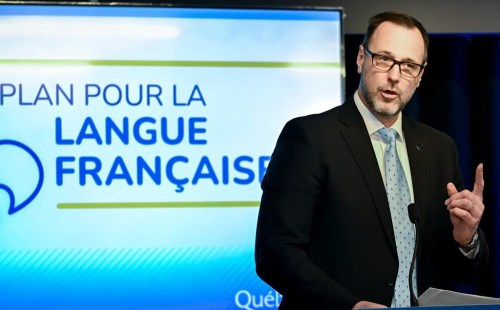
MONTREAL – Quebec is “going on the offensive” to protect and promote French, Minister Jean-François Roberge said Sunday as he presented a $603-million plan to counter what he described as the language’s decline.
Roberge, the Quebec cabinet minister responsible for the French language, said the government’s nine priorities include better monitoring of language trends, boosting the French cultural offering and improving students’ mastery of French.
Several of the measures are linked to immigration, including increasing the percentage of economic immigrants who speak French and speeding up permanent residency for international students who graduate from francophone programs.
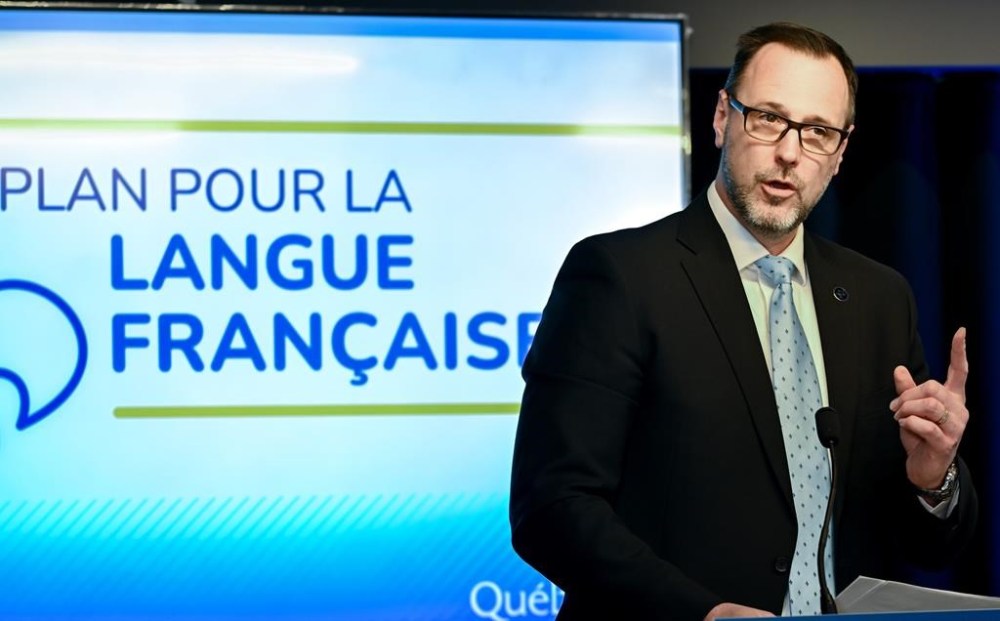
“It’s important to mention that we are no longer defending the French language,” Roberge told a news conference in Montreal. “We’re going on the offensive, no, not against anyone, but to regain lost ground and reverse the decline of French.”
The strategy unveiled Sunday includes 21 measures, some of which are already in place or have already been announced.
Those include previously-announced commitments to raise tuition by 30 per cent for out-of-province Canadians and force universities to ensure most of those students are proficient in French when they graduate. The government has also said it will impose stronger French-language requirements for temporary workers and permanent immigrants from the economic stream.
Roberge said the vitality of French in Quebec is being challenged by a number of factors including the growing numbers of non-French-speaking immigrants, the domination of mainly-English digital platforms and the number of students attending English universities.
Roberge spoke at the news conference alongside the provincial ministers from the immigration, culture, education, higher education, and international relations departments. They, and others, are part of a working group focusing on the future of French in Quebec.
He said the $603-million, five-year plan, unveiled during a “difficult budgetary context,” shows the government’s commitment to the French language. The plan specified that the funding had already been provided for in the province’s financial framework.
Roberge cited data from the 2021 census that showed the percentage of Quebec residents who predominantly speak French at home declined slightly between 2016 and 2021. At the same time, the percentage of Quebec residents whose first official language was English rose to 13 per cent from 12 per cent in the same period, Statistics Canada found.
However, Quebec’s language watchdog published a study in April that found the use of French in public spaces, such as stores and restaurants, had remained stable since 2007.
Roberge said $18 million of the funding would be spent on a project with Quebec’s statistics agency to publish regular data on language indicators in the province.
More than half the funding — $320 million — will be spent on programs to ensure temporary international workers speak and learn French.
Another $64.9 million will be dedicated to improving students’ mastery of French through programs including those that promote reading, Education Minister Bernard Drainville said.
“We have to give our children a desire to speak French,” he said, adding that teachers and school staff have a responsibility to encourage students to speak French in the classes, hallways and during extracurricular activities.
An amount of $187.3 million will be dedicated to increasing the “Francophone cultural offering” and making it more accessible. That will include funding for Quebec cultural productions, said the province’s culture minister.
Mathieu Lacombe added he planned to table a bill that aims to “guarantee our fundamental rights to the access and discoverability of French-language cultural content in the digital environment.”
Finally, the government will spend $12.8 million to strengthen Quebecers’ attachment to the French language through initiatives such as French-language scientific publications and communications campaigns.
This report by The Canadian Press was first published April 28, 2024.
Related Articles
Montreal's Concordia University reports big drop in enrolment following tuition hike
Advertisement Advertise With Us
Advertisement Advertise With Us