Google adds first Indigenous language in Canada to its translation service

Advertisement

Advertise with us

One of the most widely spoken Indigenous languages in this country is now available through Google's translation service, the first time the tech giant has included a First Nations, Métis or Inuit language spoken in Canada on its platform.

Read this article for free:


or

Already have an account? Log in here »

To continue reading, please subscribe:

Subscribe and receive a limited-edition Free Press branded hat or tote.

Digital Subscription

One year of digital access for only $205*

  • Enjoy unlimited reading on winnipegfreepress.com
  • Read the E-Edition, our digital replica newspaper
  • Access News Break, our award-winning app
  • Play interactive puzzles

*First annual payment billed as $205.00 + GST for one year. This annual subscription will automatically renew at $233.00 + GST every 52 weeks (10% off the regular annual price of $259.35). Offer available to new and qualified returning subscribers only. Cancel any time.

To continue reading, please subscribe:

Add Free Press access to your Brandon Sun subscription for only an additional

$1 for the first 4 weeks*

  • Enjoy unlimited reading on winnipegfreepress.com
  • Read the E-Edition, our digital replica newspaper
  • Access News Break, our award-winning app
  • Play interactive puzzles
Start now

*Your next Brandon Sun subscription payment will increase by $1.00 and you will be charged $17.95 plus GST for four weeks. After four weeks, your payment will increase to $24.95 plus GST every four weeks.

Hey there, time traveller!
This article was published 17/10/2024 (692 days ago), so information in it may no longer be current.

One of the most widely spoken Indigenous languages in this country is now available through Google’s translation service, the first time the tech giant has included a First Nations, Métis or Inuit language spoken in Canada on its platform.

Inuktut, a broad term encompassing different dialects spoken by Inuit in Canada, Greenland and Alaska, has been added to Google Translate, which translates text, documents and websites from one language into another.

The latest addition is part of a Google initiative to develop a single artificial intelligence language model to support 1,000 of the most spoken languages in the world.
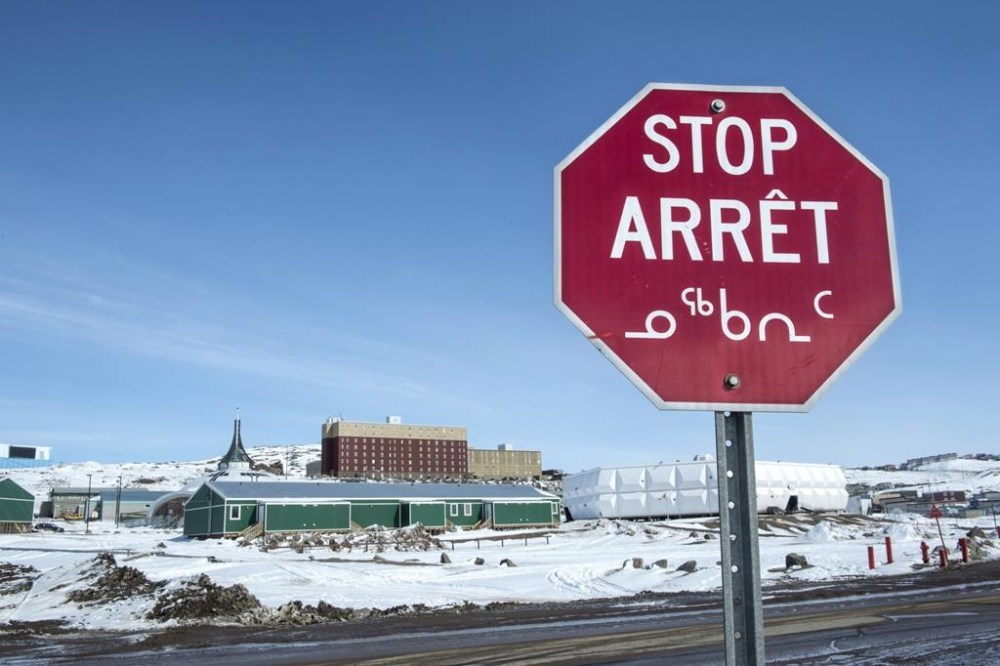
A stop sign in English, French and Inuktut syllabics is seen in Iqaluit, on April 25, 2015. One of the most widely spoken Indigenous languages in this country is now available through Google's translation service, the first time the tech giant has included a First Nations, Métis or Inuit language spoken in Canada on its platform. THE CANADIAN PRESS/Paul Chiasson

There are roughly 40,000 Inuktut speakers in Canada, data from Statistics Canada suggests.

The number of speakers alone is not enough to determine whether a language can be included in Google Translate, said Isaac Caswell, a senior software engineer with the platform.

There also has to be enough online text data to pull from to create a language model.

Other Indigenous languages in Canada have “had simply too little data to have any usable machine translation model,” said Caswell.

For example, engineers looked at adding Cree, which is spoken by more than 86,000 people in Canada, but there were fewer websites in the language to pull from.

“We don’t want to put anything on the product which just produces broken text or nonsense,” said Caswell.

“Inuktut really stands out in that it has a lot of clean and a lot of well written data, because, I think, the community is increasingly online.”

When adding a language to Google Translate, the tech company looks at two main things: whether there’s a desire or need from the community and how technically feasible is it.

After Google determined its model could recognize Inuktut, it began to consult with language speakers and organizations.

The company reached out to Inuit Tapiriit Kanatami, the national organization that represents about 70,000 Inuit in Canada, to ensure development of the model was true to the Inuktut language, including the ability to translate both of the language’s writing systems.

Inuktut uses qaniujaaqpait, or syllabics, and qaliujaaqpait, based on the Roman alphabet.

Inuit Tapiriit Kanatami has developed its own data set of common characters that can be used to write in any dialect of Inuktut to help ease written communication among the different Inuit regions.

“If we hadn’t had their help, we would have just been able to launch in syllabics, which undermines some of their current work,” said Caswell.

The organization welcomed Google’s work to include Inuktut, citing the need to revitalize, protect and promote Inuit languages.

“This is another way in which to make our language relevant, easily accessible and for those who don’t know it at all, to be able to interact with it,” Natan Obed, president of Inuit Tapiriit Kanatami, said in an interview.

“This is reconciliation in action and I really appreciate those who’ve taken the time to work with us to keep our language strong and to celebrate our language.”

With the introduction of Inuktut, Google aims to be more representative of a group often overlooked by the tech sector.

“I hope, maybe if anything, it will make them feel a little bit more seen by a big tech (company). Because, in general, Indigenous communities have had a lot of experiences being overlooked by technology,” said Caswell.

Users will have the ability to translate written Inuktut to English and vice versa through Google Translate. Other options, including the verbal translation tool, may come at a later time, said Caswell.

The use of AI in promoting Indigenous languages is not without its limitations, said Caswell, but he suspects this will change as more and more languages are unlocked with improved technology.

This report by The Canadian Press was first published Oct. 17, 2024.

Report Error Submit a Tip

More Stories

Letters, Sept. 9

7 minute read Preview

Letters, Sept. 9

7 minute read 3:00 AM CDT

As River Heights residents caught in a swath of rain and wind on Sunday evening, we survived 10 hours with no power after a big boom and an electric arc favoured us with a strike in our back lane. So far, we have had two brief additional outages (Monday) and in the early hours of (Tuesday) morning. This doesn’t begin to compare with the damage on Mathers Avenue, which is still under repair.

Read
3:00 AM CDT

All that glitters … could work here

Editorial 4 minute read Preview

All that glitters … could work here

Editorial 4 minute read Yesterday at 2:00 AM CDT

Sometimes, it’s hard to even suggest a change, because it seems there is always a plethora of people ready to tell you that your idea just won’t work.

Read
Yesterday at 2:00 AM CDT

Flash, bang … oops: police raid leads to lawsuit

Erik Pindera 4 minute read Preview

Flash, bang … oops: police raid leads to lawsuit

Erik Pindera 4 minute read 6:00 AM CDT

A couple suing the city allege Winnipeg Police Service officers trying to execute a search warrant at their condominium complex rappelled down the side of the building, broke in their glass patio door and fired off a stun grenade before realizing they were in the wrong unit.

Saeid Ghavami and Shahla Shojaei, a married couple who are academics and scientific researchers at the University of Manitoba, filed the lawsuit in Court of King’s Bench last month over the Jan. 31, 2025 incident.

The claim names the City of Winnipeg and several officers involved in the operation, whose identities are, at this point, unknown to the couple, and are referred to as “John Does.”

Officers were attempting to execute the warrant on the third floor of the eight-storey Pembina Highway building, the court filing says. The couple lives on the fourth floor.

Read
6:00 AM CDT

‘Dynacare sucks:’ premier muses about bringing lab services back into public system after strike halted

Free Press staff 4 minute read Preview

‘Dynacare sucks:’ premier muses about bringing lab services back into public system after strike halted

Free Press staff 4 minute read Updated: 11:49 AM CDT

Manitoba’s premier said the province is looking at bringing diagnostic lab services back into the public system rather than continuing to contract Dynacare, declaring the for-profit company “sucks.”

“Maybe we’ll take over the whole system… we’re working on it, we’re looking at it, the situation is not great, this company’s making a mess — I think it’s pretty clear I’m not happy with them,” Premier Wab Kinew told CBC Radio Wednesday morning. “At the same time, nobody should be trying to use people’s health care as leverage.”

Kinew made the comments the day after the Manitoba Labour Board cut short a strike by 350 lab technicians and technologists employed by Dynacare, which administers blood, urine and other medical tests for patients in Winnipeg, Brandon and surrounding communities.

Dynacare, which is contracted by the provincial government, performs the majority of non-emergency blood and urine tests in the province.

Read
Updated: 11:49 AM CDT

Governments chip in for housing at Portage Place, Market Lands, other city locations

Joyanne Pursaga 4 minute read Preview

Governments chip in for housing at Portage Place, Market Lands, other city locations

Joyanne Pursaga 4 minute read Updated: Yesterday at 8:24 PM CDT

A new government partnership will aim to speed up home construction, largely in downtown Winnipeg, with a goal to produce at least 740 affordable housing units.

The Build Canada Homes partnership, funded by the governments of Canada, Manitoba and Winnipeg, will support at least 821 housing units. The vast majority (811) will be in Winnipeg, while the rest will be added in Swan River.

Federal Housing Minister Gregor Robertson said the partnership will tackle substantial housing needs in Manitoba, at a time home prices are out of reach for many Canadians.

“Far too many people (are) sleeping outside, sleeping rough, unsheltered. Far too many people … can’t find a home they can afford,” said Robertson.

Read
Updated: Yesterday at 8:24 PM CDT

Gym, health pilot program rolls out as Manitoba children go back to school

Maggie Macintosh 2 minute read Preview

Gym, health pilot program rolls out as Manitoba children go back to school

Maggie Macintosh 2 minute read 11:31 AM CDT

There were tears and cheers on an elementary school playground in Rossmere as students arrived for the first day of classes Wednesday.

Seven-year-old Ethan Minski is among tens of thousands of Manitoba students who have officially started a new school year.

Before entering King Edward School, Minski said he was most looking forward to phys-ed class.

“Everybody loves gym. It’s just fun!” the Grade 2 student said.

Read
11:31 AM CDT