Norway’s Kon-Tiki Museum returns artifacts to Chile’s remote Easter Island

Advertisement

Advertise with us

COPENHAGEN, Denmark (AP) — Artifacts and human remains taken by a Norwegian explorer and anthropologist in the late 1940s are being returned by a museum in Oslo to Chile’s remote territory of Easter Island in the mid-Pacific, the Kon-Tiki Museum said Wednesday.

Read this article for free:


or

Already have an account? Log in here »

To continue reading, please subscribe:

Subscribe and receive a limited-edition Free Press branded hat or tote.

Digital Subscription

One year of digital access for only $205*

  • Enjoy unlimited reading on winnipegfreepress.com
  • Read the E-Edition, our digital replica newspaper
  • Access News Break, our award-winning app
  • Play interactive puzzles

*First annual payment billed as $205.00 + GST for one year. This annual subscription will automatically renew at $233.00 + GST every 52 weeks (10% off the regular annual price of $259.35). Offer available to new and qualified returning subscribers only. Cancel any time.

To continue reading, please subscribe:

Add Free Press access to your Brandon Sun subscription for only an additional

$1 for the first 4 weeks*

  • Enjoy unlimited reading on winnipegfreepress.com
  • Read the E-Edition, our digital replica newspaper
  • Access News Break, our award-winning app
  • Play interactive puzzles
Start now

*Your next Brandon Sun subscription payment will increase by $1.00 and you will be charged $17.95 plus GST for four weeks. After four weeks, your payment will increase to $24.95 plus GST every four weeks.

Hey there, time traveller!
This article was published 13/11/2024 (675 days ago), so information in it may no longer be current.

COPENHAGEN, Denmark (AP) — Artifacts and human remains taken by a Norwegian explorer and anthropologist in the late 1940s are being returned by a museum in Oslo to Chile’s remote territory of Easter Island in the mid-Pacific, the Kon-Tiki Museum said Wednesday.

In 1947, explorer Thor Heyerdahl sailed on a log raft named Kon-Tiki from Peru to Polynesia in 101 days to prove his theory — that the South Sea Islands were settled by seafarers from South America.

He brought 5,600 objects back from Easter Island, also known as Rapa Nui. This is the third time objects taken by him are being returned.
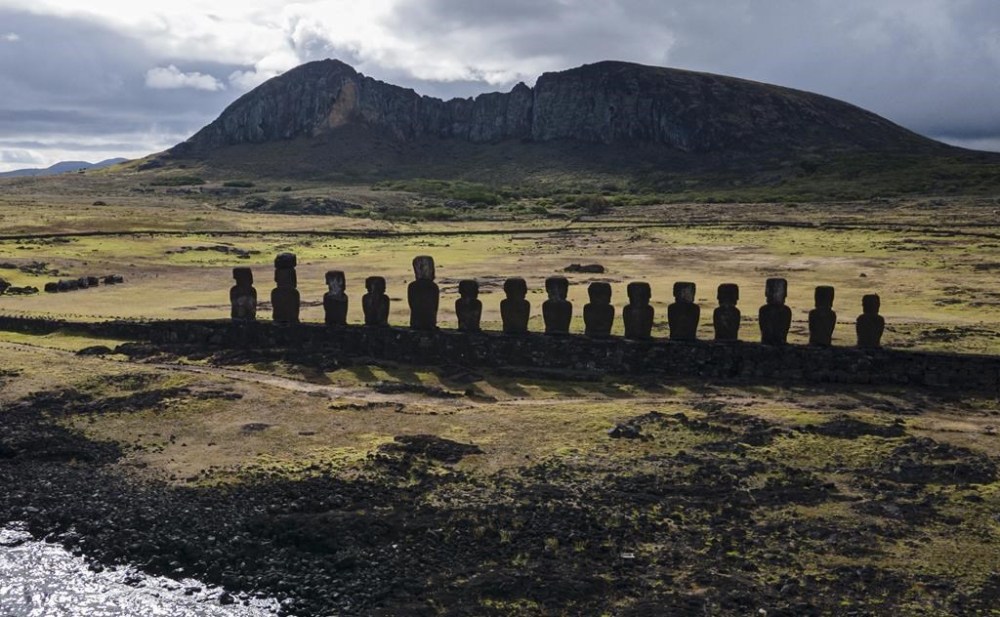
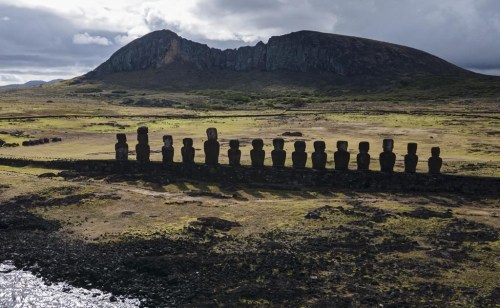
FILE - Moai statues stand on Ahu Tongariki near the Rano Raraku volcano, top, on Rapa Nui, or Easter Island, Chile, Nov. 27, 2022. (AP Photo/Esteban Felix, File)

Many have been stored and displayed at the Kon-Tiki Museum in Oslo, Norway’s capital, and some were given back in 1986 and others 2006. The return has been a collaboration between the museum, Chile and Rapa Nui’s local authorities.

“My grandfather would have been proud of what we are about to achieve,” said Liv Heyerdahl, head of the museum and the explorer’s granddaughter.

She told the Norwegian news agency NTB that the objects were brought to Norway “with a promise that they would one day be returned.”

Among those that are being returned this time around are human remains called Ivi Tepuna and sculpted stones.

A nine-person delegation had traveled to Norway this week to collect the items. Four of them spent the night at the Oslo museum, alongside the remains as part of a ritual ceremony to take back the spirits of the remains.
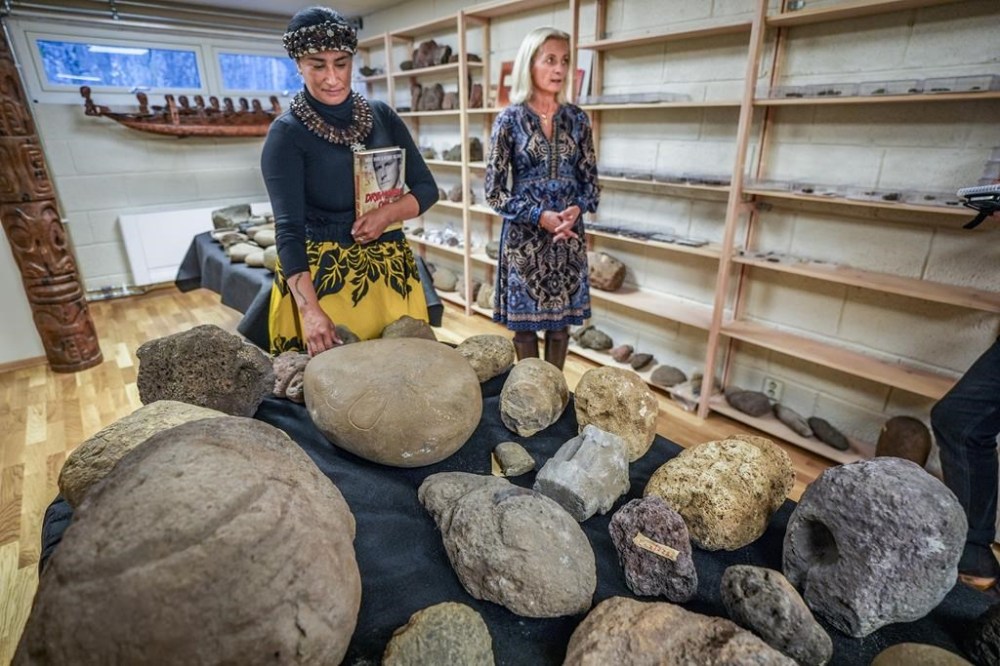
Kon-Tiki Museum's director Liv Heyerdahl, right, and Rapa Nui Chilean politician Laura Tarita Rapu Alarcon attend the
Kon-Tiki Museum's director Liv Heyerdahl, right, and Rapa Nui Chilean politician Laura Tarita Rapu Alarcon attend the "repatriation" ceremony for artifacts and human remains, at the Kon Tiki Museum in Oslo, Norway, Tuesday, Nov. 12, 2024. (Lise Åserud/NTB Scanpix via AP)

“First one must awaken the spirits, and then speak to them in our original language. Food is then prepared to eat a meal with them, where the smell of the food goes to the spirits,” a member of the delegation, Laura Tarita Rapu Alarcón, told NTB.

“It is important that those who own the culture are involved in the process,” Liv Heyerdahl was quoted as saying by NTB. “Of course these remains should be returned, and it feels right because they belong to the Rapa Nui.”

In 2019, an agreement was signed in Santiago, Chile, during a visit by Norway’s King Harald. However, the COVID-19 pandemic stopped all activities in 2020, the museum said. Harald met with the Rapa Nui delegation on Tuesday.

A book about Thor Heyerdahl’s voyage — he died in 2002 at the age of 87 — has become an international bestseller, and his film of the journey won an Academy Award for best documentary in 1951.

Rapa Nui is best known for the hundreds of moai — monolithic human figures carved centuries ago by this remote Pacific island’s Rapanui people.
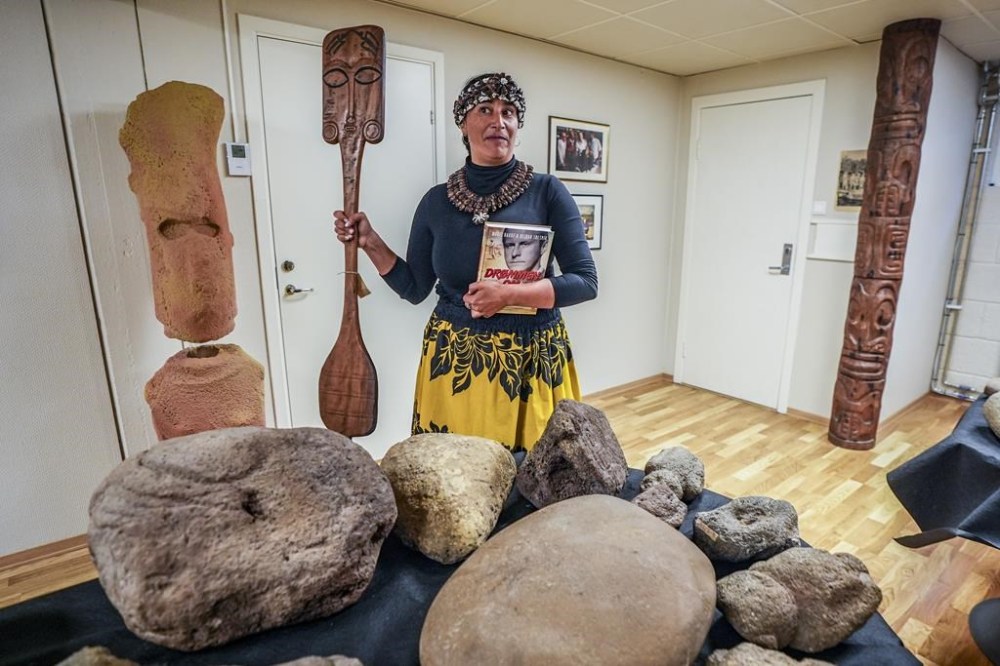
Rapa Nui Chilean politician Laura Tarita Rapu Alarcon attends the
Rapa Nui Chilean politician Laura Tarita Rapu Alarcon attends the "repatriation" ceremony for artifacts and human remains, at the Kon Tiki Museum in Oslo, Norway, Tuesday, Nov. 12, 2024. (Lise Åserud/NTB Scanpix via AP)

Covering about 164 square kilometers (63 square miles) and home to about 7,700 people, half of them with Rapa Nui ancestry, Easter Island was formed at least 750,000 years ago by volcanic eruptions and is one of the world’s most isolated inhabited islands.

Located 3,700 kilometers (2,300 miles) from South America, Rapa Nui was declared a UNESCO World Heritage Site in 1995. In 2019, it was officially renamed “Rapa Nui-Easter Island” from its previous name of just Easter Island.

Report Error Submit a Tip

More Stories

Steinbach Credit Union member warns others after scammer steals $10K

Scott Billeck 5 minute read Preview

Steinbach Credit Union member warns others after scammer steals $10K

Scott Billeck 5 minute read Yesterday at 5:19 PM CDT

A Winnipeg single mother whose bank account was drained of nearly $10,000 says Steinbach Credit Union needs to warn its members about what she believes is a broader security problem.

The woman, who is not being named to protect her identity, said a scammer gained access to her account earlier this week after calling SCU’s contact centre, claiming to be her and successfully completing the credit union’s authentication process.

She said she knows of at least six others who have experienced similar incidents in which callers impersonate SCU account holders and pass the authentication checks.

The woman discovered something was wrong when her minor son asked why money had been transferred out of an account they jointly hold.

Read
Yesterday at 5:19 PM CDT

Cabernet Sauvignon star of wine festival

Ben Sigurdson 5 minute read Preview

Cabernet Sauvignon star of wine festival

Ben Sigurdson 5 minute read 3:00 AM CDT

The Winnipeg Wine Festival will celebrate the king of red wine grapes next weekend — the theme of this year’s festival, which takes place Sept. 25 and 26 at the RBC Convention Centre, is Cabernet Sauvignon.

Cab Sauv, as it’s also known, is the world’s most widely planted wine grape of any colour, first coming to prominence in the 1800s in France’s Bordeaux region, where the grape is still popular. Rather than single-variety wines, Bordeaux reds tend to be blends, with those coming from the left bank of the Gironde estuary being Cabernet-dominant, while right-bank wines are Merlot-dominant, with Cabernet Sauvignon playing a supporting role. Cabernet and Merlot work well together and many other countries have followed suit in blending the two.

A team at University of California Davis put Cabernet Sauvignon through a DNA test in 1996 and discovered its parent grapes are Cabernet Franc and Sauvignon Blanc — it’s likely that at some point the two varieties, planted next to each other in some vineyard, crossed and mutated and became the grape we know today. (Someone growing grapes in the 19th century must have had an inkling of what was up, as the grape has been called Cabernet Sauvignon since long before the DNA test.)

Flavour-wise, most Cabernet Sauvignon wines are big and bold, with a core of deep dark berry flavours, some graphite and spice notes and relatively bright acidity. It’s a grape that is well-suited to barrel aging, with most examples seeing at least some time in wood.

Read
3:00 AM CDT

American Hostage stars recall warmth of Winnipeggers during brutal winter

Randall King 7 minute read Preview

American Hostage stars recall warmth of Winnipeggers during brutal winter

Randall King 7 minute read Yesterday at 6:13 PM CDT

TORONTO — When you stream the eight-part series American Hostage, a sense of familiarity may strike.

That’s because the show was shot in Winnipeg — especially in the Exchange District — from November of last year to the beginning of February, with Winnipeg portraying Indianapolis circa 1977.

The whole world seemed to be watching that midwest American city that year as a hostage crisis unfolded involving one Tony Kiritsis, an angry man who goes ballistic when a mortgage brokerage was poised to foreclose on property he had dreamed of developing into a shopping centre.

Kiritsis kidnapped his mortgage broker, Richard Hall, wiring a shotgun to the back of his head, and demanded a public airing of his grievances, with the reluctant help of popular radio broadcaster Fred Heckman.

Read
Yesterday at 6:13 PM CDT

Day 1 of Jets training camp in the books with pairings essentially cemented

Ken Wiebe 7 minute read Preview

Day 1 of Jets training camp in the books with pairings essentially cemented

Ken Wiebe 7 minute read Thursday, Sep. 17, 2026

Nearly six minutes into his question-and-answer session, Scott Arniel took a welcome detour from the news of the day.

After exhausting the discussion around the goalie who wasn’t in training camp, the head coach of the Winnipeg Jets finally got a query about the line combinations and defensive pairings that were unveiled in training camp.

And unlike past years, when exhibition games were more frequent and the training camp wasn’t this condensed, Arniel conceded these groupings were intentional and were likely staying together for some time.

The expansion to an 84-game regular season brings with it a reduction to four pre-season games and a much shorter training camp, which could limit the amount of experimentation that Arniel can do during the next two weeks.

Read
Thursday, Sep. 17, 2026

Canada must not accept another Iranian autocracy

David Matas 5 minute read 2:01 AM CDT

Iran is a state run by a radical government victimizing its citizens and its neighbours. How do we change that? Any regime change that repeats the mistakes of the past is not a solution.

What went wrong in the past which led to the current regime? One answer is the U.K. and American aided coup which led to the ouster in 1953 of a democratically elected government headed at the time by Mohammad Mossadegh and its replacement with an American friendly autocrat, the Shah of Iran, Mohammad Reza Pahlavi.

The Shah imposed his rule through the Iranian National Intelligence and Security Organization — SAVAK, the acronym of its Persian name. SAVAK systematically inflicted torture, arbitrary killings and extra-judicial killings on perceived opponents of the regime. It was only a matter of time before repression of a regime directed to serving foreign interests would be overthrown.

What replaced the regime of the Shah, in 1979, the current regime of the mullahs, is a regime as intolerant and violent as the regime of the Shah and then some. That was not inevitable. But neither was it surprising. The vicious nature of the current regime, following the example set by the Shah, and its hatred for the United States, reacting to the U.S. aided imposition of the Shah, both echoes and reacts to the past. In 1979, the U.S. reaped what it sowed in 1953.

Puzzles Palace

1 minute read Monday, Jul. 27, 2026

To solve our puzzles, please subscribe with this special offer: |