Chernobyl Diaries’ selfish victims are not worth caring about
Advertisement
Read this article for free:
or
Already have an account? Log in here »
To continue reading, please subscribe:

Digital Subscription
One year of digital access for only $205*
- Enjoy unlimited reading on winnipegfreepress.com
- Read the E-Edition, our digital replica newspaper
- Access News Break, our award-winning app
- Play interactive puzzles
*First annual payment billed as $205.00 + GST for one year. This annual subscription will automatically renew at $233.00 + GST every 52 weeks (10% off the regular annual price of $259.35). Offer available to new and qualified returning subscribers only. Cancel any time.
To continue reading, please subscribe:
Add Free Press access to your Brandon Sun subscription for only an additional
$1 for the first 4 weeks*
- Enjoy unlimited reading on winnipegfreepress.com
- Read the E-Edition, our digital replica newspaper
- Access News Break, our award-winning app
- Play interactive puzzles
*Your next Brandon Sun subscription payment will increase by $1.00 and you will be charged $17.95 plus GST for four weeks. After four weeks, your payment will increase to $24.95 plus GST every four weeks.
Read unlimited articles for free today:
or
Already have an account? Log in here »
Hey there, time traveller!
This article was published 26/05/2012 (5241 days ago), so information in it may no longer be current.
I’m done with movies that ask us to follow a flashlight beam into faux fog for the better part of two hours.
Eventually, you just get tired of waiting for the monster to show up in the blurry half-light — if the monster ever really shows at all.
Sometimes they do — and it’s disappointing. Often they don’t, which tends to be even more of a let down if you’ve been expecting a grand, terrifying reveal that never arrives.
The whole engine behind these movies is the delicate balance between doubt and credibility, and making your audience believe what they can’t see is far scarier than anything they actually can.
It worked for The Blair Witch Project a decade ago. But production designer turned director Bradley Parker has a much harder time capitalizing on a technique that hit its stale date with the last round of Paranormal Activity.
Attempting to deliver a first-person style diary account of a Russian tour gone terribly wrong, Parker sets up the story with casual footage of young American tourists hitting the bars of Europe.
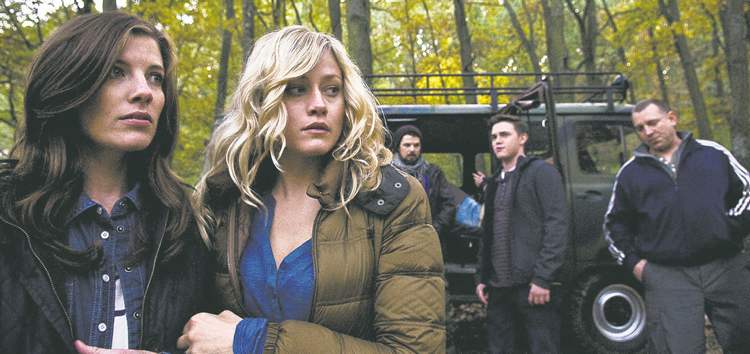
These scenes of goofy fun are supposed to pull us into the intimate circle of Chris (Jesse McCartney), his would-be fiancée Natalie (Olivia Dudley), his brother Paul (Jonathan Sadowski) and sexy adventuress Amanda (Devin Kelley).
They are also supposed to lay down a framework of familiarity, where we all feel safe because things look recognizable and civilized and we have the normalizing force of a McDonalds on every street corner.
We don’t believe bad things will happen to us under bright lights, or among crowds of people, so we can usually hop aboard any horror story that begins with people making decisions we, ourselves, might make in a similar situation.
The hook in Chernobyl Diaries happens in the first act as our foursome of funsters decide to take an “extreme tour” with Uri, a Ukrainian tour operator who boasts creepy tours of Pripyat, the abandoned city surrounding the infamous reactor that had a core meltdown a quarter century ago.
Though they’re all a little hesitant about getting on the bus and driving into a radioactive ghost town, they convince each other it will be fun. After all, “why not see as much as you can?”
From the moment they make this fatal and yes, foolish, decision, we’re forced to wait for bad things to happen — usually through the narrow beam of a flashlight bulb.
On screen, this translates into a lot of nothing moments punctuated by brief scenes of desired shock and awe.
It doesn’t work.
Part of the problem is we’re forced to wait too long. Parker spends a good 30 minutes building the supposed suspense, defusing every scare bomb along the way.
First, we suspect Uri may be a Russian mobster who will kill the boys and sell the girls on the black market. Then, when that doesn’t pan out, we wonder if Chernobyl has become an Island of Dr. Moreau, where mutant animals are running amok.
Certainly, that’s the best bet for Chernobyl horror, but outside of a flesh-coloured snake-headed fish he offers up a scare at the end of Act 1, Parker doesn’t spend too much time conjuring the ghosts of Cold War paranoia and misguided science.
He reverts to the tried and true strains of — zombie genre.

As the ensemble of young people — which now also includes a couple of backpackers to up the body count — are dragged off one by one, the viewer is forced to empathize with stupid and obnoxious characters who scream all the time.
In order for these baseline exercises in survival horror to really work, the characters have to be smart. They must demonstrate skills or sympathy or something emotionally redeeming — otherwise they’re not worth the stress factor.
As a result, when this band of morons ignores the obvious solution, which was to push their broken down army truck to a checkpoint together as a group, they lose our empathy.
The lapse in collective intelligence makes the ensuing bloodbath easier to watch, because in the end, who cares about six selfish people lost in the radioactive wasteland hunted by pale-faced mutants?
— Postmedia News