These nice guys crack wise, crack skulls
Retro romp mixes detective work with pulp action, comedy hijinks
Advertisement
Read this article for free:
or
Already have an account? Log in here »
To continue reading, please subscribe:

Digital Subscription
One year of digital access for only $205*
- Enjoy unlimited reading on winnipegfreepress.com
- Read the E-Edition, our digital replica newspaper
- Access News Break, our award-winning app
- Play interactive puzzles
*First annual payment billed as $205.00 + GST for one year. This annual subscription will automatically renew at $233.00 + GST every 52 weeks (10% off the regular annual price of $259.35). Offer available to new and qualified returning subscribers only. Cancel any time.
To continue reading, please subscribe:
Add Free Press access to your Brandon Sun subscription for only an additional
$1 for the first 4 weeks*
- Enjoy unlimited reading on winnipegfreepress.com
- Read the E-Edition, our digital replica newspaper
- Access News Break, our award-winning app
- Play interactive puzzles
*Your next Brandon Sun subscription payment will increase by $1.00 and you will be charged $17.95 plus GST for four weeks. After four weeks, your payment will increase to $24.95 plus GST every four weeks.
Read unlimited articles for free today:
or
Already have an account? Log in here »
Hey there, time traveller!
This article was published 20/05/2016 (3774 days ago), so information in it may no longer be current.
Shane Black films are unmistakably Shane Black films, with crackling dialogue, relentless action and tough guys cut from a decidedly retro cloth.
In The Nice Guys, which he directed, and co-wrote with Anthony Bagarozzi, that cloth is the kind of polyester that might make up a late-’70s leisure suit.
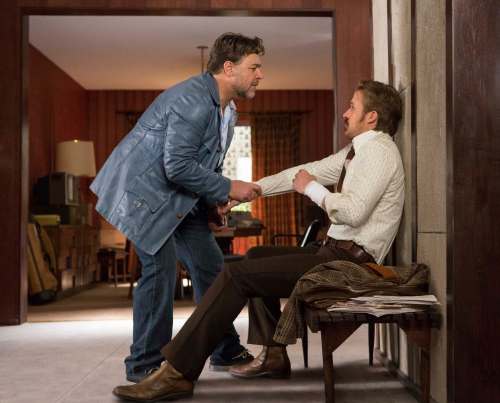
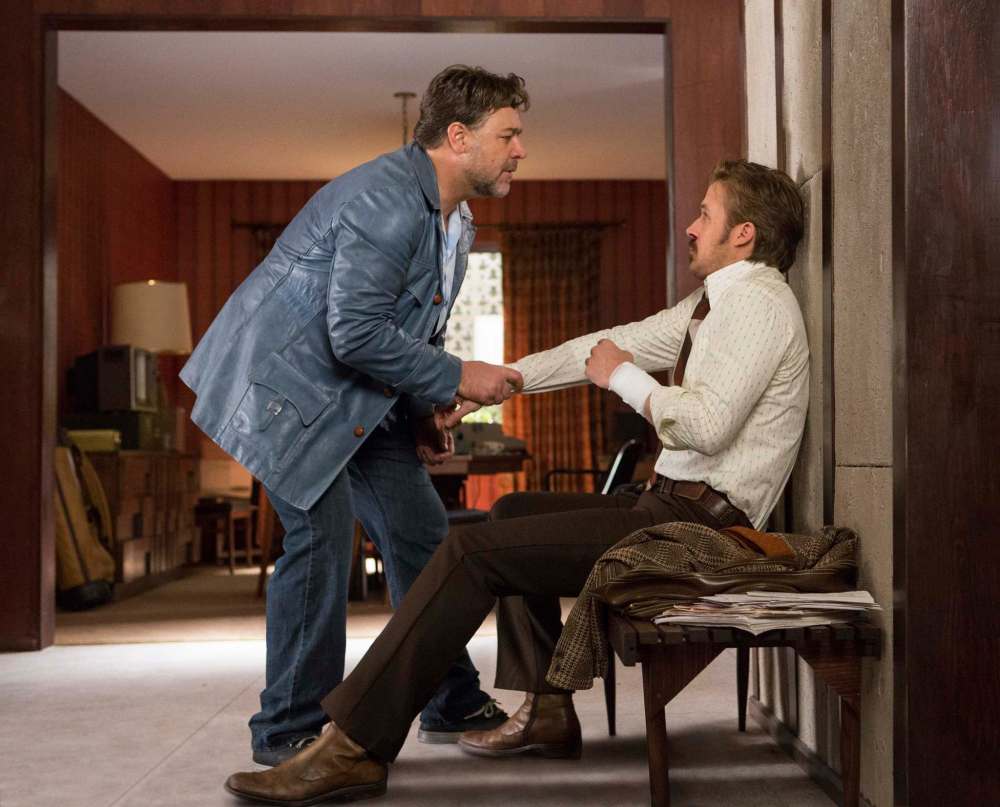
While Black’s films are always deeply influenced by his appreciation for pulp noir detective fiction, The Nice Guys is one of the purest expressions of Black’s esthetic — a bloody, hilarious, convoluted mystery that’s as funny as it’s dark. And, in Russell Crowe and Ryan Gosling, Black has found two perfectly suited nice guys who can also crack wise all over 1977 Los Angeles.
These guys, Jackson Healy (Crowe) and Holland March (Gosling), aren’t very nice on paper. Healy’s an amateur tough hired to beat up and threaten creeps and unsavoury types, while March is one of the world’s worst detectives — as he is dubbed by his whip-smart 13-year-old daughter Holly (Angourie Rice). He’s an unrepentant drinker and a hack, who has no qualms about milking extra fees from desperate older ladies.
They cross paths on competing cases — March has been hired to find a young woman named Amelia (Margaret Qualley), and Amelia herself has hired Healy to scare off anyone looking for her. She’s loosely connected to the death of adult film star Misty Mountains, who turns up dead in a car crash.
Much like the plot of Black’s 2005 comeback film and directorial debut, Kiss Kiss Bang Bang, it’s a twisty, complicated mystery, winding and wending its way through the hedonistic Hollywood Hills.
Black makes every film his own, woven through with sly and smart one-liners that almost feel like inside jokes. But he allows us in on these jokes, the things that thrill him and make him giggle, from Healy’s cynical cracks about marriage, to March’s unexpectedly high-pitched screams.
It’s a treat to muck around in this world of haphazard, underdog detectives who solve mysteries with their own mishaps. March literally falls on top of a break in the case, not once, but twice.
Gosling proves himself to be an adept physical comedian, subjecting himself to all manner of humiliations and abjection, falling down hills, getting caught in the john with his pants down, but always maintaining an air of leisure-suited finesse.
Crowe is the murderous moral compass, the bear-like protector of young women within the ultra-liberated, and predatory, 1970s sexual atmosphere.
Though young Holly is repeatedly thrust into inappropriate situations, the two men take care to protect, though not coddle her. She’s ends up being their ringer, the true detective among all the chaos.
Though the nice guys are hired to look for Amelia, the real prize is a film she stars in, an “experimental” project with the intent to expose the truth about a justice-department coverup allowing Detroit automakers to pollute the environment.
The nudity and sex? Purely for commercial reasons. At the climax, every PI and nice guy in town is chasing down this particular roll of celluloid.

The meta film-within-the-film is the cherry on the cake of retro detective hijinks, containing an optimistic message about the inflammatory power of cinema to effect change in the world — even if it is lowbrow or smutty.
— Tribune News Service