When they’re 63
Long-running British series powerful, poignant look at life and aging

Advertisement
Read this article for free:
or
Already have an account? Log in here »
To continue reading, please subscribe:

Digital Subscription
One year of digital access for only $205*
- Enjoy unlimited reading on winnipegfreepress.com
- Read the E-Edition, our digital replica newspaper
- Access News Break, our award-winning app
- Play interactive puzzles
*First annual payment billed as $205.00 + GST for one year. This annual subscription will automatically renew at $233.00 + GST every 52 weeks (10% off the regular annual price of $259.35). Offer available to new and qualified returning subscribers only. Cancel any time.
To continue reading, please subscribe:
Add Free Press access to your Brandon Sun subscription for only an additional
$1 for the first 4 weeks*
- Enjoy unlimited reading on winnipegfreepress.com
- Read the E-Edition, our digital replica newspaper
- Access News Break, our award-winning app
- Play interactive puzzles
*Your next Brandon Sun subscription payment will increase by $1.00 and you will be charged $17.95 plus GST for four weeks. After four weeks, your payment will increase to $24.95 plus GST every four weeks.
Read unlimited articles for free today:
or
Already have an account? Log in here »
Hey there, time traveller!
This article was published 29/08/2020 (2209 days ago), so information in it may no longer be current.
Film is a time-based medium. The documentary 63 Up, which is now showing at Cinematheque, is 144 minutes long, but it’s also part of a series that has been running for 56 years. Each of the films in this project offers up modest observations about ordinary people and everyday life. Taken all together, though, they are an extraordinary achievement.
Back in 1964, Seven Up! started with the adage, “Give me the child until he is seven, and I will show you the man.” The producers wanted to track a group of English schoolchildren, beginning at age seven and then revisiting them every seven years.
Filmmaker Michael Apted, who worked on the first instalment, stayed on, and has directed all eight subsequent films. Those one-time schoolchildren are now in their 60s, and while some have come and gone over the decades, the core group is still here. For Up fans, they have the familiarity of old friends.
The project’s original impetus was primarily political: A bunch of Granada Television lefties wanted to demonstrate the extent to which the British class system determined a person’s future. The chosen children included a trio of prep-school toffs and a “cheeky chappy” from East London, an upper-class girl expected to marry well and a working-class girl hoping to work at Woolworth’s, and a few kids from the broad middle classes. (While the original group covered the socioeconomic range, there were fewer girls than boys and only one person of colour. In 2020, this isn’t exactly a cross-section of Britain.)
Political issues are still important. The participants often talk about housing, education, health care, the erosion of the social safety net, and 63 Up sees them dealing with the fallout of Brexit. But increasingly, the series has become preoccupied with big human questions. Even across the participants’ very different circumstances, we see commonalities.
We’ve witnessed these people growing up, finding their way — and sometimes losing it. We’ve seen them marry and divorce, celebrate the birth of children and grieve the death of parents. In this instalment, we watch them confront their own mortality. As Sue says, “Once you get to your 60s, you’re thinking, how much time have we got left now?” 63 Up marks the first death in the original group of 14.
Each film folds in footage from the earlier films. Partly this is a practical consideration: Even if you haven’t seen the previous entries, you can join in. But the effect of these overlays is also poetic and emotional. Open and eager children are juxtaposed with sullen teens. People heedlessly confident in their 20s are seen in bemused middle age. We watch as faces and bodies gradually soften and thicken.
Sometimes the participants — and Apted, heard off-camera — discuss the films themselves. While they generally affirm the value of the Up series as a social document, they also express questions about its shortcomings — how do you compress the complexities of seven years of life into maybe 10 minutes of screentime? — and they have concerns about the personal costs.
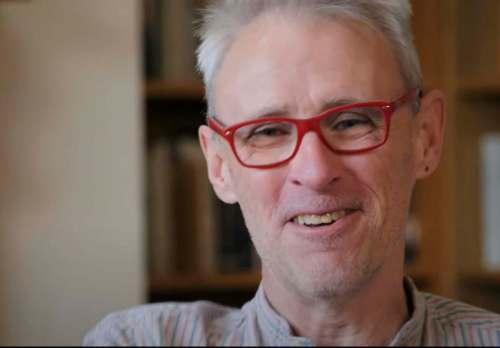
Nick, the Yorkshire farmer’s son who became a nuclear physicist and is currently dealing with throat cancer, admits that he has always dreaded the seven-year public stocktaking, finding it “emotionally draining and wrenching.”
(It’s perhaps significant that the first dropout from the series was Charles, who worked in documentary film and presumably knew what he was up against).
For people who watch the series looking for the age-related shifts — what does it mean to be young? Middle-aged? Getting ready for seniors’ discounts? — 63 Up is encouraging (mostly).

Andrew, who as a seven-year-old schoolboy declared that he liked to read the Financial Times, is preparing to let go of his work life. Neil, who has lived through periods of depression and bouts of near homelessness, has found an equilibrium in his church and in public service. Undauntable Jackie, who has had to deal with chronic health issues and some sudden losses, counts the blessings of her children and grandchildren.
Many of the participants seem to be heading into this new stage of life with a keener sense of who they really are and what really matters. Sometimes there are things they wish they could have told their 21-year-old selves, but they’re not over-burdened by regrets. As Symon points out, regrets don’t get you very far: “There’s only your life as it is.”
With its profound, poignant examination of time and age, continuity and change, 63 Up is a remarkable expression of life as it is. And as Bruce reminds us, “It’s not all over yet.”
He’s right: The Up series demonstrates, like nothing else on film, the way the years just slip away. 70 Up will be here before we know it.
alison.gillmor@freepress.mb.ca
Studying at the University of Winnipeg and later Toronto’s York University, Alison Gillmor planned to become an art historian. She ended up catching the journalism bug when she started as visual arts reviewer at the Winnipeg Free Press in 1992.
Our newsroom depends on a growing audience of readers to power our journalism. If you are not a paid reader, please consider becoming a subscriber.
Our newsroom depends on its audience of readers to power our journalism. Thank you for your support.
Studying at the University of Winnipeg and later Toronto’s York University, Alison Gillmor planned to become an art historian. She ended up catching the journalism bug when she started as visual arts reviewer at the Winnipeg Free Press in 1992.
Our newsroom depends on a growing audience of readers to power our journalism. If you are not a paid reader, please consider becoming a subscriber.
Our newsroom depends on its audience of readers to power our journalism. Thank you for your support.
Advertisement Advertise With Us
Advertisement Advertise With Us