Director’s surprise endings getting old

Advertisement
Read this article for free:
or
Already have an account? Log in here »
To continue reading, please subscribe:

Digital Subscription
One year of digital access for only $205*
- Enjoy unlimited reading on winnipegfreepress.com
- Read the E-Edition, our digital replica newspaper
- Access News Break, our award-winning app
- Play interactive puzzles
*First annual payment billed as $205.00 + GST for one year. This annual subscription will automatically renew at $233.00 + GST every 52 weeks (10% off the regular annual price of $259.35). Offer available to new and qualified returning subscribers only. Cancel any time.
To continue reading, please subscribe:
Add Free Press access to your Brandon Sun subscription for only an additional
$1 for the first 4 weeks*
- Enjoy unlimited reading on winnipegfreepress.com
- Read the E-Edition, our digital replica newspaper
- Access News Break, our award-winning app
- Play interactive puzzles
*Your next Brandon Sun subscription payment will increase by $1.00 and you will be charged $17.95 plus GST for four weeks. After four weeks, your payment will increase to $24.95 plus GST every four weeks.
Read unlimited articles for free today:
or
Already have an account? Log in here »
Hey there, time traveller!
This article was published 31/07/2021 (1874 days ago), so information in it may no longer be current.
M. Night Shyamalan’s newest film, Old, has a surprise ending. That fact, unfortunately, comes as no surprise.
The latest from the polarizing Philly filmmaker follows a group of tourists trapped on a beach where a mysterious power is causing them to age at a rapid rate.
For most of its runtime, the sci-fi suspense flick is frustrating but somehow still fascinating. It’s the obligatory gotcha conclusion that makes Old feel, well, old.
At this point, audiences are expecting Shyamalan to pull a fast one, narratively speaking, so they tend to brace themselves. Meanwhile, Shyamalan’s desperate need to define himself as the king of the twist means he has filmed himself into a corner. Forced to deliver astonishing, mind-altering finishes, he often mangles his main plots.
Shyamalan’s breakthrough feature was 1999’s The Sixth Sense, its whispery I-see-dead-people dread and big wowza reveal seamlessly combining to make it a fan favourite. Later attempts to recapture that magic, whether that involved Joaquin Phoenix tinfoil-hatting it in Signs or Mark Wahlberg trying to look sciencey in The Happening, mostly fizzled out. Perhaps the most egregious of the twist conclusions came in The Village. Even many Shyamalan superfans viewed its bonkers ending not just as a letdown but as an out-and-out betrayal.
Starting out with a promising premise, Old feels like part of the recent anti-resort genre that includes The White Lotus and the upcoming Nine Perfect Strangers. (Put it this way: If someone offers you a suspiciously good deal on a luxury hotel with an unctuous manager and a 24-hour candy station for your children, don’t go.)
Vicky Krieps and Gael Garcia Bernal are a troubled couple, hoping for one last vacation with their kids before they all sit down for “the divorce talk.” Rufus Sewell is an arrogant surgeon travelling with his young trophy wife (Abbey Lee) and his elderly mother (Kathleen Chalfont). Another married pair, Ken Leung and Nikki Amuka-Bird, are dealing with a chronic illness, and Aaron Pierre is a rapper whose brilliantly bad moniker is “Mid-Sized Sedan.” Shyamalan himself drops in with a cameo that takes a deliberately sinister turn.
As the group begins to visibly age — the children rocketing into puberty, the adults slowing, fading and faltering, all in a matter of hours — the movie can’t quite decide whether it’s a snappy Twilight Zone episode or a brooding Bergman film.
That’s the exasperating thing about the Shyamalan oeuvre. It’s such a mix of good and bad, sincerity and ridiculousness, oddball originality and shameless B-movie cliches.
Old is packed with potential. It’s about how we move through time and how time moves through us. There’s the terrifying biological reduction of our lives to a rapid round of sex, aging, disease and death, making for some oogie Cronenbergian body horror. There’s a lovely little fable about what remains at the end, as wealth, status and beauty fall away and only love endures.
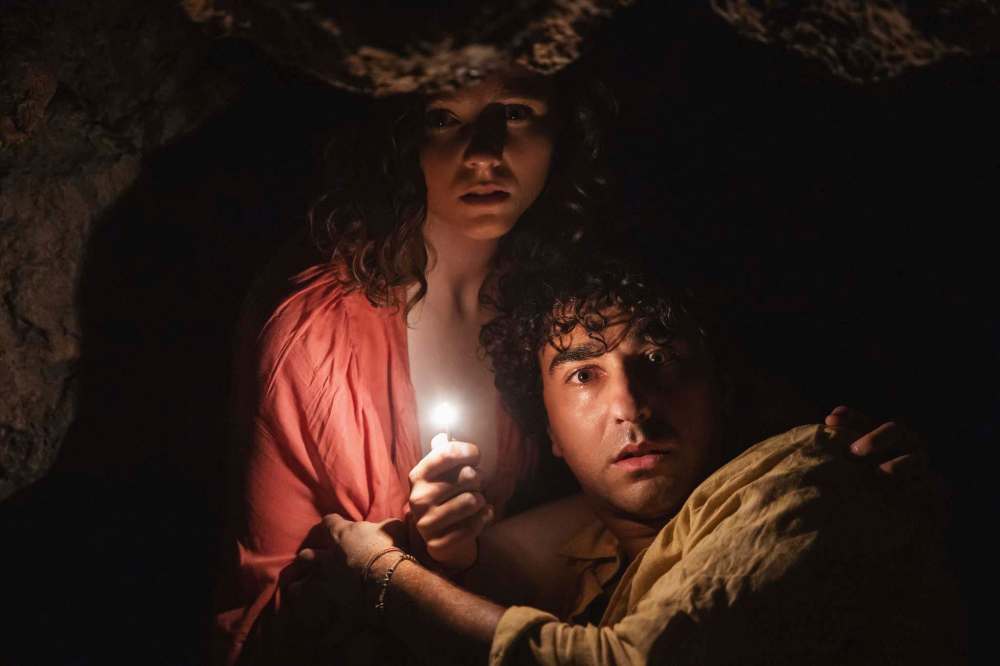
And there are some genuinely strange, surreal and poignant moments, as the characters grapple with a world that no longer makes sense. If Shyamalan had been content to lean into the oceanic ambiguity, he might have done something really interesting. The story’s source material, for example, the graphic novel Sandcastle by Pierre-Oscar Levy and Frederick Peeters, mostly keeps things melancholy and mysterious and existential.
But because Shyamalan is gunning for the Big Twist, he must explain what’s happening and dissect the details. At that point, the story’s enigmatic power just collapses, and the movie becomes oversimplified and goofy. Its weaknesses (atrocious dialogue) overpower its strengths (atmospheric visuals), and its poetic mood is punctured by its completely implausible mechanics.
When it comes to his surprise endings, Shyamalan may think he’s wrapping things up, but too often his story is actually falling apart.
alison.gillmor@freepress.mb.ca
Studying at the University of Winnipeg and later Toronto’s York University, Alison Gillmor planned to become an art historian. She ended up catching the journalism bug when she started as visual arts reviewer at the Winnipeg Free Press in 1992.
Our newsroom depends on a growing audience of readers to power our journalism. If you are not a paid reader, please consider becoming a subscriber.
Our newsroom depends on its audience of readers to power our journalism. Thank you for your support.
Studying at the University of Winnipeg and later Toronto’s York University, Alison Gillmor planned to become an art historian. She ended up catching the journalism bug when she started as visual arts reviewer at the Winnipeg Free Press in 1992.
Our newsroom depends on a growing audience of readers to power our journalism. If you are not a paid reader, please consider becoming a subscriber.
Our newsroom depends on its audience of readers to power our journalism. Thank you for your support.
Advertisement Advertise With Us
Advertisement Advertise With Us