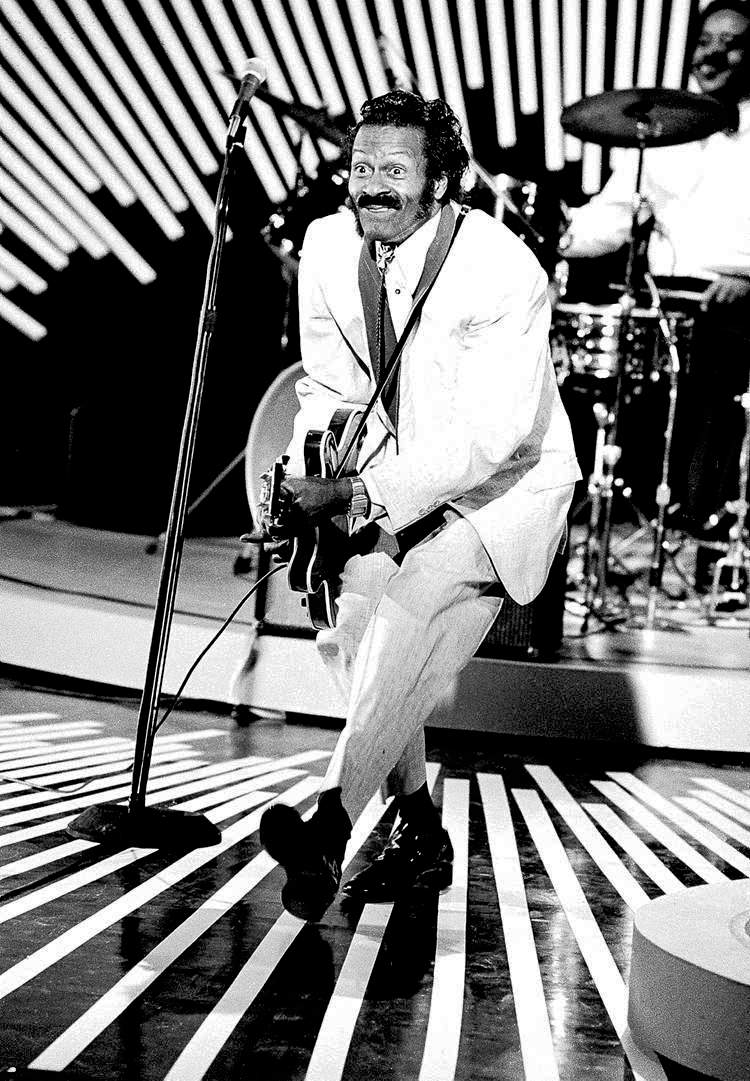
Who wrote the book of rock? No. 6: Chuck Berry
The man may have really written only one song and all the rest are variations, but we're still hearing that song when any band renews its vows with the three-chord basics
Advertisement
Read this article for free:
or
Already have an account? Log in here »
To continue reading, please subscribe:

Digital Subscription
One year of digital access for only $205*
- Enjoy unlimited reading on winnipegfreepress.com
- Read the E-Edition, our digital replica newspaper
- Access News Break, our award-winning app
- Play interactive puzzles
*First annual payment billed as $205.00 + GST for one year. This annual subscription will automatically renew at $233.00 + GST every 52 weeks (10% off the regular annual price of $259.35). Offer available to new and qualified returning subscribers only. Cancel any time.
To continue reading, please subscribe:
Add Free Press access to your Brandon Sun subscription for only an additional
$1 for the first 4 weeks*
- Enjoy unlimited reading on winnipegfreepress.com
- Read the E-Edition, our digital replica newspaper
- Access News Break, our award-winning app
- Play interactive puzzles
*Your next Brandon Sun subscription payment will increase by $1.00 and you will be charged $17.95 plus GST for four weeks. After four weeks, your payment will increase to $24.95 plus GST every four weeks.
Read unlimited articles for free today:
or
Already have an account? Log in here »
Hey there, time traveller!
This article was published 24/06/2012 (5200 days ago), so information in it may no longer be current.
In this 10-part series, we pay tribute to the rock ‘n’ roll-era visionaries who came up with the musical vocabulary we’re still hearing today – the ones without whom the language of rock ‘n’ roll would not sound the same.
MONTREAL — Rock ‘n’ roll is not only music, but musical attitude.
That’s why almost no one can sing, on demand, the opening guitar lick of Ain’t That Just Like a Woman, waxed as a blues foxtrot in 1946 by Louis Jordan and his Tympany Five. When it was released, a 20-year-old man from St. Louis, Mo., named Chuck Berry was doing time in a reformatory for armed robbery.

Move the story forward 12 years. Berry takes Jordan’s lick note for note, adds some dirty amplified harmonics, uses the riff to usher in a semi-autobiographical song about a guitar picker with an eye on fame and fortune, and popular music’s DNA is changed.
With its dumb-like-a-fox primal twang, the better to put grimaces on the faces of Bing Crosby-loving parents, Johnny B. Goode’s opening guitar salvo came to define rock ‘n’ roll as perfectly as anything. It was destined to be played or evoked in every bar and arena for the next half-century and beyond.
It wasn’t Berry’s first record. He had been laying the groundwork for his immortal sped-up, blues-based boogie for three years — which comes out to a year per chord. Acknowledged classics like Roll Over Beethoven, School Days and Sweet Little Sixteen had preceded it, but the saga of Mr. B. Goode was his defining moment.
Strangely, this man who wrote his own songs — almost unprecedented in rock ‘n’ roll at that point — and tapped so skilfully into the nascent youth market couldn’t have been less like his audience.
When Berry wrote his teenage anthems, he was in his 30s, married with a child, a black man in still-segregated America and an ex-con to boot. The carefree world of the classroom bell, the after-school jukebox and the autograph book, which white kids identified with so completely, must have seemed strange to him as he documented it.
Berry, at the height of his power in the late-’50s, was both celebrating the rock ‘n’ roll revolution and observing it as a complete outsider. The colour of his skin also meant that his knowing smirk shouldn’t be seen too much, especially by suburban moms and dads.
Many of his best-loved songs were adult in theme. No Money Down, Brown-Eyed Handsome Man, Memphis, Back in the U.S.A. and You Never Can Tell touched on such topics as teenage marriage, consumer excess and divorce. And he wrote them with an economy, wit and knack for storytelling few have ever equalled.
In a way, Berry’s story ends in 1962, with another trip to prison for transporting a minor over state lines for immoral purposes, a charge some say was trumped up. A few great tracks, more unpleasant blemishes on his personal reputation and some forgettable retreads were still ahead. But as a generation of British Invasion disciples, including The Beatles and The Rolling Stones, sang his praises, acknowledged his influence and covered his entire catalogue, an embittered Berry left the stage in the longest fadeout in rock history.
After decades on the oldies circuit, playing one-nighters with pickup bands and leaving the premises with a suitcase full of cash, Berry, now 85, still picks up a guitar sometimes. But the returns diminished so long ago that his incalculable influence on rock ‘n’ roll is in danger of being forgotten.
When all is said and done, maybe he really wrote only one song and all the rest are variations. But even if that’s so, we’re still hearing that song when any band plugs in and decides to renew its vows with the three-chord basics. The simple truths are the ones Chuck Berry taught them.
— The Montreal Gazette
Skipper Dean on Chuck Berry:
TO me, Chuck Berry was one of the first performers to actually relate, in song, to the youth of his time. Young people could identify with the song School Days, and I’m sure they sang the lyrics on the way to school. My friends and I would sing Johnny B. Goode, Maybellene and Sweet Little Sixteen on our own way to class every morning. Young people were hearing their emotions, thoughts and experiences being expressed in his songs.
And with records like You Never Can Tell, No Particular Place to Go and Reelin’ and Rockin’, it was easy for anyone to identify with him. There was always one or two guys having trouble with a girlfriend (Maybelline, why can’t you be true?), someone in love (Sweet Little Sixteen) and, of course, we all thought we were Johnny B. Goode. He tugged at all the emotions — happy, sad, good and bad.
He was one of the few black performers of the era to cross over from what was called black music into the mainstream, where young white listeners picked up on his music. Most people in the white venues in which he played came in thinking he was a white performer, so when they announced his name and he appeared on stage, there was dead silence in the room. The black audiences took for granted he was black.
But Chuck Berry never let racial barriers stand in his way and he became an international success. He was always in tune with his audience, a true pioneer and ahead of his time. His music is still being covered by other singers.
It was only after I started singing professionally that I realized how much he influenced my approach to singing. I learned how to relax and be myself on stage because of his wit and sincerity when he performed.
Veteran R&B singer Skipper Dean tore up the stage in Esquire Show Bar: The Revue, which opened in 2008. The Montrealer has since left the ensemble. Family Man is his most recent disc.
KEY TRACKS:

1. Roll Over Beethoven
2. You Can’t Catch Me
3. School Days
4. Johnny B. Goode
5. Nadine (Is It You?)
Related Articles
Who wrote the book of rock? No. 1 -- The Beatles
Advertisement Advertise With Us
Advertisement Advertise With Us