Bruno shifts gears
Smooth, dapper pop crooner takes a turn for the gritty on his sophomore album
Advertisement
Read this article for free:
or
Already have an account? Log in here »
To continue reading, please subscribe:

Digital Subscription
One year of digital access for only $205*
- Enjoy unlimited reading on winnipegfreepress.com
- Read the E-Edition, our digital replica newspaper
- Access News Break, our award-winning app
- Play interactive puzzles
*First annual payment billed as $205.00 + GST for one year. This annual subscription will automatically renew at $233.00 + GST every 52 weeks (10% off the regular annual price of $259.35). Offer available to new and qualified returning subscribers only. Cancel any time.
To continue reading, please subscribe:
Add Free Press access to your Brandon Sun subscription for only an additional
$1 for the first 4 weeks*
- Enjoy unlimited reading on winnipegfreepress.com
- Read the E-Edition, our digital replica newspaper
- Access News Break, our award-winning app
- Play interactive puzzles
*Your next Brandon Sun subscription payment will increase by $1.00 and you will be charged $17.95 plus GST for four weeks. After four weeks, your payment will increase to $24.95 plus GST every four weeks.
Read unlimited articles for free today:
or
Already have an account? Log in here »
Hey there, time traveller!
This article was published 03/01/2013 (4990 days ago), so information in it may no longer be current.
LOS ANGELES — When Bruno Mars made it big a couple of years ago with his debut, Doo-Wops & Hooligans, the impeccably attired singer did it with such conclusive style that you never really thought about the effort he put into his image.
In an era of amateur-driven American/ Voice/ Factor pop, here was a guy who seemed to have appeared fully formed one day: a pompadoured crooner in the tradition of Frankie Lymon, yet remade with modern trimmings that appealed to a crowd raised on X-rated hip-hop and post-everything boy bands.
His music felt just as precision-crafted: Just the Way You Are and Grenade propelled Mars to No. 1 on the singles chart, he sold 1.8 million albums and earned multiple nominations for Grammy Awards. It was a level of renown Mars had been aiming for since he moved to L.A. nearly a decade ago to pursue a solo career. Or at least that’s the way it seemed.
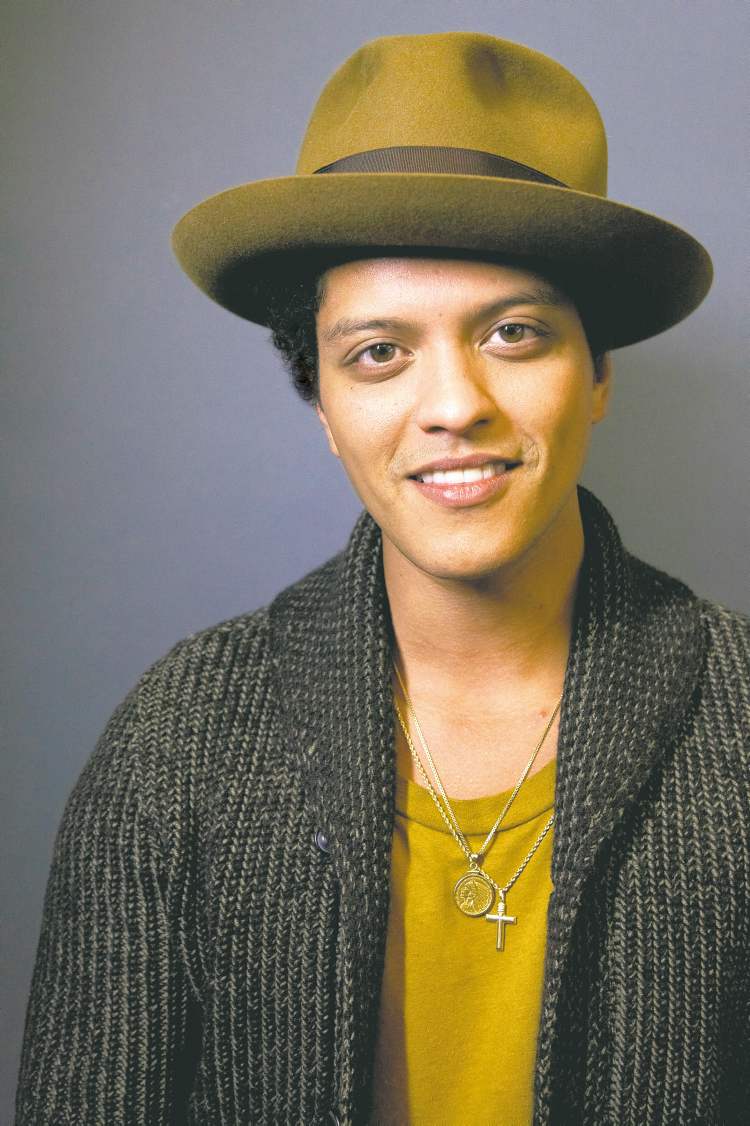
“Becoming famous was never what I wanted to do,” he insists. “There’s a lot of things that come with fame — it’s what people in the limelight have to do. I’m like, ‘Can’t I just write and sing?'”
On a recent visit to his Cape Cod-style home high in the Hollywood Hills, Mars, 27, looked dressed less for success than for hiding from it. Wearing rumpled jeans and an untucked T-shirt, his eyes shielded behind silver aviators, the usually dapper entertainer was due to fly to Sweden the next morning to promote his new sophomore disc. At the moment, though, he hardly seemed in the mood to talk himself up.
“If people are going to have an idea of me,” he said, “I’d just want them to think of a guy who goes in the studio, works hard and jams out.”
Unorthodox Jukebox, which came out Dec. 11, gives a different impression of the man behind the choreographed moves, presenting a dramatic vision of love under siege by fame (Young Girls), fortune (Natalie), and his own tomfoolery (When I Was Your Man).
Even relatively conflict-free tunes such as Moonshine and Gorilla — in which he invites a “dirty little lover” to bang on his chest like a great ape — exude a gritty desperation.
It’s an unexpected shift in tone from an artist known initially as pop’s go-to good guy, an old-fashioned romantic doling out positive affirmations not long after he’d first appeared with ingratiating guest spots on B.o.B.’s Nothin’ on You and Travie McCoy’s Billionaire.
“I think people will be surprised by it,” said Philip Lawrence, one of Mars’ partners in his L.A.-based production crew, the Smeezingtons. “But it’s not for shock value — it’s telling a story, digging deeper into the feeling of what it means to become a celebrity.”
Speaking in a relaxed manner opposite his frenzied stage presence, Mars described that experience as “being thrown to the wolves and having to deal with it” and said he wanted Unorthodox Jukebox to reflect where he is, not where he was. “I love those (older) songs,” he said, sunning himself on a patio as one of his handlers arrived bearing cigarettes and coconut water. “I’ll stand by them and sing them till the day I die. But an artist has to stay excited to keep on doing it. And the way to stay excited is to keep pushing and to keep experimenting. I feel like I pushed on this record.”
So far he hasn’t seen any pushback: Last week the album entered Billboard’s album chart at No. 2, while Locked Out of Heaven, the disc’s lead single, just spent its second week atop the Hot 100. Reviews have been strong too, with high praise from Entertainment Weekly and Rolling Stone, the latter of which said the album “makes the competition sound sad and idea-starved by comparison.”
Indeed, the songs on Unorthodox Jukebox burst with detail, each one a meticulously constructed example of its genre. In Locked Out of Heaven, Mars and his mates re-create the sharp-angled reggae-rock of the early ’80s Police. Treasure is a lush disco-soul jam. And If I Knew channels Sam Cooke’s church-born R&B.
The infectious sonics soften the effect of edgy themes such as the homage to a stripper named Where Your Stacks At in Money Make Her Smile. And they provide a buoyancy that, as in so much great pop, lifts Mars above the sometimes-bleak scenes he describes. (It’s worth remembering that the Smeezingtons were behind the endearingly acidic Cee Lo Green hit known on the radio as Forget You.)
“One of their great talents is that they have this fun, light vibe in the studio,” said Jeff Bhasker, who along with Mark Ronson joined the Smeezingtons for production and songwriting work on Unorthodox Jukebox. “That allows you to be free so that you can let that primal emotion come out without being embarrassed. Then they polish afterward.”
Part of that polish, added Ronson, is the charisma Mars has honed since his childhood days as an Elvis impersonator in Hawaii, where he grew up.
“Everything Bruno adds is what takes it into superstardom,” said the producer, who recalled being impressed by Mars’ performance in a tribute to Amy Winehouse at the 2011 MTV Video Music Awards. (Ronson co-produced Winehouse’s Back to Black album.) “If you put any other singer over Billie Jean it wouldn’t be one of the most impactful songs of all time, and the same is true with Locked Out of Heaven.”
Whether or not Unorthodox Jukebox lives up to the work of Michael Jackson, Mars said he longs for the pre-digital era when acts like Jackson and Prince retained an air of mystery.
At his house he seemed happy to chat despite the last-minute tasks he had to accomplish before flying to Europe. But if his music has grown more intimate, in person he still evinced some of the reflective opacity endemic to superstars: What you look for in Mars he’d prefer you find in his songs.
“Don’t you love it that Prince doesn’t use Twitter?” he asked. “Don’t you think he’s somewhere on a unicorn?”
Then he admitted that he wished he hadn’t “wasted” a title he used for his first EP. It was called It’s Better If You Don’t Understand.
— Los Angeles Times