Washington Opera offers new ending to Puccini’s final work
Advertisement
Read this article for free:
or
Already have an account? Log in here »
To continue reading, please subscribe:

Digital Subscription
One year of digital access for only $205*
- Enjoy unlimited reading on winnipegfreepress.com
- Read the E-Edition, our digital replica newspaper
- Access News Break, our award-winning app
- Play interactive puzzles
*First annual payment billed as $205.00 + GST for one year. This annual subscription will automatically renew at $233.00 + GST every 52 weeks (10% off the regular annual price of $259.35). Offer available to new and qualified returning subscribers only. Cancel any time.
To continue reading, please subscribe:
Add Free Press access to your Brandon Sun subscription for only an additional
$1 for the first 4 weeks*
- Enjoy unlimited reading on winnipegfreepress.com
- Read the E-Edition, our digital replica newspaper
- Access News Break, our award-winning app
- Play interactive puzzles
*Your next Brandon Sun subscription payment will increase by $1.00 and you will be charged $17.95 plus GST for four weeks. After four weeks, your payment will increase to $24.95 plus GST every four weeks.
Read unlimited articles for free today:
or
Already have an account? Log in here »
Hey there, time traveller!
This article was published 08/05/2024 (847 days ago), so information in it may no longer be current.
NEW YORK (AP) — Ever since Giacomo Puccini died without finishing his last opera, “Turandot,” audiences have thrilled to its soaring melodies like “Nessun Dorma,” but also perhaps lamented the lack of a proper ending.
Now the Washington National Opera is offering an alternative, commissioning both new words and new music for the final 18 or so minutes of the piece. The production, with libretto by Susan Soon He Stanton and music by Christopher Tin, runs from Saturday to 25.
“Turandot,” tells of a Chinese princess who condemns all her suitors to have their heads chopped off unless they can answer three riddles. When an unknown prince manages to do this, Turandot is obligated to marry him, but he gives her a way out of the bargain if she can guess his identity.
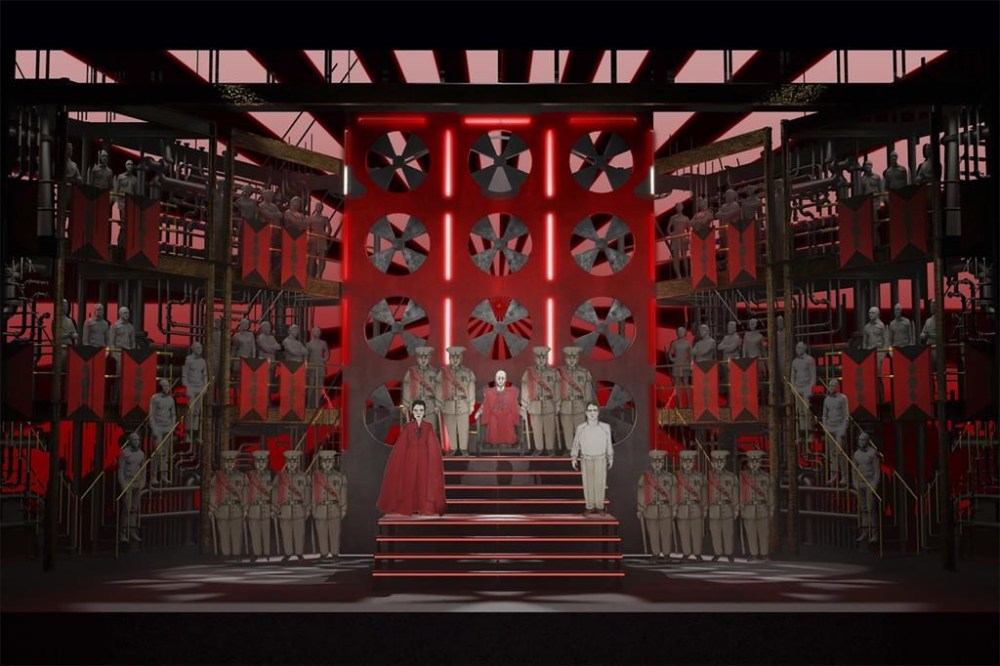
In the final scene, according to the original libretto, the prince kisses Turandot and then — confident he has won her love — reveals that his name is Calaf. The opera concludes amid general rejoicing.
Francesca Zambello, artistic director of the WNO, is among those who find this ending less than satisfying.
“You have a very proud and fiery princess who spends the entire opera saying ‘No,‘” she said. “Then Calaf comes along, he ignores her ‘No,’ then plants a big old kiss on her against her will, and as a result she is suddenly transformed into this nice, magnanimous ruler.”
Now that the copyright on the work has expired, she said, “I wanted to change the story in a way that I hoped Puccini’s ghost might have approved.”
Adding to the implausibility of the resolution is the character of Liu, a slave girl so devoted to Calaf that she kills herself rather than reveal his name under torture. In the final scene, Liu’s fate is barely mentioned and quickly forgotten.
Puccini had completed his score up to the point where Liu dies, but left only musical sketches for the remainder when he died in 1924 while undergoing treatment for throat cancer.
Franco Alfano was hired to complete the music from Puccini’s notes and it’s usually a version of his score that is performed today, though there have been several attempts to improve upon it.
Luciano Berio orchestrated a new ending which premiered in 2002; Chinese composer Hao Weiya crafted his own version in 2008, and Opera Delaware is offering a conclusion in May composed by Derrick Wang, whose earlier opera “Scalia/Ginsburg” told of the friendship between the two Supreme Court justices.
But none have gone as far as WNO in rewriting both text and music for the final scene.
Stanton, a playwright and screenwriter who worked on the hit TV series “Succession,” said she tried to understand Turandot’s character and motivations in a way that rang true psychologically. And she came to a surprising conclusion.
In Turandot’s entrance aria “In questa reggia,” she describes her cruel behavior in sending suitor after suitor to their deaths as revenge for the fate of her ancestor, Princess Lo-u-ling, who she says was sexually assaulted and murdered.
But Stanton said, “I just didn’t believe her. The body count is so high that it didn’t make sense that she’s going to be killing all these men because of something that happened to a long-ago ancestor.
“It felt more like a trauma response of somebody who’s really afraid of getting married,” Stanton said. So in the new final scene she has Turandot reveal that it was actually she herself who was raped.
And now it’s Turandot who initiates the kiss, first tentatively, then passionately, making her more of an equal partner in her relationship with Calaf.
Stanton also brings Liu back into the story. In the new version, Turandot’s father has died during the night, and her first decree as ruler is to announce that the slave girl will be buried in a place of honor alongside the emperor, hinting of an egalitarian society to come.
To craft new music for this revised story, Zambello turned to Tin, a Grammy award-winning composer who has written for film, TV and video game soundtracks.

Zambello said she told Tin she “didn’t want it to sound like a completely different musical language. I wanted to have something that felt like maybe Puccini wrote it but it went through a contemporary filter.”
Tin said he made heavy use of melodies and themes that appear in the parts of the opera Puccini did finish, but he recast them to fit the new libretto.
In a way, he said he thinks he was better-suited for the assignment than Alfano, who belonged to the next generation after Puccini and took a somewhat more modernist approach in his music.
“I’m a very melodic composer,” Tin said, “I write very easy-to-parse musical structures. And that made me a pretty good fit for this job. It’s still daunting, because you already have 100 years of people’s opinions about what you should write.
“Ultimately the only way I could proceed was to tune it all out,” he said. “At the end of the day nobody wants to hear second-rate Puccini. But somebody might want to hear first-rate Christopher Tin.”