Hip documentary a bittersweet love song

Advertisement
Read this article for free:
or
Already have an account? Log in here »
To continue reading, please subscribe:

Digital Subscription
One year of digital access for only $205*
- Enjoy unlimited reading on winnipegfreepress.com
- Read the E-Edition, our digital replica newspaper
- Access News Break, our award-winning app
- Play interactive puzzles
*First annual payment billed as $205.00 + GST for one year. This annual subscription will automatically renew at $233.00 + GST every 52 weeks (10% off the regular annual price of $259.35). Offer available to new and qualified returning subscribers only. Cancel any time.
To continue reading, please subscribe:
Add Free Press access to your Brandon Sun subscription for only an additional
$1 for the first 4 weeks*
- Enjoy unlimited reading on winnipegfreepress.com
- Read the E-Edition, our digital replica newspaper
- Access News Break, our award-winning app
- Play interactive puzzles
*Your next Brandon Sun subscription payment will increase by $1.00 and you will be charged $17.95 plus GST for four weeks. After four weeks, your payment will increase to $24.95 plus GST every four weeks.
Read unlimited articles for free today:
or
Already have an account? Log in here »
Hey there, time traveller!
This article was published 14/09/2017 (3304 days ago), so information in it may no longer be current.
Yeah, so, you’re probably going to want to bring Kleenex to this one.
Long Time Running, Jennifer Baichwal and Nicholas de Pencier’s affecting documentary on the Tragically Hip’s 2016 tour, begins with cameras trained on the fans. As Gord Downie sings the titular song, the camera follows faces in the audience, illuminated by the lights onstage. Many are singing along. But many more are weeping, tears streaming down their cheeks.
What was supposed to be a regular album cycle tour for the band’s 14th studio album, Man Machine Poem, became something bigger than even the biggest band in Canada. In spring 2016, the country was hit hard by the news that Downie had an aggressive form of brain cancer, and that it was terminal. In the weeks that followed, a lot was written about the man and the band — about its legacy, about its importance, its place in the cultural fabric of Canada — but much of it felt as though it was eulogizing a man who was still very much alive. A man who, despite undergoing an invasive temporal lobectomy decided to hit the road, one more time.
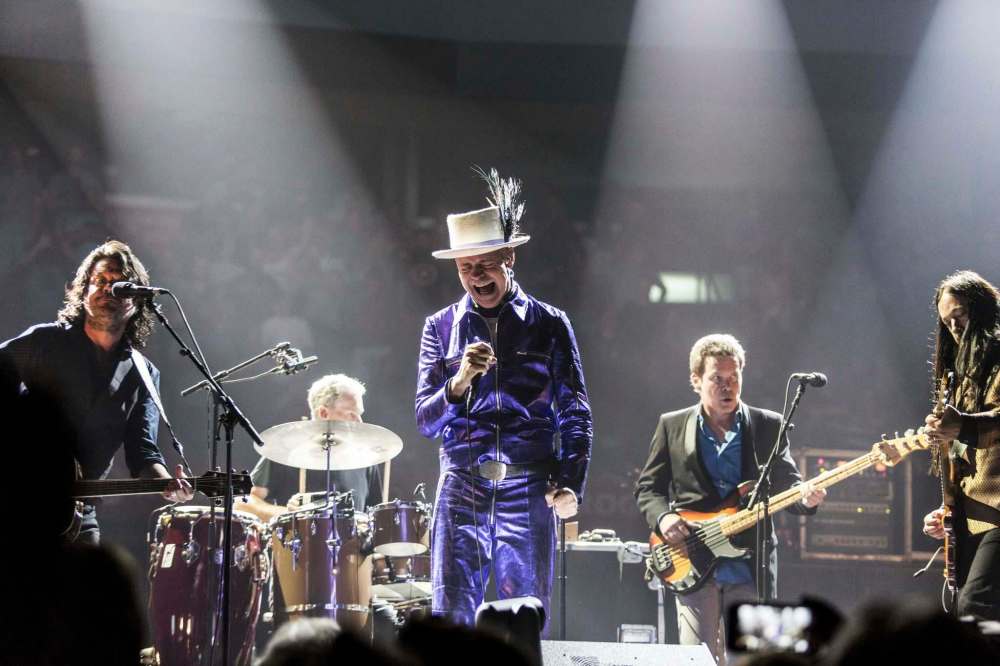
But Long Time Running isn’t maudlin, and it’s not exactly a eulogy either. Interspersed with beautifully shot concert footage, the filmmakers offer an intimate, revealing backstage look at a high-pressure tour packing improbable weight. Because as much as this story is about a newsworthy tour — which culminated in a hometown show in Kingston, Ont., that was broadcast coast-to-coast and watched by millions — it’s also about a band, its crew and its fans holding on to hope.
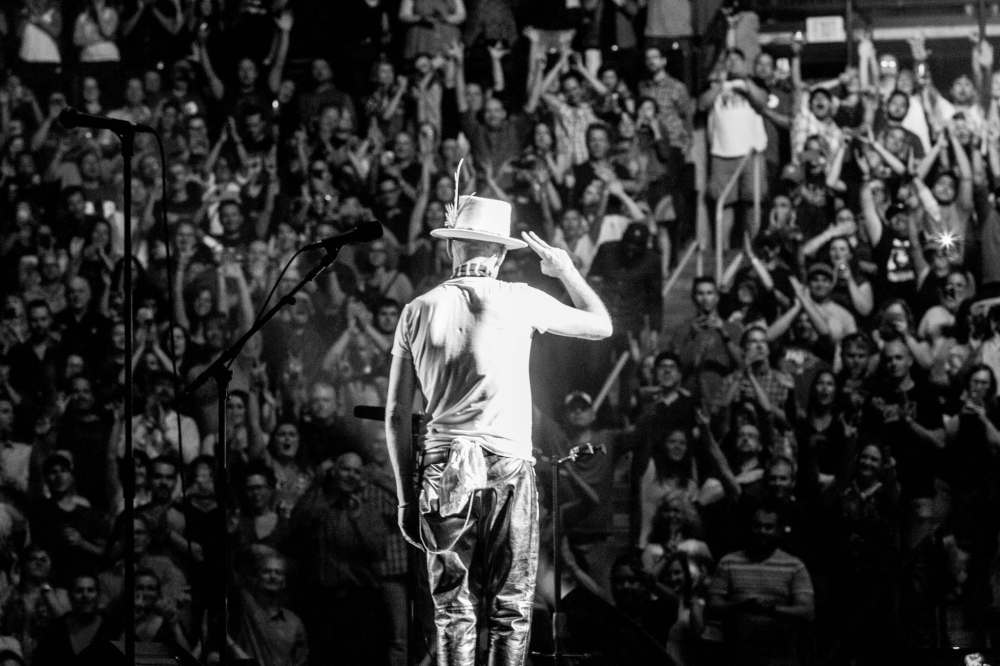
Some parts are hard to watch. At the first rehearsal for the tour, Downie struggles to remember lyrics. Song and album titles elude him. “I think I started to cry,” he recalls. Seeing those first few shaky rehearsals makes the actual tour even more remarkable. The band prepared some 90 songs for the Man Machine Poem tour — roughly double that of a regular tour — so that it could perform something from every album. Downie worked rigorously to pull it all off, but those closest to him had concerns. Guitarist Rob Baker, in particular, was hesitant about even going on the road. Touring is gruelling for a healthy person, let alone someone battling cancer and recovering from brain surgery. What if Gord had a seizure onstage, with everyone documenting it on their iPhones? Baker didn’t want that for his friend.
We know how it turned out, of course. Man Machine Poem tour was a victory lap.
What makes Long Time Running shine is that it doesn’t focus all of its attention on Downie. This isn’t a doc about a rock god facing down his mortality. It’s about a workhorse band coming together when times are tough. Despite having a brilliant, charismatic man out in front, the Tragically Hip was never all about Gord Downie. The Hip is unusually democratic for a band — songwriting credits split five ways and a lineup that has remained unchanged. It’s become cliché to say bands are like families, but these guys are brothers. It only makes sense that this film is just as much about Baker, guitarist Paul Langlois, bassist Gord Sinclair and drummer Johnny Fay.
Long Time Running also serves as a poignant reminder that behind every great rock band is a massive team (and, yes, family) that gets it onstage every night. This film is about those people, too. Everyone from the band managers and tour managers to the security staff and roadies — many of whom have been on the road with the Hip since the ’90s — who have to shelve their feelings to do their jobs. You see the care and concern in their faces as they shuttle a weak Downie to the dressing room, exhausted after leaving everything onstage. In one incredibly touching scene, Karyn Ruiz, the Toronto milliner who made Downie’s iconic hats for the tour, reveals that she sewed her favourite Hip lyrics into the liners. As her way to say thanks.
The gratitude is mutual. Downie’s sincere love and affection for his team comes through in a pre-show ritual: everyone in his band and crew gets a kiss on the lips, then he pulls each person in close to tell them how much he loves them. And he looks everyone in the eye. It’s as if he’s trying to memorize their faces, to bottle the moment.
Those who were fortunate enough to be at the shows or public screenings that summer will recognize that look. It’s the same one he gave the audience at the end of each and every show. “I love you, I love you, I love you.”
jen.zoratti@freepress.mb.ca
Twitter: @JenZoratti
Jen Zoratti is a columnist and feature writer working in the Arts & Life department, as well as the author of the weekly newsletter NEXT. A National Newspaper Award finalist for arts and entertainment writing, Jen is a graduate of the Creative Communications program at RRC Polytech and was a music writer before joining the Free Press in 2013. Read more about Jen.
Every piece of reporting Jen produces is reviewed by an editing team before it is posted online or published in print – part of the Free Press‘s tradition, since 1872, of producing reliable independent journalism. Read more about Free Press’s history and mandate, and learn how our newsroom operates.
Our newsroom depends on a growing audience of readers to power our journalism. If you are not a paid reader, please consider becoming a subscriber.
Our newsroom depends on its audience of readers to power our journalism. Thank you for your support.
MOVIE REVIEW
Long Time Running
Starring Gord Downie, Rob Baker, Gord Sinclair, Paul Langlois and Johnny Fay
Grant Park, Polo Park, McGillivray
PG
97 minutes
★★★★ out of five
Other voices
Given the circumstances of the tour, it would have been ridiculous for Baichwal and de Pencier not to shine more light on Downie. They found the right balance, though, celebrating a band’s place in the country’s cultural fabric.
— Brad Wheeler, Globe and Mail
Long Time Running digs deeper than most have dug with the Tragically Hip — although Downie has a reputation for being guarded, the rest of the band has always kept a pretty low media profile, too.
— Ben Rayner, Toronto Star
The structure, alternating well-recorded concert footage with talking heads, can’t help but resemble the reality-TV approach. Still, they are engaging guys, and the fashion-forward Downie is, as ever, a candid interview subject.
— Ken Eisner, Georgia Straight
Jen Zoratti is a columnist and feature writer working in the Arts & Life department, as well as the author of the weekly newsletter NEXT. A National Newspaper Award finalist for arts and entertainment writing, Jen is a graduate of the Creative Communications program at RRC Polytech and was a music writer before joining the Free Press in 2013. Read more about Jen.
Every piece of reporting Jen produces is reviewed by an editing team before it is posted online or published in print – part of the Free Press‘s tradition, since 1872, of producing reliable independent journalism. Read more about Free Press’s history and mandate, and learn how our newsroom operates.
Our newsroom depends on a growing audience of readers to power our journalism. If you are not a paid reader, please consider becoming a subscriber.
Our newsroom depends on its audience of readers to power our journalism. Thank you for your support.
Advertisement Advertise With Us
Advertisement Advertise With Us