Netflix crime drama trades slick for substance

Advertisement
Read this article for free:
or
Already have an account? Log in here »
To continue reading, please subscribe:

Digital Subscription
One year of digital access for only $205*
- Enjoy unlimited reading on winnipegfreepress.com
- Read the E-Edition, our digital replica newspaper
- Access News Break, our award-winning app
- Play interactive puzzles
*First annual payment billed as $205.00 + GST for one year. This annual subscription will automatically renew at $233.00 + GST every 52 weeks (10% off the regular annual price of $259.35). Offer available to new and qualified returning subscribers only. Cancel any time.
To continue reading, please subscribe:
Add Free Press access to your Brandon Sun subscription for only an additional
$1 for the first 4 weeks*
- Enjoy unlimited reading on winnipegfreepress.com
- Read the E-Edition, our digital replica newspaper
- Access News Break, our award-winning app
- Play interactive puzzles
*Your next Brandon Sun subscription payment will increase by $1.00 and you will be charged $17.95 plus GST for four weeks. After four weeks, your payment will increase to $24.95 plus GST every four weeks.
Read unlimited articles for free today:
or
Already have an account? Log in here »
Hey there, time traveller!
This article was published 21/10/2017 (3264 days ago), so information in it may no longer be current.
Mindhunter, the new crime drama streaming on Netflix, is a strange and rare thing. It’s a serial-killer series without the usual serial-killer clichés.
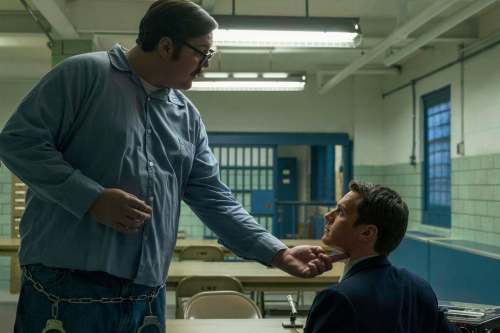
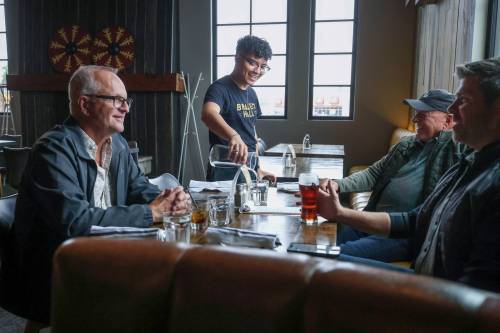
Set in 1977 and loosely based on a memoir by former FBI agent John E. Douglas, this unusual, unsettling, extremely bingeable show goes back to the very beginnings of the bureau’s Behavioral Science Unit. Holden Ford (Jonathan Groff) and Bill Tench (Holt McCallany) start interviewing convicted serial killers, trying to figure out what’s going on in their heads.
“How do we get ahead of crazy, if we don’t know how crazy thinks?” says Bill.
https://youtu.be/7gZCfRD_zWEScripter Joe Penhall and director David Fincher (Se7en, Zodiac), who helms four of the episodes and also executive produces, know the serial-killer genre, but they keep playing against type.
Mindhunter’s law-enforcement men aren’t the tortured and self-destructive souls of True Detective or The Following, sometimes barely distinguishable from the men they’re hunting. There’s a noticeable lack of fake tough-guy talk and cut-rate nihilism.
Holden and Bill’s home lives are actually pretty good; not without problems, but mostly just struggling with the recognizable ups and downs of real relationships. And these men can have actual whole back-and-forth conversations with live women.
Just as important, the serial killers aren’t the exquisite esthetes and intellectuals so beloved by shows like Hannibal and Dexter, whose multiple murderers always seem to be reading Dante’s Inferno in Italian or composing harpsichord music when they’re not butchering their fellow humans.
Based on actual killers such as Ed Kemper and Jerry Burdos, Mindhunter’s murderers are mostly blank-faced illustrations of the banality of evil, overbearing know-it-alls who can’t stop talking about their hobbies in excruciating detail.
Finally, there is very little graphic gore. Unlike many serial-killer shows, which denounce violence while queasily fetishizing nude dead girls, Mindhunter offers only brief glimpses of grainy crime-scene photos. The series faces horror dead-on, but it comes out in words, which are graphic and ugly enough. This is possibly the chattiest crime story you’ve ever watched.
Much of Mindhunter’s freshness comes from its period. Fincher and Penhall — an Australian-born, England-based playwright — are self-consciously looking back to a time before the modern North American conception of the serial killer invaded our popular culture. In fact, the whole notion of serial murder is so new, the FBI doesn’t even have a term for it yet. Holden is tentatively experimenting with the term “sequence killer, if you will.”
The characters in Mindhunter are, in some ways, far more innocent than the average viewer, who has been raised up on true-crime podcasts and CSI forensics and the Hare Psychopathy Checklist.
These days, we know all about patterns and triggers and trophies and “organized” and “disorganized” killings. We can connect the Freudian dots between early childhood trauma and later kinks. We’re all profilers now. These poor guys are just figuring it out.
These ideas are investigated with intelligence and craft. Penhall pulls off some theatrical set-pieces, long, tense, talky scenes set in the confined spaces of maximum-security prisons. He writes complex and layered characters. McCallany looks like an old-school cop from central casting, but soon reveals a lot more, while Goff’s fresh-faced Junior G-man is almost too good to be true, until his calmness starts to seem a bit ominous.
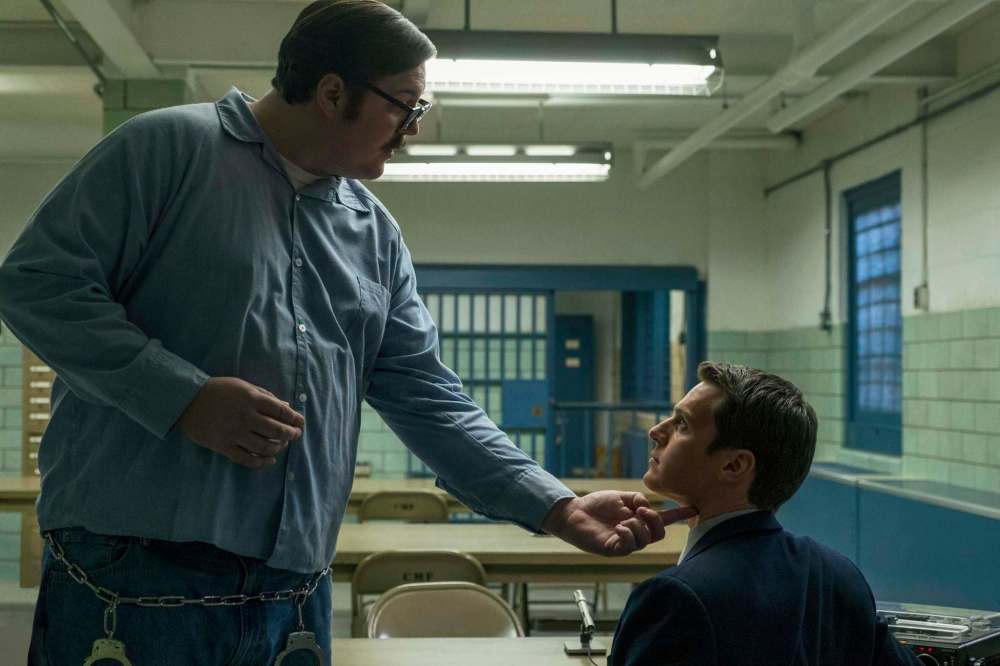
Fincher, as always, builds up a sense of bland menace, with a desaturated colour palette, stealthy camera moves and deliberate pacing.

While the show looks back to the past, its subtext is very contemporary. Crucially, in dealing with sexualized, violent male-on-female crimes, it directly confronts the misogyny that drives its killers. Mindhunter includes some much-needed female perspective, from steely psychologist Dr. Wendy Carr (Anna Torv) and from Debbie Mitford (Hannah Gross), Holden’s lover, a sociology student and no-nonsense 1970s feminist who goes way beyond the usual girlfriend character.
The series is also not afraid to be ever so slightly boring, and I mean that in the best way. It doesn’t rely on cliffhangers or contrivances or intricate puzzle-box plots. It is satisfyingly unsatisfying, in the sense that it admits that the horror and grief around violent death cannot be neatly resolved. And it takes its time.
It isn’t until episode 9 that Bill suggests maybe they should call the men they’re dealing with serial killers. “That’s better,” says Wendy. “Let’s see if it sticks.”
Oh, yeah, it’ll stick. Thankfully, Mindhunter is able to examine our cultural obsession with serial killers without pandering to it.
alison.gillmor@freepress.mb.ca
Studying at the University of Winnipeg and later Toronto’s York University, Alison Gillmor planned to become an art historian. She ended up catching the journalism bug when she started as visual arts reviewer at the Winnipeg Free Press in 1992.
Our newsroom depends on a growing audience of readers to power our journalism. If you are not a paid reader, please consider becoming a subscriber.
Our newsroom depends on its audience of readers to power our journalism. Thank you for your support.
Studying at the University of Winnipeg and later Toronto’s York University, Alison Gillmor planned to become an art historian. She ended up catching the journalism bug when she started as visual arts reviewer at the Winnipeg Free Press in 1992.
Our newsroom depends on a growing audience of readers to power our journalism. If you are not a paid reader, please consider becoming a subscriber.
Our newsroom depends on its audience of readers to power our journalism. Thank you for your support.
Advertisement Advertise With Us
Advertisement Advertise With Us