After Season 2’s slow start, Ted Lasso finds back of net

Advertisement
Read this article for free:
or
Already have an account? Log in here »
To continue reading, please subscribe:

Digital Subscription
One year of digital access for only $205*
- Enjoy unlimited reading on winnipegfreepress.com
- Read the E-Edition, our digital replica newspaper
- Access News Break, our award-winning app
- Play interactive puzzles
*First annual payment billed as $205.00 + GST for one year. This annual subscription will automatically renew at $233.00 + GST every 52 weeks (10% off the regular annual price of $259.35). Offer available to new and qualified returning subscribers only. Cancel any time.
To continue reading, please subscribe:
Add Free Press access to your Brandon Sun subscription for only an additional
$1 for the first 4 weeks*
- Enjoy unlimited reading on winnipegfreepress.com
- Read the E-Edition, our digital replica newspaper
- Access News Break, our award-winning app
- Play interactive puzzles
*Your next Brandon Sun subscription payment will increase by $1.00 and you will be charged $17.95 plus GST for four weeks. After four weeks, your payment will increase to $24.95 plus GST every four weeks.
Read unlimited articles for free today:
or
Already have an account? Log in here »
Hey there, time traveller!
This article was published 24/07/2021 (1904 days ago), so information in it may no longer be current.
As the second season of Ted Lasso opens, recently relegated AFC Richmond and its fatalistic fans are suffering through a streak of draws. Their star player has the yips, and their mascot — well, I won’t say anything more, but it’s not good.
In an unfortunate parallel, the early episodes of the show’s second season (on Apple+, with new episodes releasing on Fridays) had me fretting the series was going the way of its unlucky footballers.
As someone with a huge emotional investment in Team Lasso, I was initially inconsolable. Thankfully, though, this ensemble sports sitcom pulled off a mid-season turnaround, at which point I felt like spilling out onto the street and flipping over a car for sheer joy (except I knew Ted wouldn’t approve).
Why was this season such a roller-coaster ride for me? It’s not just because I thought Season 1 of Ted Lasso was one of the best shows of 2020. It also felt like one of the most necessary shows of 2020. In a difficult, divisive year, this saga of a sweetly earnest, enthusiastic American coach (Jason Sudeikis) trying to turn around a failing British football club was a feeling, funny testament to the radical power of kindness.
After the show’s enormous and unlikely Season 1 success, I wanted — I needed — the second season to be just as good. Worrying the series was in a sophomore slump, I suddenly understood the title of last season’s final episode, The Hope that Kills You. My outsized, optimistic, Ted Lasso-like expectations for the series were making my disappointment even harder to bear.
I should say that the early episodes of Season 2 aren’t bad. There is still reliable pleasure to be found in Ted knowing everyone’s name and bringing everyone biscuits and making goofy dad jokes and dropping obscure ’90s pop-culture references. But the starting storylines feel a bit like a series of nil-nil football matches.
Some of the familiar stuff seems too familiar — “It’s deja vu all over again,” as one of the announcers quotes at one point. Meanwhile, a new set of subplots is curiously tension-free. When player Sam Obisanya (Toheeb Jimoh) takes on economic imperialism in Nigeria, for example, the issue is raised and then — poof! — easily solved.
At some point, I felt like those three rabid Richmond fans who are always staring glumly at the pub TV. Like so many critics, I had made the 2020 case for Ted Lasso as pro-nice comedy, arguing that the show’s kinder, gentler approach was timely, refreshing, even revolutionary. The possibility that Ted Lasso was becoming maybe too nice felt crushing. It didn’t help that the weakest Season 2 entry is the Christmas episode, in which the niceness is cranked up into misfiring comedy and mawkish drama. (Admittedly, it was 34 C when I was watching it, not ideal Christmas episode weather, but still.)
And then, a miracle. About midway through the eight episodes made available to critics, everything just clicked, and the show I loved was back — and maybe even better. It was like a come-from-behind sports story, an overtime victory — it felt even better than winning a game where you’ve always been ahead.
There was the Ted Lasso I adored, nice as ever. There was his talent for innocent fun. (On “Surprise Sandwich Day,” he and Coach Beard bring special sandwiches and then swap them.) There was his gratitude for everyday gifts. (Tap water, he enthuses, “delicious as always.”) There were his adorably dorky Jimmy Buffet riffs.

More seriously, there was Ted’s approach to the beautiful game. He doesn’t really know much about English football — he’s still a little hazy on the offside rule — but he coaches by helping his players become better men, which makes for a sneaky, subversive investigation into masculinity.
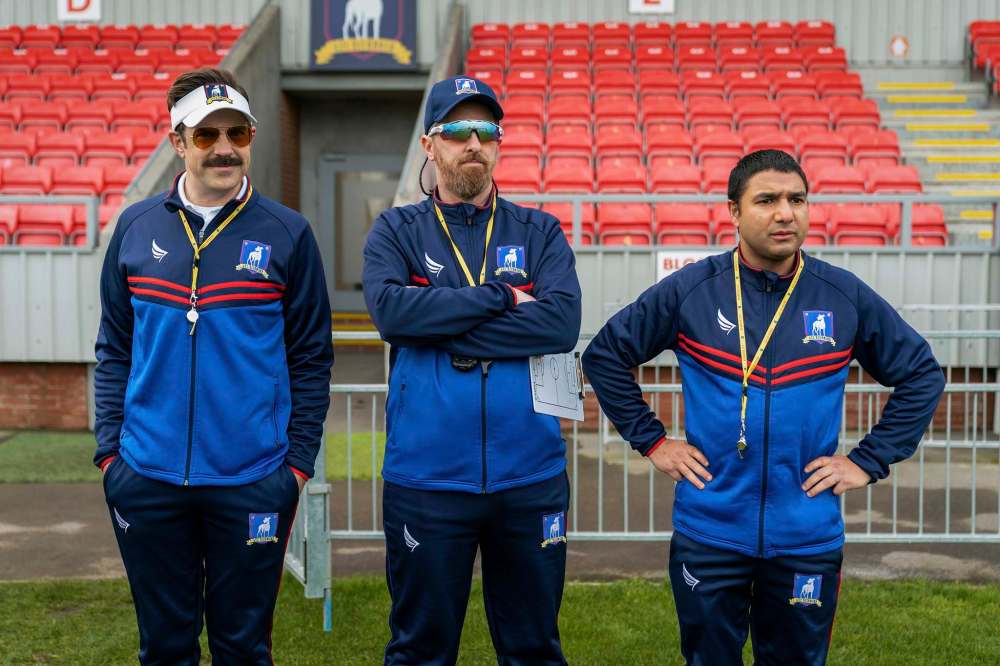
And while the series remains almost absurdly hopeful about human nature, some darker shades eventually seep into this second season as the storylines expand, and even Ted’s supreme sunniness dims a little. He now has an antagonist — and he’s a guy who doesn’t believe in antagonists — after the team brings in sports psychologist Dr. Sharon Fieldstone (Sarah Niles).
The good doctor seems impervious not just to Ted’s folksy charms but to his home-baked biscuits. Ted, meanwhile, claims a “modest Midwestern scepticism” about therapy, but it’s clear something deeper is going on. When Sharon tells Ted he can come in and talk anytime, he responds by saying, “I talk all the time.” That is absolutely true, as Ted fans know, but Season 2 is finally ready to explore how the man’s compulsive chattiness might be a defence mechanism.
Ted, it turns out, is painfully nice, and finding out where the painful part comes from means that Season 2 should finish strong.
alison.gillmor@freepress.mb.ca
Studying at the University of Winnipeg and later Toronto’s York University, Alison Gillmor planned to become an art historian. She ended up catching the journalism bug when she started as visual arts reviewer at the Winnipeg Free Press in 1992.
Our newsroom depends on a growing audience of readers to power our journalism. If you are not a paid reader, please consider becoming a subscriber.
Our newsroom depends on its audience of readers to power our journalism. Thank you for your support.
Studying at the University of Winnipeg and later Toronto’s York University, Alison Gillmor planned to become an art historian. She ended up catching the journalism bug when she started as visual arts reviewer at the Winnipeg Free Press in 1992.
Our newsroom depends on a growing audience of readers to power our journalism. If you are not a paid reader, please consider becoming a subscriber.
Our newsroom depends on its audience of readers to power our journalism. Thank you for your support.
Advertisement Advertise With Us
Advertisement Advertise With Us