Mystery ingredient / Frog legs
Advertisement
Read this article for free:
or
Already have an account? Log in here »
To continue reading, please subscribe:

Digital Subscription
One year of digital access for only $205*
- Enjoy unlimited reading on winnipegfreepress.com
- Read the E-Edition, our digital replica newspaper
- Access News Break, our award-winning app
- Play interactive puzzles
*First annual payment billed as $205.00 + GST for one year. This annual subscription will automatically renew at $233.00 + GST every 52 weeks (10% off the regular annual price of $259.35). Offer available to new and qualified returning subscribers only. Cancel any time.
To continue reading, please subscribe:
Add Free Press access to your Brandon Sun subscription for only an additional
$1 for the first 4 weeks*
- Enjoy unlimited reading on winnipegfreepress.com
- Read the E-Edition, our digital replica newspaper
- Access News Break, our award-winning app
- Play interactive puzzles
*Your next Brandon Sun subscription payment will increase by $1.00 and you will be charged $17.95 plus GST for four weeks. After four weeks, your payment will increase to $24.95 plus GST every four weeks.
Read unlimited articles for free today:
or
Already have an account? Log in here »
Hey there, time traveller!
This article was published 23/10/2010 (5782 days ago), so information in it may no longer be current.
What is it?
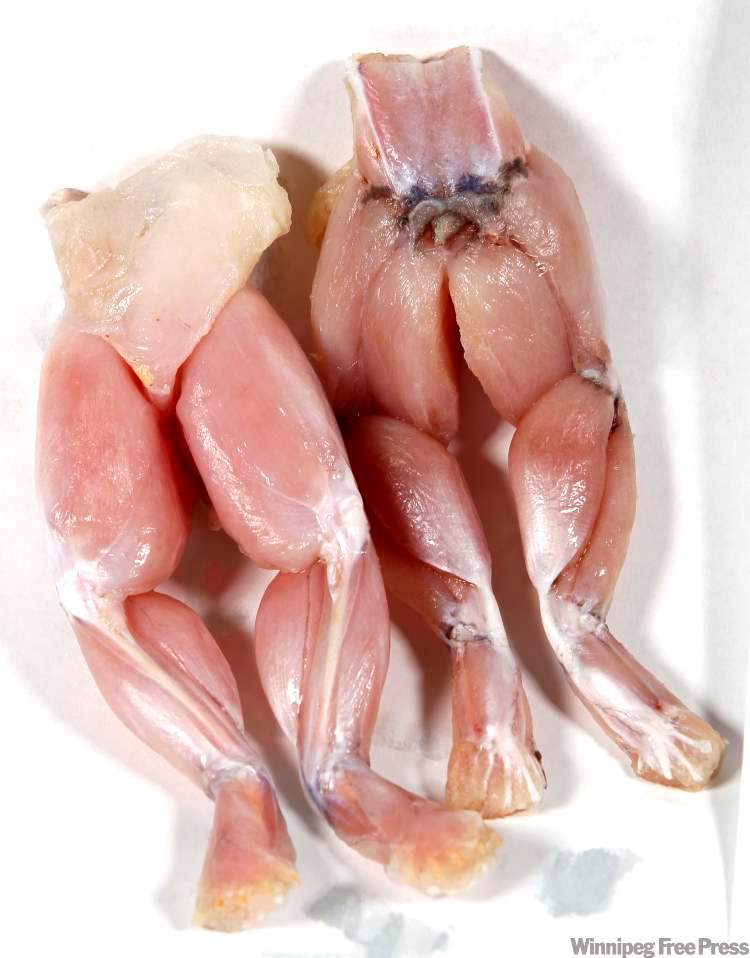
An edible amphibian (Rana esculenta) that has long been prized for its tender rear legs — and not just by the French. In Thailand, sacks of live frogs are a common feature of food markets, where they are prepared on the spot and eaten whole in a green curry. In the West, it is usually just the legs that are consumed. Food frogs are increasingly being farmed in Asia and the Americas.
Looks like:
The lower half of a skinned frog. Aquacultured (farmed) frog legs are lighter in color and milder in taste than wild ones. They are also cleaner. The raw flesh looks like chicken. They’re usually sold by the number of leg pairs per pound, ranging from the largest at 2/4 count to the smallest at 16/20 count.
Tastes like:
Not quite like chicken, contrary to popular belief. Although the meat has a poultry-ish appearance, the slightly gelatinous texture is closer to young rabbit. Their flavour is actually quite mild, and slightly fishy.
Used in:
Rana esculenta’s lower extremities can be sautéed, battered and deep-fried, baked, pan-fried or broiled. Some complementary flavours include: cayenne, celery, garlic, lemon, paprika, thyme and Worcestershire sauce.
To prepare, rinse thawed or fresh legs in cold water and pat dry. Scald in boiling water with lemon juice and salt. Remove, dry, season to taste and proceed with recipe.

In Italy, frogs’ legs are eaten in risottos, frittatas, and tomato stews. In France, they are preferred sautéed in butter with garlic and parsley.
Found at:
Lucky Supermarket, 1051 Winnipeg Ave.