History and hope on a bun
The Coney Island hotdog a constant in downtrodden Detroit
Advertisement
Read this article for free:
or
Already have an account? Log in here »
To continue reading, please subscribe:

Digital Subscription
One year of digital access for only $205*
- Enjoy unlimited reading on winnipegfreepress.com
- Read the E-Edition, our digital replica newspaper
- Access News Break, our award-winning app
- Play interactive puzzles
*First annual payment billed as $205.00 + GST for one year. This annual subscription will automatically renew at $233.00 + GST every 52 weeks (10% off the regular annual price of $259.35). Offer available to new and qualified returning subscribers only. Cancel any time.
To continue reading, please subscribe:
Add Free Press access to your Brandon Sun subscription for only an additional
$1 for the first 4 weeks*
- Enjoy unlimited reading on winnipegfreepress.com
- Read the E-Edition, our digital replica newspaper
- Access News Break, our award-winning app
- Play interactive puzzles
*Your next Brandon Sun subscription payment will increase by $1.00 and you will be charged $17.95 plus GST for four weeks. After four weeks, your payment will increase to $24.95 plus GST every four weeks.
Read unlimited articles for free today:
or
Already have an account? Log in here »
Hey there, time traveller!
This article was published 05/04/2014 (4494 days ago), so information in it may no longer be current.
LANSING, Mich. — Slathered in chili sauce, mustard and onions, Detroit’s homegrown Coney Island hotdog remains a gastronomic constant in a city that’s seen people, businesses and, at times, hope flee.
Restaurants serving the grease bombs named for New York’s waterfront playground have persisted and evolved for almost 100 years in the ravaged auto-making capital. Detroit’s population peaked in 1950 at 1.85 million, just as assembly-line hamburger factories began their march across the landscape.
Today, with two-thirds fewer residents, Detroit is home to about 150 Coney Islands. That’s roughly equal to the sum of all fast-food places in the city, including outlets of McDonald’s, Burger King Worldwide, Wendy’s and Yum Brands’ KFC, the Michigan Restaurant Association says.
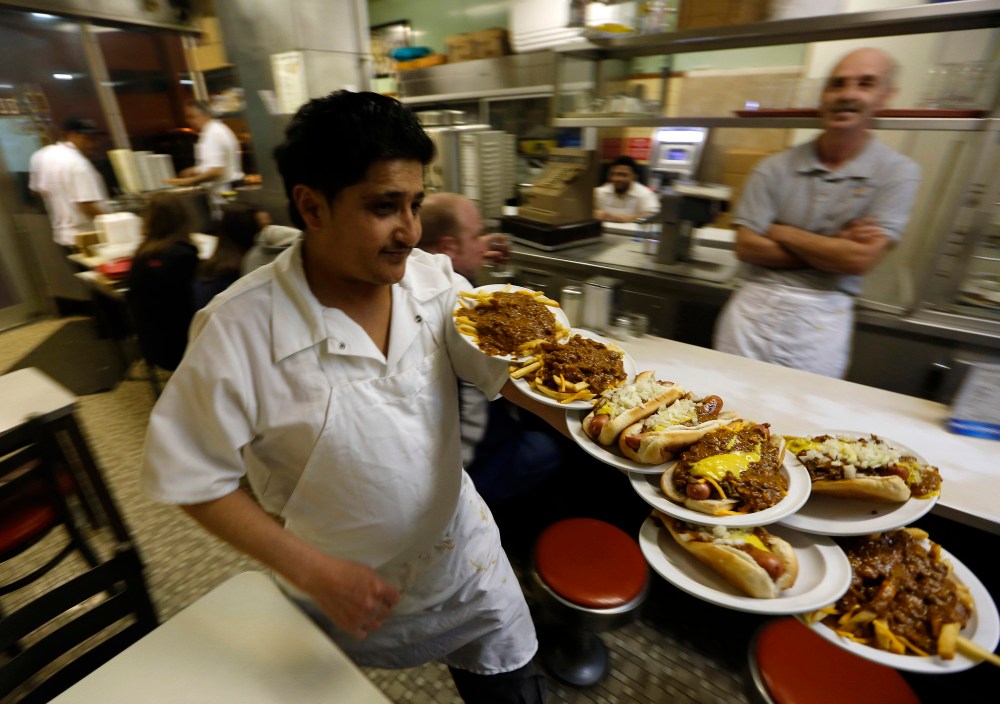
Casual food reflects community ethos. New Orleans has its lavish muffuletta sandwiches. Maine has rich-yet-simple lobster rolls. Detroit’s Coney Islands fuel a bankrupt city fighting to revive itself with menus that reflect its trapped-in-time essence and modern aspirations. And they’re cheap.
“You get a lot more for your money versus a Burger King or McDonald’s,” said Mario Gjolaj, 39, who in 2011 opened Onasis Coney Island in the Corktown neighbourhood. Gjolaj’s menu includes Mexican, Greek, stir-fry and 12 salads.
“Our No. 1 niche is Coney dogs, that’s what we do best,” he said.
Detroit Coney Islands, many run by ethnic Albanians, range from simple stands to diners that recall New Jersey’s all-night oases. Some thrive next to fast-food chains. Others serve blighted neighbourhoods, workers labouring behind bullet-proof windows. The culture long ago followed the flight of Detroiters to the suburbs, where sit-down versions reign, some in shopping malls.
“Coney Island” has become a generic brand, said Tom Giftos, president of Roseville, Mich.-based National Coney Island, which operates 20 restaurants in the city and suburbs and manufactures chili sauce sold to other restaurants and retail stores.
“It’s an instant way of letting people know what’s behind the doors,” he said.
Detroit would have more newfangled fast-food outlets were it not for its population loss, said Malcolm Knapp, a New York- based restaurant industry adviser.
Indeed, the city of 700,000 has fewer total eating establishments than all but one of the 16 other U.S. cities with populations between 600,000 and 900,000. Detroit lost 78 per cent of all retail businesses from 1972 to 2007, the Citizens Research Council of Michigan, a public-policy non-profit, said.
The vacuum allowed Coneys Islands to fortify themselves against national chains.
“They seem to be immune to that kind of pressure,” said Joe Grimm, a journalism instructor at Michigan State University in East Lansing and co-author of the 2012 book Coney Detroit, a hotdog history.
Some even see proximity as an advantage. Having a McDonald’s nearby is a help, said Nick Musollaj, 26, co-owner of Hollywood Coney Island on the east side.
“They do the marketing,” he said. “You know they’re bringing people in.”
L. George’s Coney Island in northwest Detroit faces off against Burger King and KFC franchises across the street. No worry, said co-owner Lonnie Domgjoni, 36, whose father bought the business in 1982.
“We have good food and low prices,” he said. Among his edible arsenal: chicken, salads and a fish dog — catfish on a hotdog bun for $2.85
At L. George’s, a Coney dog costs $1.80, a quarter-pound bacon burger is $3.45 and fries are $1.40. That compares with Burger King’s $3.49 Whopper hamburger and $2.09 medium-size fries.
The restaurants serve everything from deep-fried jalapenos to nachos to corned beef. Years ago the venerable Coney got a companion: a “loose hamburger” version that replaces the hotdog with finely chopped, seasoned ground beef covered with chili sauce and mustard. It defines gloppy.
Willie Davis, 59, manager of Detroit Corned Beef and Coney Island — a spare take-out with a garish yellow exterior — said he serves the taste of home.
“I know a lot of people who leave Detroit and as soon as they come back here, the first thing they want is to get a Coney Island,” Davis said.
Deantae Butler, 24, drives 10 miles from his suburban house to Ed’s Apollo Coney Island, an island in a west-side neighbourhood pocked with abandoned homes, a gutted church and boarded-up storefronts.
“A lot of people have specific Coney Islands they go to,” Butler said. “You don’t just stop in any Coney Island. Some are nasty.”
The origin of the chili-laden hotdog is elusive, said Grimm. He found a few purveyors on the East Coast in the 1920s, though he said the genre flourished in Detroit with an influx of Greek immigrants. They were lured to a booming city of auto plants and industry.
“They came through New York’s Ellis Island, they go to Coney Island and see Americans eating hotdogs,” Grimm said. “Nobody will hire them, so they go into their own businesses.”
About 1920, Greek immigrant William Keros opened Lafayette Coney Island in downtown Detroit with a chili sauce of his own devise. Three years later his brother, Constantine “Gust” Keros, opened American Coney Island next door, according to William’s son, John Keros, 79, an accountant in the area.
At Lafayette, a customer could place, pay for and receive an order in 30 seconds, said Keros. Today, orders aren’t written but shouted by waiters who add bills in their heads.
Both restaurants became landmarks, with walls lined by photos of celebrity customers, including actress Drew Barrymore and Vice President Joe Biden.
Eighteen months ago, American Coney Island opened a branch in a Las Vegas hotel. “We’re taking Vegas by storm,” said owner Grace Keros, granddaughter of the founder.
Back in Detroit, A-Eagle Coney Island has been in owner Gjina Merditaj’s Albanian family since 1988. Merditaj, 41, has watched customers’ children grow up to be customers themselves.
“We plan to be here a long, long time,” Merditaj said.
She’s grooming her 20-year-old son to take over, a new generation supplying the city with the food that holds a special place in its heart — and stomach.
— Washington Post-Bloomberg