‘Expired’ food can often be safely eaten

In many cases, dates on labels only indicate when an item will stop looking and tasting its best

Advertisement

Advertise with us

Last year, Mom’s Organic Market founder and CEO Scott Nash did something many are afraid to do: he ate a cup of yogurt months after its expiration date. And then tortillas a year past their expiration date. “I mean, I ate heavy cream I think 10 weeks past date,” Nash says, “and then meat sometimes a good month past its date. It didn’t smell bad. Rinse it off, good to go.” It was all part of his yearlong experiment to test the limits on food that had passed its expiration date.

Read this article for free:


or

Already have an account? Log in here »

To continue reading, please subscribe:

Subscribe and receive a limited-edition Free Press branded hat or tote.

Digital Subscription

One year of digital access for only $205*

  • Enjoy unlimited reading on winnipegfreepress.com
  • Read the E-Edition, our digital replica newspaper
  • Access News Break, our award-winning app
  • Play interactive puzzles

*First annual payment billed as $205.00 + GST for one year. This annual subscription will automatically renew at $233.00 + GST every 52 weeks (10% off the regular annual price of $259.35). Offer available to new and qualified returning subscribers only. Cancel any time.

To continue reading, please subscribe:

Add Free Press access to your Brandon Sun subscription for only an additional

$1 for the first 4 weeks*

  • Enjoy unlimited reading on winnipegfreepress.com
  • Read the E-Edition, our digital replica newspaper
  • Access News Break, our award-winning app
  • Play interactive puzzles
Start now

*Your next Brandon Sun subscription payment will increase by $1.00 and you will be charged $17.95 plus GST for four weeks. After four weeks, your payment will increase to $24.95 plus GST every four weeks.

Hey there, time traveller!
This article was published 22/06/2019 (2645 days ago), so information in it may no longer be current.

Last year, Mom’s Organic Market founder and CEO Scott Nash did something many are afraid to do: he ate a cup of yogurt months after its expiration date. And then tortillas a year past their expiration date. “I mean, I ate heavy cream I think 10 weeks past date,” Nash says, “and then meat sometimes a good month past its date. It didn’t smell bad. Rinse it off, good to go.” It was all part of his yearlong experiment to test the limits on food that had passed its expiration date.

It turns out the dates on food labels have little to do with food safety. In many cases, expiration dates do not indicate when the food stops being safe to eat — rather, they tell you when the manufacturer thinks that product will stop looking and tasting its best. Some foods such as deli meats, unpasteurized milk and cheeses, and prepared foods like potato salad that you don’t reheat, probably should be tossed after their use-by dates for safety reasons.

Tossing out a perfectly edible cup of yogurt every once in a while doesn’t seem that bad. But it adds up. According to The Dating Game, a 2003 report by the Natural Resources Defense Council and Harvard Food Law and Policy Clinic, 91 per cent of consumers said they occasionally throw out food past its sell-by date because they think it is unsafe. That food waste in landfills generates carbon dioxide and methane, a greenhouse gas 28 to 36 times more effective at trapping heat in the atmosphere than carbon dioxide. And you’re not just wasting calories and money. You’re wasting all the resources that went into growing, packaging and transporting that food.

The FDA, researchers and the grocery manufacturing industry largely agree on an initial solution to this particular part of the food waste problem: clearer package-date labels. In 2017, the grocery industry, led by the Grocery Manufacturers Association (GMA) and the Food Marketing Institute (FMI), announced a voluntary standard on food-date labelling. They narrowed the plethora of date-label terms down to two: “best if used by” and “use by.” “Best if used by” describes product quality, meaning the product might not taste as good past the date but is safe to eat. “Use by” is for products that are highly perishable and should be used or tossed by that date. The FDA announced in May 2019 that it “strongly supports” the GMA and FMI efforts to use the “best if used by” label to designate food quality. When it comes to food safety, the FDA said manufacturers can use whatever terminology they want to convey health risk. But while the FDA is encouraging manufacturers to use “best if used by” as a best practice, it’s still not required by law. There is no U.S. federal law that requires dates on food, except for infant formula.

Emily Broad Leib, of the Harvard Food Law and Policy Clinic, says that to have an effect, these changes need to be federally mandated.

“We’re going to need the main government agencies that regulate food to be able to say: these are what these labels mean. When you see these on products, here’s what you should do, here’s how you should interpret them,” Broad Leib said.

Others who advocate replacing current food date labels suggest using language that indicates shelf life after opening or the date on which the product was packed. Nash argues for something more unambiguous.

“They’re trying to bring clarity to the descriptor of the date. OK, that’s great, that’s better than what we have now,” he said. “But I think some things just shouldn’t be dated.”

— Washington Post

Report Error Submit a Tip

More Stories

‘Expired’ food can often be safely eaten

Daron Taylor 4 minute read Saturday, Jun. 22, 2019

Last year, Mom’s Organic Market founder and CEO Scott Nash did something many are afraid to do: he ate a cup of yogurt months after its expiration date. And then tortillas a year past their expiration date. “I mean, I ate heavy cream I think 10 weeks past date,” Nash says, “and then meat sometimes a good month past its date. It didn’t smell bad. Rinse it off, good to go.” It was all part of his yearlong experiment to test the limits on food that had passed its expiration date.

It turns out the dates on food labels have little to do with food safety. In many cases, expiration dates do not indicate when the food stops being safe to eat — rather, they tell you when the manufacturer thinks that product will stop looking and tasting its best. Some foods such as deli meats, unpasteurized milk and cheeses, and prepared foods like potato salad that you don’t reheat, probably should be tossed after their use-by dates for safety reasons.

Tossing out a perfectly edible cup of yogurt every once in a while doesn’t seem that bad. But it adds up. According to The Dating Game, a 2003 report by the Natural Resources Defense Council and Harvard Food Law and Policy Clinic, 91 per cent of consumers said they occasionally throw out food past its sell-by date because they think it is unsafe. That food waste in landfills generates carbon dioxide and methane, a greenhouse gas 28 to 36 times more effective at trapping heat in the atmosphere than carbon dioxide. And you’re not just wasting calories and money. You’re wasting all the resources that went into growing, packaging and transporting that food.

The FDA, researchers and the grocery manufacturing industry largely agree on an initial solution to this particular part of the food waste problem: clearer package-date labels. In 2017, the grocery industry, led by the Grocery Manufacturers Association (GMA) and the Food Marketing Institute (FMI), announced a voluntary standard on food-date labelling. They narrowed the plethora of date-label terms down to two: “best if used by” and “use by.” “Best if used by” describes product quality, meaning the product might not taste as good past the date but is safe to eat. “Use by” is for products that are highly perishable and should be used or tossed by that date. The FDA announced in May 2019 that it “strongly supports” the GMA and FMI efforts to use the “best if used by” label to designate food quality. When it comes to food safety, the FDA said manufacturers can use whatever terminology they want to convey health risk. But while the FDA is encouraging manufacturers to use “best if used by” as a best practice, it’s still not required by law. There is no U.S. federal law that requires dates on food, except for infant formula.

‘Parental rights’ issue resurfaces

Maggie Macintosh 4 minute read Preview

‘Parental rights’ issue resurfaces

Maggie Macintosh 4 minute read Yesterday at 2:00 AM CDT

Trustee campaign material that condemns rainbow flags is being met with outrage of all kinds, written complaints and, in one case, a cease-and-desist order.

“Parental rights,” including questions about classroom diversity, equity and inclusion policies, are resurfacing heading into school board elections across Manitoba.

“People are trying to advance their politics and their issues while simultaneously calling teachers ideologues and brainwashers,” said Shannon Moore, an associate professor at the University of Manitoba who studies sexual health education. “And I find that rich.”

Moore said parents have a right to choose independent school or homeschool, but they do not have a right to dictate curriculum that is currently developed using research and mainstream morals.

Read
Yesterday at 2:00 AM CDT

Space war and other distractions

Gwynne Dyer 5 minute read 2:00 AM CDT

When Troy Meink, the chief of the U.S. Space Force, announces for no obvious reason that the United States “now has on-orbit space-control weapons,” people naturally assume that something is up. Why is Meink admitting the truth now? He’s even boasting about it!

Quilt tradition from Underground Railroad period big part of new exhibition

Conrad Sweatman 6 minute read Preview

Quilt tradition from Underground Railroad period big part of new exhibition

Conrad Sweatman 6 minute read 2:00 AM CDT

Long before she became a professional quilter, Melinda Clayton Patterson used to watch her mother make quilts from clothing scraps and cardboard templates.

“I came from a family of 14 kids, so going to whatever the store was back then, K-Mart or Woolworth, to buy quilts or blankets for 14 kids was just not feasible because the people were not wealthy,” she says.

“Quilts were not viewed as art. But when I came to Winnipeg, I started taking quilting seriously in my 30s … the heritage came later.”

Today, the 61-year-old native of East Preston, N.S., lives in Winnipeg, stitching together stories of her Black Loyalist heritage and Preston’s foundational role in the birth of Canadian Black culture.

Read
2:00 AM CDT

‘One of a kind’: CEO, philanthropist Doug Harvey dies at 72

Morgan Modjeski 4 minute read Preview

‘One of a kind’: CEO, philanthropist Doug Harvey dies at 72

Morgan Modjeski 4 minute read Updated: Yesterday at 12:57 PM CDT

Doug Harvey, a Winnipeg business titan and philanthropist, has died after battling cancer for more than a decade.

Harvey gave millions of dollars to Winnipeg organizations while he was CEO of DLH Group, a nationwide network of businesses that support heavy duty truck and trailer users.

Loren Remillard, CEO and president of the Winnipeg Chamber of Commerce, said the business community is mourning the loss of the influential businessman who helped shape Winnipeg.

“We are a transportation and logistics hub in Winnipeg and it was partly the result of geography, and a big part because of leaders and visionaries like Doug Harvey,” he said.

Read
Updated: Yesterday at 12:57 PM CDT

‘A new future’: city dentist Cholakis donates $2M to school of dental hygiene

Melissa Martin 3 minute read Preview

‘A new future’: city dentist Cholakis donates $2M to school of dental hygiene

Melissa Martin 3 minute read Updated: Yesterday at 3:25 PM CDT

Dental hygienist training in Manitoba is getting a big boost, after a major gift from a local dentist.

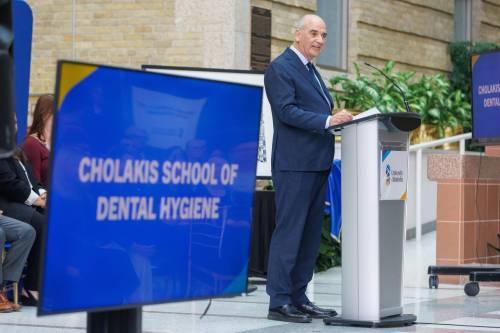
On Thursday, the dental hygiene school at the University of Manitoba’s Dr. Gerald Niznick College of Dentistry unveiled a new $2-million donation from Dr. Ernest Cholakis. It’s the largest gift the program has ever received, and in honour of the funding, the school will be named the Cholakis School of Dental Hygiene.

The gift was unveiled at a ceremony Thursday morning at the U of M’s Brodie Centre in the Health Sciences Centre complex. The benefactor and other dignitaries, including Premier Wab Kinew, were in attendance, as well as the three-year program’s current students.

Cholakis, who graduated from the U of M’s dentistry school in 1982, had high praise for the dental hygiene profession.

Read
Updated: Yesterday at 3:25 PM CDT